Based on books by Brant Pitre and Scott Hahn, with meditations by Tom Craigmyle, English Assistant to the Community of the Sons and Daughters of God
In guiding your audience to meditate, you can help deepen their understanding of Mary’s place in salvation history, while encouraging personal growth in their relationship with God and the Virgin Mary through prayer and reflection.
In Jesus and the Jewish Roots of Mary Brant Pitre writes:
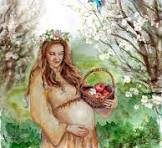
According to the book of Genesis, Adam is not the only human being created by God and placed in the Garden of Eden. Moreover, Adam does not bring sin and death into the world alone.
As Adam’s partner, Eve plays an essential role in bringing about the fall of humankind.
In Genesis Adam declares: “She shall be called Woman (Hebrew ’ishah), because she was taken out of Man (Hebrew ’ish)”
If you keep reading Genesis, you will discover that Adam does not give her the name Eve until after they commit the first sin.
Scott Hahn points out that when Jesus from the cross gave Mary over to His “beloved disciple,” in effect He gave her to all His beloved disciples of all time.
Like Eve, whom Genesis (3:20) calls “mother of all living,” Mary is mother to all who have new life in Baptism. At Cana, then, the New Eve radically reverses the fatal decision of the first Eve. It was “woman” who led the old Adam to his first evil act in the garden. It was “woman” who led the New Adam to His first glorious work.
The medieval poets summed up the matter neatly by pointing out that the Angel Gabriel’s Ave (the Latin greeting) reversed the name of Eva. So also did it reverse the rebellious inclination Eve left to her children—to you and to me—and replace it with the readiness to obey, which Mary wants to teach us when she says: “Do whatever He tells you.”
Tom Craigmyle writes: Our first mother was Eve. “The man called his wife ‘Eve’ because she became the mother of all the living.” [Gn 3:20] Eve [“Ghevvah”] is taken to mean “life” or “life giver” in Hebrew. The man [“ha-adam”] does not name her till after the fall. It is as if her identity as the mother of all of us only came about as a comfort against the loss of Paradise. Motherhood was to be the salvation of fallen man.
Our Lord gives from the cross, when He says: “There is your mother.” [Jn 19:27] Is He naming His mother as “Eve”? We greet her with “Ave!”, and we proclaim her as the mother of us all. She stands quietly before the cross, as Eve stood unquietly before the Tree of Knowledge. Mary could have asked to be spared that pain: would not her son have given her what she desired, as he did at the wedding feast at Cana? She surely withstood a much greater temptation than Eve, yet asked no relief from Him.
Eve’s son, Abel, whose sacrifice was acceptable to God, found that it cost him his own life. The loss of a son is part of the deal.
The Book of Revelation: The “Woman,” the Serpent, and the Messiah
The Book of Revelation also provides evidence for seeing Mary as foreshadowed in the Book of Genesis:
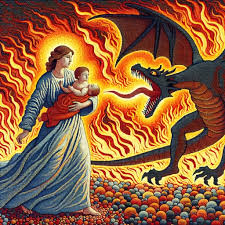
…. a great portent …. a woman clothed with the sun ….. another portent appeared in heaven; behold, a great red dragon …. And the dragon stood before the woman who was about to bear a child, that he might devour her child when she brought it forth; she brought forth a male child, one who is to rule all the nations with a rod of iron, but her child was caught up to God and to his throne, and the woman fled into the wilderness, where she has a place prepared by God, in which to be nourished for one thousand two hundred and sixty days. .
Immaculate Mary
Ancient Christians came to believe that just as Eve had played a unique role in the fall of humankind, so Mary plays a unique role in its redemption. Consider the following quotations from ancient Christians living in the East and the West:
For Eve…having conceived the word of the serpent, brought forth disobedience and death. But the Virgin Mary received faith and joy. (Justin Martyr, Dialogue with Trypho 100 [2nd century A.D.])
The knot of Eve’s disobedience was loosed by the obedience of Mary. For what the virgin Eve had bound fast through unbelief, this did the virgin Mary set free through faith. (Irenaeus, Against Heresies 3.22.4 [2nd century A.D.])
Let women praise her, the pure Mary,—that as in Eve their mother,—great was their reproach,—lo! in Mary their sister,—greatly magnified was their honor. (Ephrem the Syrian, Hymns on the Nativity 15.23 [4th century A.D.])
Death came through a virgin, Eve. It was necessary that life also should come through a virgin…(Cyril of Jerusalem, Catechetical Lectures 12.15 [4th century A.D.])
A maiden expelled us from paradise, through a maiden we find eternal life. (John Chrysostom, Commentary on the Psalms . [4th century A.D.])
Death came through Eve, but life has come through Mary. (Jerome, Letters 22.21 [4th–5th century A.D.])
Through woman, poison was poured upon man, in order to deceive him, but salvation was poured out upon man from a woman, that he might be reborn in grace. (Augustine, Sermons 51.3 [4th–5th century A.D.])
What a remarkable symphony of ancient voices! These quotations are from Christians writing in Greek, Latin, and Syriac, living in the Holy Land, Africa, Asia Minor, and Europe. For this reason, the famous nineteenth-century expert on the church fathers John Henry Newman once wrote: “The great rudimental teaching of Antiquity from the earliest date” about Mary is that “She is the Second Eve.”
Tom writes: There is an aspect of Mary’s story we need to look at: after the Annunciation, Mary’s plight, as an as-yet-unmarried mother, is precarious.
She seeks asylum with Elizabeth and Zachariah for three months. In that first trimester she could have concealed her situation, but it needed to be squared with Joseph.
He was prepared to set her aside discreetly to minimise the dishonour and maybe to save her life, but he was actually persuaded in a dream to go-ahead and take the mother as his wife.
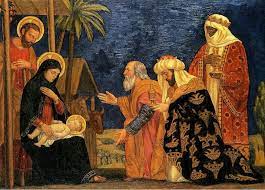
Evidently she was not out of the woods, because he takes her with him to Bethlehem. She did not have to go there. Could he not have parked her with Elizabeth and Zachariah again? If people knew about her situation Joseph would need to keep her under his eye for her protection. In those days people were zealous for the Law. There could even have been competition within the family for inheritance. Indeed, his own family did not make room for the couple in the house, and she is on the point of giving birth! (“kataluo” is a guest room, not an “inn”, as the King James and tradition has it.) Her situation was an abomination. By the time of the Magi’s visit, the young family were in a house in the town.
All this puts us in mind of the rejection of the Hebrew people by their enemies. It tells the history of their own behaviour towards God’s promise. It is prophetic of the treatment of the Messiah by the people of God, and the whole story is wrapped-up in the purity of the Mother of God and fidelity to His law.
These are the things that take our attention when looking at the stories of the Old Testament. These are the things we find in our personal spiritual journeys. If we can avoid these same errors, perhaps we can grow in holiness.
Joseph accepted the advice of an angel to marry Mary, just as Tobias did to marry Sarah. Which rejected ideas would we accept at the advice of an angel so as to align our wills with God’s?
Meditation Exercises
Consider drawing parallels between the actions, roles, and virtues of Old Testament women and those of the Blessed Virgin Mary. Reflection on how these types illustrate the mystery of salvation and their connection to your spiritual life. Here are a few suggestions for leading your audience toward meditation and prayer:
Eve and Mary – The New Eve
Mary is the Ark of the New Covenant
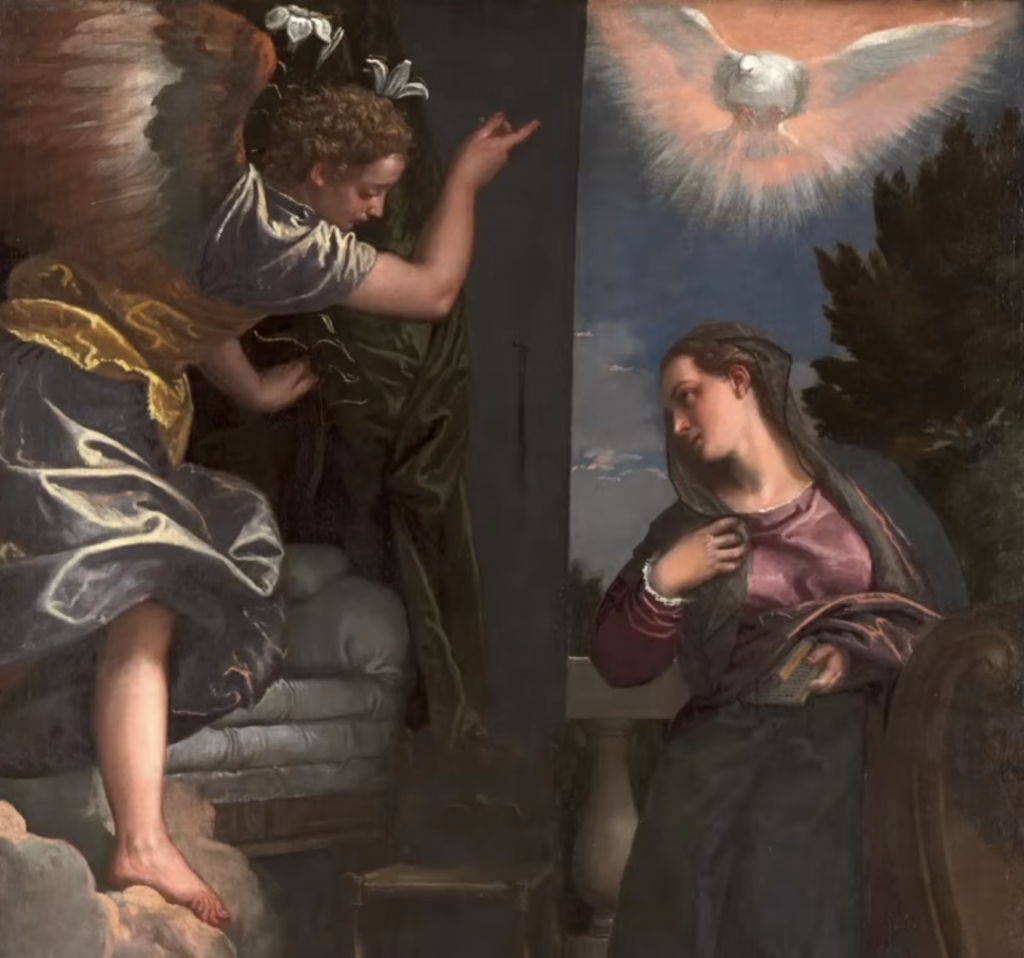
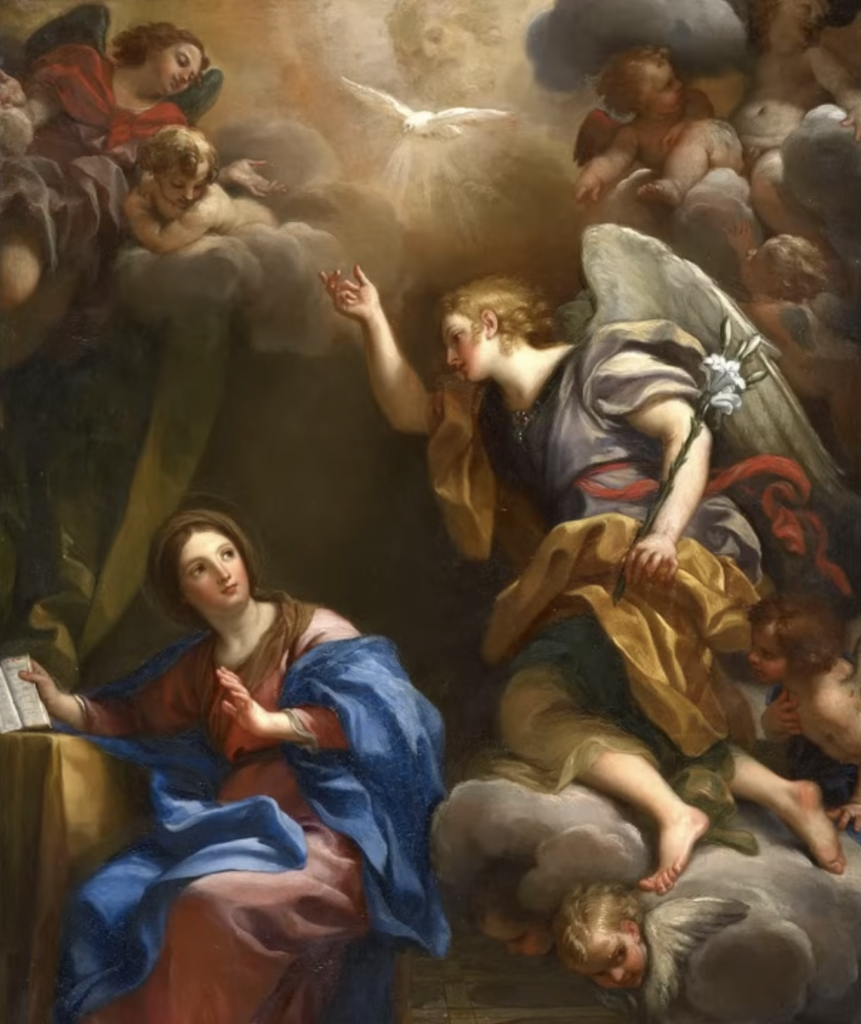
The Annunciation: The Return of the Glory Cloud
Reading the New Testament through ancient Jewish eyes, we see a new Exodus and Ark of the Covenant. We discover that Mary, the mother of Jesus, is linked with the glory cloud and the Ark itself.
From a first-century Jewish perspective, the annunciation is not just the conception of “the Son of God”.
It is also the return of the long-absent “cloud” of God’s “glory.” “The Holy Spirit will come upon you, and the power of the Most High will overshadow you,” (Luke 1:35)
There is an important parallel between the descent of the glory cloud upon the Tabernacle – The cloud of the Lordʼs glory “overshadows” (episkiaz) the Tabernacle. (Exodus 40:35–35 LXX) – and the descent of the Holy Spirit upon Mary
Scott Hahn describes how Luke’s Gospel leads us to see Mary as the Ark of God’s New Covenant and implies that the sacred ark of the Old Covenant merely prefigured a more wonderful Ark to come: the Mother of the divine Messiah.
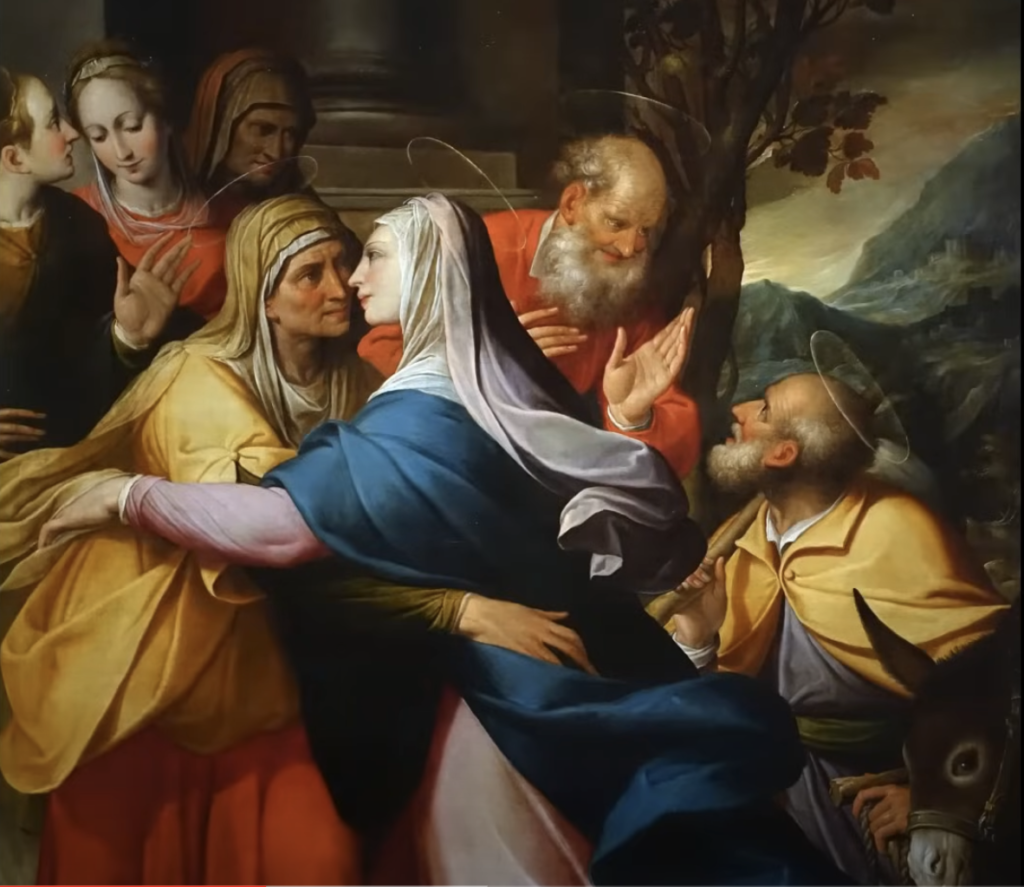
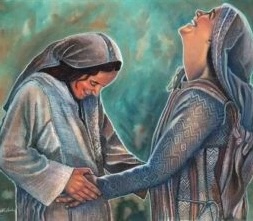
Luke draws upon 2 Samuel to set up the subtle but significant parallels between Mary’s Visitation and David’s effort to bring the ark of the covenant to Jerusalem. When Luke tells us that Mary “arose and went” into the Judean hill country to visit her kinswoman (Lk. 1:39), he reminds us of how David “arose and went” into the same region centuries earlier to retrieve the ark.
The joy surrounding this great encounter causes the infant John to leap with excitement (Lk. 1:41), much as David danced with excitement before the ark (2 Sam. 6:16). Finally, Luke adds that Mary stayed in the “house of Zechariah” for “three months” (Lk. 1:40, 56), which recalls how the ark of the covenant was temporarily stationed in the “house of Obed-edom” for a waiting period of “three months” (2 Sam. 6:11).
Taken together, these parallels show us that Mary now assumes a role in salvation history that was once played by the ark of the covenant.
Whatever made the ark holy made Mary even holier. If the first ark contained the word of God in stone, Mary’s body contained the Word of God enfleshed. If the first ark contained miraculous bread from heaven, Mary’s body contained the very Bread of Life that conquers death forever. If the first ark contained the rod of the long-ago ancestral priest, Mary’s body contained the divine person of the eternal Priest, Jesus Christ.
The Queenship of Mary
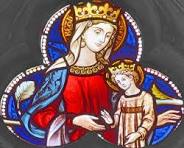
If Jesus is the new Davidic king, then who is the new queen? Although modern-day Bible readers might not think of a queen when it comes to the kingdom of God, as any first-century Jew would have known, under the reign of David’s royal family, the kingdom was ruled by both a king and a queen. In ancient Israel it was not the king’s wife who was queen but his mother. The Queen Mother (Hebrew Gebira) was second only to the king himself. She was honoured with a royal throne and functioned as a supreme royal intercessor with the king. The Queen Mother also appears in prophecies of the future.
Isaiah, in the early eighth century BC, prophecies that God will give a miraculous “sign”: Behold, a maiden shall conceive and bear a son, and shall call his name Immanuel.
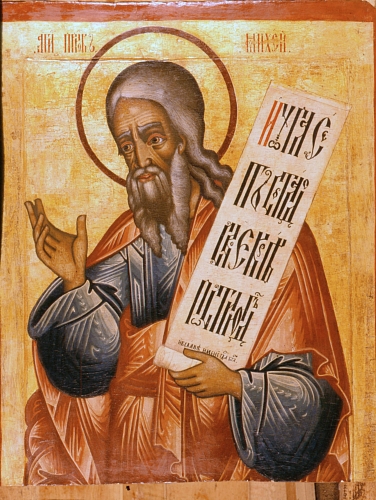
In the same century the prophet Micah declares: “But you, O Bethlehem of Ephrathah, who are one of the little clans of Judah, from you shall come forth for me one who is to rule in Israel, whose origin is from of old, from ancient days. Therefore he shall give them up until the time when she who is in labor has brought forth.“
Mary the New Queen
Through ancient Jewish eyes Mary is the queen mother of the Messiah’s kingdom. As Elizabeth greeted her: “And why is this granted me, that the mother of my lord should come to me?” It would have been unheard of for an older person to honour a younger, unless this person was royalty. The Magnificat implies that, although in the eyes of the world she is just a lowly handmaiden, both she and her son have been exalted to sit upon the thrones of the Davidic king and his mother.
As Scott Hahn points out, Solomon rose from the throne when his mother entered the room. He showed further respect by bowing before her and by seating her in the place of greatest honour at his right hand.
Chapter 31 of the Book of Proverbs provides a striking illustration of how seriously a king took the Queen Mother’s counsel. Introduced as “the words of Lemuel, king of Massa, which his mother taught him”, the chapter goes on to give substantial practical instructions in governance.
As David established a holy city in Jerusalem, so his ultimate successor would create a heavenly Jerusalem, where, in fact, His mother would reign at His right hand, clothed with the sun, crowned with twelve stars (signifying the twelve tribes of Israel), and with the moon at her feet.
The Davidic monarchy finds its perfect fulfillment in the reign of Jesus Christ – and there was never a Davidic king without a Davidic mother. Only with this Davidic key can we unlock the mysteries, for example, of the wedding feast at Cana. Mary approaches her Son to intercede for the people—just as Bathsheba interceded to Solomo on behalf of Adonijah.
Mary counsels her Son about the matter at hand, yet she counsels others to obey Him and not her. Jesus, then, speaks to His mother as her superior, yet He defers to her suggestion—just as one might expect a Davidic king to grant the wish of his queen mother.

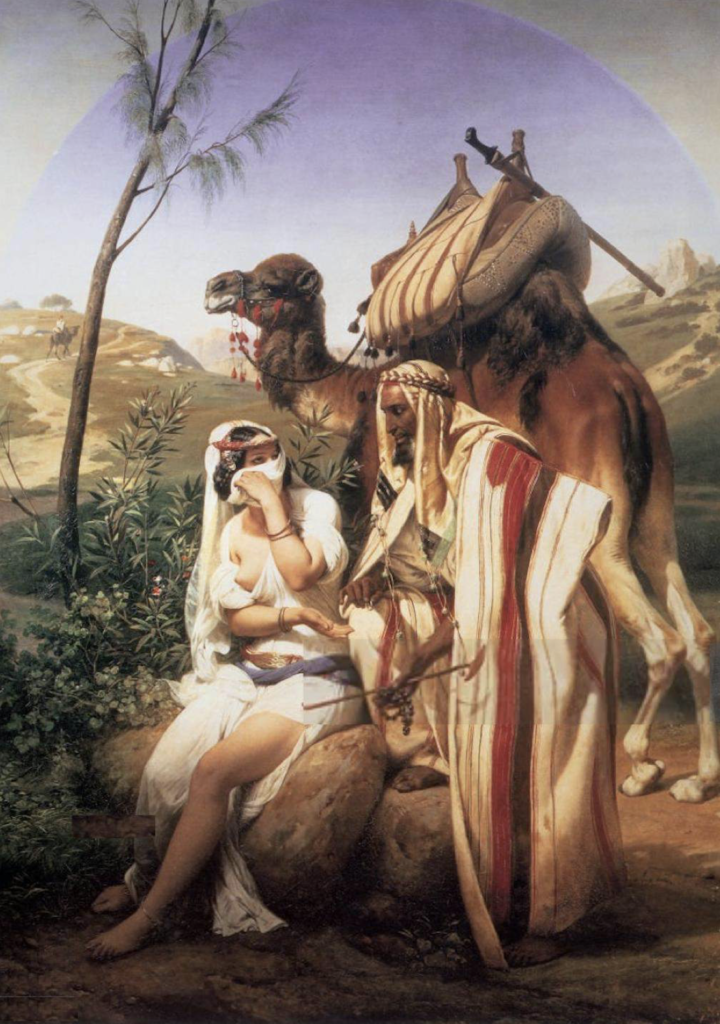
St Matthew draws our attention to five women in his genealogy: Tamar, Rehab, Ruth, Bathsheba, then, of course, Mary herself.
The first three, maybe Bathsheba too, were foreigners. All five could be considered unclean in some way: Tamar played the prostitute to fulfill her marriage obligations. “Rehab the whore” needs no introduction. Ruth covered herself with the cloak of Boaz: an invitation. Bathsheba had to have conspired with King David to be available to her husband when she became pregnant. But in spite of these shocking beginnings she was bride to the king, and mother to the king. It is from her that the idea of the “Queenship” of Mary comes to us. She interceded with her husband and was enthroned at the right hand of her son when he ruled. And Mary,…