
“Consider how Jesus Christ teaches us to be humble, by making us see that our virtue does not depend on our work alone but on grace from on high. He commands each of the faithful who prays to do so universally, for the whole world. For he did not say “thy will be done in me or in us,” but “on earth,” the whole earth, so that error may be banished from it, truth take root in it, all vice be destroyed on it, virtue flourish on it, and earth no longer differ from heaven.”
Quoted in the Catholic Catechism on The Our Father
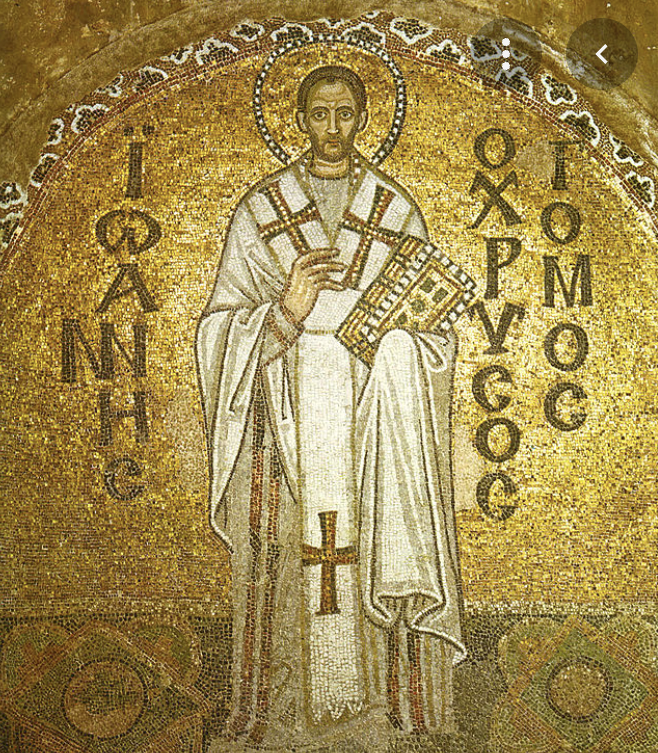
He was born in Antioch. After a thorough education he took up the ascetic life. He was ordained to the priesthood a became a fruitful and effective preacher.
He was elected Patriarch of Constantinople in 397 and was energetic in reforming the ways of the clergy and laity alike. He incurred the displeasure of the Emperor and was twice forced into exile. When the second exile to Armenia had lasted three years, it was decided that he should be sent still further away, but he died on the journey, worn out by his hardships.
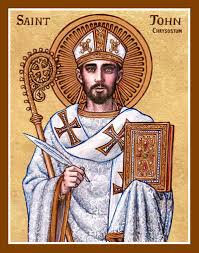
His sermons and writings did much to explain the Catholic faith and to encourage the living of the Christian life; his eloquence earned him the surname “Chrysostom” ( the Greek for golden mouth).
John, surnamed in the sixth century ‘golden-mouthed’ (Chrysostom), was the famous preacher of God as the ‘friend of humankind’, as the one who in Christ became the brother of the poor. He bore witness, even to death, to an uncompromising ethic of ecclesial and social service. He was the marvellous liturgist who gave form to the celebration of the Eucharist. The ‘Liturgy of St John Chrysostom’ is still constantly in use in the Orthodox Church today.
Orthodox Easter Vigil:
Let every one who loves God rejoice in this festival of light!
Let the faithful servant gladly enter into the joy of his Lord!
Let those who have borne the burden of fasting come now to reap their reward!
Let those who have worked since the first hour receive now their just wage!
Let those who came after the third hour keep this festival with gratitude!
Let those who arrived only after the sixth hour approach with no fear: they will not be defrauded.
If someone has delayed until the ninth hour, let him come without hesitation.
And let not the workman of the eleventh hour be ashamed: the Lord is generous.
He welcomes the last to come no less than the first.
He welcomes into his peace the workman of the eleventh hour as kindly as the one who has worked since dawn.
The first he fills to overflowing: on the last he has compassion.
To the one he grants his favour, to the other pardon.
He does not look only at the work: he sees into the intention of the heart.
Enter then all of you into the joy of your Master. First and last, receive your reward …
Abstinent and slothful celebrate this feast. You who have fasted, rejoice today.
The table is laid: come all of you without misgivings. The fatted calf is served, let all take their fill.
All of you, share in the banquet of faith: all of you draw on the wealth of his mercy …
Let no one weep for his sins: forgiveness is risen from the tomb.
Let no one fear death: the Saviour’s death has set us free. When it held him chained, he struck it down. When he descended to hell, he plundered it.
He destroyed it for attacking his flesh, as Isaiah had foretold: hell was dismayed at his coming.
It was dismayed because it was trampled on; it was in bitterness because it was deceived.
It had taken hold of a body and was confronted by God. It had taken hold of the visible, and the invisible had routed it.
Death, where is thy sting? Where, hell, thy victory? Christ is risen and thou art brought to nothing. Christ is risen and the devils are fallen. Christ is risen and the angels rejoice.
Christ is risen and life has prevailed. Christ is risen, and the dead are delivered from the grave.
For Christ, risen from the dead, is become the first fruits of those who sleep. To him be glory and might for ever and ever. Amen.


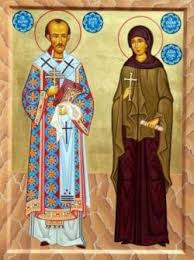

He was born at Antioch into an aristocratic family. At a very early age he was left an orphan by the death of his father. Through the psychological effects of this, as quite often happens in the case of churchmen, he was profoundly influenced for good by the faith of his mother. She instilled in him exquisite human sensitivity.
When John reached the age of eighteen she wanted to keep him near her at home as a ‘house monk’.
After completing his elementary and advanced studies crowned by courses in philosophy and rhetoric, he had as his teacher Libanius, a pagan and the most famous rhetorician of that time. At his school John became the greatest orator of late Greek antiquity. He was baptized in 368 and trained for the ecclesiastical life by Bishop Meletius, who instituted him as lector in 371. This event marked Chrysostom’s official entry into the ecclesiastical cursus. From 367 to 372, he attended the Asceterius, a sort of seminary in Antioch, together with a group of young men, some of whom later became Bishops, under the guidance of the exegete Diodore of Tarsus, who initiated John into the literal and grammatical exegesis characteristic of Antiochean tradition.
He then withdrew for four years to the hermits on the neighboring Mount Silpius. He extended his retreat for a further two years, living alone in a cave under the guidance of an “old hermit”. In that period, he dedicated himself unreservedly to meditating on “the laws of Christ”, the Gospels, and especially the Letters of Paul.
Then came a terrible crisis of conscience. Was not monasticism a ‘holy deviation’ anyway? Was it right to keep oneself ‘pure’ on the ‘heights’ while leaving one’s brethren to perish? He came to the decision that, since the world was now nominally Christian, what was needed was to Christianize the world.
Back in Antioch he was ordained a deacon in 380 and a priest in 386. He was later to write that were he to choose between the troubles of Church government and the tranquillity of monastic life, he would have preferred pastoral service a thousand times
He preached on the very day of his ordination and sometimes he preached for two hours at a time, amidst applause from the people. He wrote commentaries on Scripture, in particular the Epistle to the Romans: everything is grace, therefore ‘if we will we can’. Since the world, including the Emperor, was Christian, he preached against the reactionary minorities that exercised a corrupting influence. Against the lust and idleness of the rich, he praised the the liberation of slaves, issuing a summons to individual and collective sharing – he outlined a plan for eliminating poverty from Antioch – for ‘mine and thine are empty words’; what counts is use that is common to all. At the same time, this man who for so long had been a fierce ascetic and doubtless dreamt of transforming society into a vast monastery, this glorifier of virginity, gradually came to affirm that marriage is the ‘sacrament of love’, the family a ‘little church’ and true virginity is a spiritual chastity that can co-exist with human love.
He preached homilies against the Arians, followed by homilies commemorating the Antiochean martyrs. The year 387 was John’s “heroic year”, that of the so-called “revolt of the statues”. As a sign of protest against levied taxes, the people destroyed the Emperor’s statues.

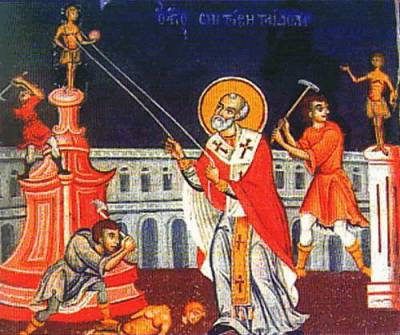
It was in those days of Lent and the fear of the Emperor’s impending reprisal that Chrysostom gave his twenty-two vibrant Homilies on the Statues, whose aim was to induce repentance and conversion. This was followed by a period of serene pastoral care (387-397).
Chrysostom is among the most prolific of the Fathers: seventeen treatises, more than seven hundred authentic homilies, commentaries on Matthew and on Paul (Letters to the Romans, Corinthians, Ephesians, and Hebrews), and 241 letters are extant.

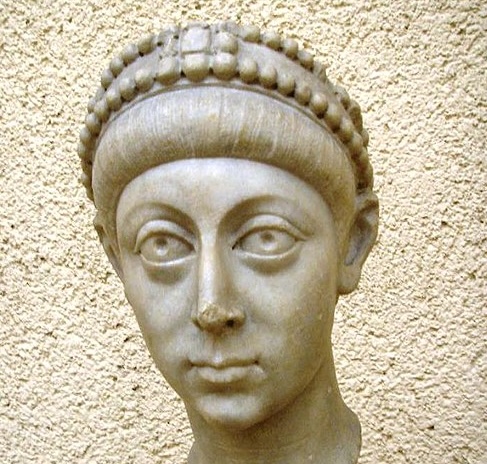

In 397, because of his reputation as an orator and much against his inclination, John was chosen as Archbishop of Constantinople, the capital of the Roman Empire of the East. Since the Emperor Arcadius was afraid that Antioch was not prepared to let their great pastor leave, without causing a stir. So he ordered Asterius, the Governor of Antioch, to meet him outside the city gates with a state carriage already waiting and inform him of his appointment Bishop of the capital and have him driven directly to Constantinople.
There he reformed his Church: the austerity of the episcopal residence had to be an example for all — clergy, widows, monks, courtiers, and the rich. Attentive to the poor, he was called “the Almoner”. He always spoke kindly to women and showed special concern for marriage and the family. He won the people’s hearts, he increased the number of hospitals and centres of reception, he evangelized the countryside, including the Goths who were settling in the Empire. He waged a relentless war against heretics, but he refused the support of the secular arm. He concluded his admirable homilies On the Incomprehensibility of God with the words: ‘The Inaccessible comes down to us by love.’
But here, in confrontation with power, we see him above all as the purifying apostle. He resists Eutropius, the all-powerful minister, when he wishes to abolish the right of asylum, yet protects him against a riotous mob when he falls from power and takes refuge in the basilica. John sought to reform the higher clergy and to prevent the bishop of Alexandria from persecuting Origenist monks.
He sought also to improve the moral tone of the court and especially of the Empress Eudoxia, that ‘modern Herodias’. His enemies combined against him. having removed six Bishops in Asia in 401 A.D. who had been improperly appointed, he was accused of having over-stepped the boundaries of his own jurisdiction, and thus he easily became the target of accusations. Another accusation against him concerned the presence of some Egyptian monks, excommunicated by Patriarch Theophilus of Alexandria, who had sought refuge in Constantinople. A heated argument then flared up on account of Chrysostom’s criticism of the Empress and her courtiers, who reacted by heaping slander and insults upon him. Thus, they proceeded to his removal during the Synod organized by the same Patriarch Theophilus in 403, which led to his condemnation and his first, brief exile.
His illegal deposition in 403 proved only momentary. But in 404 he was exiled to Lower Armenia and remained there for three years, free, but under surveillance. He learned the patience of Job and the primacy of charity. He found that hell matters less than losing the presence of the Kingdom. He discovered that the cross was public and the resurrection secret, yet the true glory is identified with the cross. His correspondence, however, in particular with an old friend the deaconess Olympias, together with the influx of visitors, many of them from Antioch, alarmed the civil power, which decided to deport him to the shores of the Black Sea on the eastern border of the Empire. It was a long and exhausting journey, on foot. At Comana he prepared himself for death. He clothed himself in white, received Holy Communion, prayed for those present, and breathed his last, saying: ‘Glory be to God for everything.’


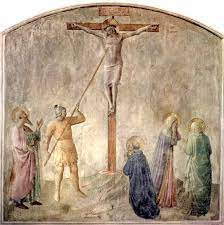
He left behind many magnificent writings.
From On the Incomprehensibility of God: “There are many things at which we marvel without fear, for example the beauty of architecture, the masterpieces of painting, or the glory of the human form. We also marvel at the vastness and infinite depth of the sea, but to be above that depth is also terrifying. In the same way the sacred writer as he leaned out over the infinite abyss of God’s wisdom was seized with giddiness. Filled with wonder he drew back trembling, and said, ‘I praise thee, for thou art fearful and wonderful. Wonderful are thy works.’ And again: ‘Such knowledge is too wonderful for me; it is high, I cannot attain it.’”
From Homily on First Corinthians: “The Magi adored this body lying in the manger … It is not now lying in a crib that I see thee but upon the altar. You should believe that today also it is the same meal over which Jesus presides. There is no difference between the Eucharist and that. This is that same body that was covered in blood, pierced by the spear, pouring forth the saving streams of blood and water, for the whole world. Christ soared up from the depths of the abyss in dazzling light and leaving his rays there he went up to his throne in heaven. It is that body that he gives us to hold and to eat now.”
He wrote further on the Eucharist: “the priest says, ‘This is my body’, and these words change the nature of the offerings. Thus the word of the Saviour, pronounced once, has sufficed and will suffice to fulfil the most perfect sacrifice on the altar of every church, from the Last Supper of Jesus Christ right up till our time and till his coming again. The bread becomes the bread of heaven. It is not the work of any human power. He who did this at the Last Supper still does it now. For our part, we hold the rank of servants: it is he who sanctifies and transforms. There is only one Christ, whole and entire now as then, a single body … We do not offer another victim as the high priest did in the Old Testament, It is always the same victim.”
On the Church he wrote : “just as the head and the body constitute a single human being, so Christ and the Church constitute a single whole. This union is effected through the food that he has given us in his desire to show the love he has for us. For this reason he united himself intimately with us, he blended his body with ours like leaven, so that we should become one single entity, as the body is joined to the head.
Christ makes of us a single body. Thus he who lives in Rome looks on the Indians as his own members. Is there any union to be compared with that? Christ is the head of all.

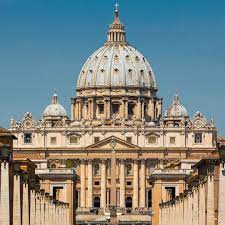


Imagine two chariots. Harness virtue and pride to one, sin and humility to the other. You will see the chariot drawn by sin outstrip that of virtue … To understand why one of these vehicles is faster than the other, remember the Pharisee and the publican … One relied on his own righteousness, on his own fasting and the tithes that he paid. The other needed to say only a few words to be free of all his sins. That was because God was not only listening to his words, he also saw his soul, and finding him humble and contrite he judged him worthy of his compassion and love. Let us then be content to surrender and go to him and never to leave him.
Nothing is so well calculated to dispel sloth and negligence as anguish that gathers the spirit together from all sides and makes it return into itself. Anyone who prays in anguish will be able, after his prayer, to know a great joy in his soul. Just as clouds when they gather begin by making the day dark, then, once they have poured out all the water they contained, the atmosphere is serene and light; so anguish, as it builds up in our heart, plunges our thoughts into darkness, but then, when it has vented all its bitterness through prayer and accompanying tears, it brings to the soul a great light. God’s influence irradiates the soul of the one who is praying, like a ray of sunlight.
From On the Incomprehensibility of God: What is it then to be a fool for Christ? It is to control one’s thoughts when they stray out of line. It is to make the mind empty and free so as to be able to offer it in a state of readiness when Christ’s teachings are to be assimilated, swept clean for the words of God that it needs to welcome.
In the world there are many things obscuring the view and disturbing taste and hearing. That is why it is necessary … to run away from all excitement and take refuge in the desert where tranquillity is total, serenity complete, noise does not exist, where eyes are fixed on God alone and ears attentive to hearing only the divine words. The ears delight to hear the symphony of the Spirit whose power over the soul is so strong that, once anyone has been touched by this music, he can no longer prefer either food or drink or sleep to it. Henceforward neither the crowd nor the bustle of this world’s affairs can distract one whose attention is so engaged … So those who have climbed to the mountain top no longer hear more of what is going on in the cities than an insignificant and irritating noise resembling the buzzing of bees. John Chrysostom Second Sermon to Stelechius on Compunction
In union with God, the heart absorbs the Lord and the Lord the heart, and the two become one.
By prayer I mean not that which is only in the mouth, but that which springs up from the bottom of the heart. In fact, just as trees with deep roots are not shattered or uprooted by storms … in the same way prayers that come from the bottom of the heart, having their roots there, rise to heaven with complete assurance and are not knocked off course by the assault of any thought. That is why the psalm says: ‘Out of the deep have I called unto thee, O Lord’



From On Ozias:
On high the armies of the angels are giving praise. Here below, in the Church, the human choir takes up after them the same doxology. Above us, angels of fire make the thrice-holy hymn resound magnificently. Here below is raised the echo of their hymn. The festival of heaven’s citizens is united with that of the inhabitants of earth in a single thanksgiving, a single upsurge of happiness, a single chorus of joy.
It can be said that John of Antioch, nicknamed “Chrysostom”, that is, “goldenmouthed”, because of his eloquence, is also still alive today because of his works. An anonymous copyist left in writing that “they cross the whole globe like flashes of lightening.” Chrysostom’s writings also enable us, as they did the faithful of his time whom his frequent exiles deprived of his presence, to live with his books, despite his absence. This is what he himself suggested in a letter when he was in exile (To Olympias)
At the end of his life, from his exile on the borders of Armenia, “the most remote place in the world”, John, linking up with his first preaching in 386, took up the theme of the plan for humanity that God pursues, which was so dear to him: it is an “indescribable and incomprehensible” plan, but certainly guided lovingly by Him. Even if we are unable to unravel the details of our personal and collective history, we know that God’s plan is always inspired by his love. Thus, despite his suffering, Chrysostom reaffirmed the discovery that God loves each of with an infinite love and therefore desires salvation for us all. For his part, throughout his life the holy Bishop cooperated generously in this salvation, never sparing himself. Indeed, he saw the ultimate end of his existence as that glory of God which—now dying—he left as his last testament: “Glory be to God for all things”.