
Ephrem, honored by Christian tradition with the title “Harp of the Holy Spirit”, remained a deacon of the Church throughout his life. His hymns On the Nativity of Christ expressed his wonder before the Virgin in inspired tones:

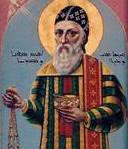
Saint Ephrem the Syrian was born into a Christian family in Nisibis, in present day Turkey, in about 306 A.D. He was Christianity’s most important Syriac-speaking representative and uniquely succeeded in reconciling the vocations of theologian and poet. He was educated and grew up beside James, Bishop of Nisibis (303-338), and with him founded the theological school in his city. He was ordained a deacon and was intensely active in local Christian community life until 363, the year when Nisibis fell into Persian hands.
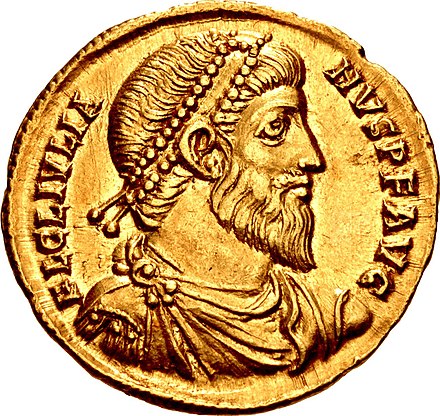
In Ephrem’s view this was a just punishment for the Emperor Julian the Apostate’s ‘s return to the ancient cults of the gods and his proceedings against the Christians. He even wrote Hymns against Julian.
Ephrem then emigrated to Edessa in Greece, where he continued his activity as a preacher. He died in this city in 373, a victim of the disease he contracted while caring for those infected with the plague. It is not known for certain whether he was a monk, but we can be sure, in any case, that he remained a deacon throughout his life and embraced virginity and poverty.
Prayer of St. Ephraim : Lord and Despot of my life, do not give me the spirt of laziness, curiosity, love of power, and idle collection but spirit of wisdom, lowliness, patient endurance, and love grace me Your servant.

Saint Ephrem has left us an important theological inheritance. His substantial opus can be divided into four categories: works written in ordinary prose (his polemic works or biblical commentaries); works written in poetic prose; homilies in verse; and lastly, hymns, undoubtedly Ephrem’s most abundant production. He is a rich and interesting author in many ways, but especially from the theological point of view. It is the fact that theology and poetry converge in his work which makes it so special. If we desire to approach his doctrine, we must insist on this from the outset: namely, on the fact that he produces theology in poetical form. Poetry enabled him to deepen his theological reflection through paradoxes and images.
At the same time, his theology became liturgy, became music; indeed, he was a great composer, a musician. Theology, reflection on the faith, poetry, song, and praise of God go together; and it is precisely in this liturgical character that the divine truth emerges clearly in Ephrem’s theology. In his search for God, in his theological activity, he employed the way of paradoxes and symbols. He made ample use of contrasting images because they served to emphasize the mystery of God.
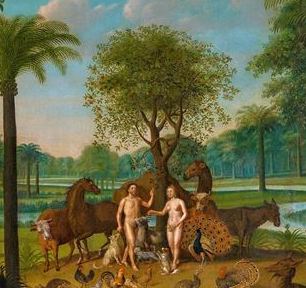
To express the mystery of Christ, Ephrem uses a broad range of topics, expressions, and images. In one of his hymns he effectively links Adam (in Paradise) to Christ (in the Eucharist):
It was by closing with the sword of the cherub
that the path to the tree of life was closed.
But for the peoples, the Lord of this tree
gave himself as food in his (Eucharistic) oblation.
The trees of the Garden of Eden were given as food
to the first Adam. For us, the gardener of the Garden
in person made himself food for our souls.
Indeed, we had all left Paradise together with Adam,
who left it behind him.
Now that the sword has been removed here below (on the Cross),
replaced by the spear, we can return to it. (Hymn 49:9-11)

To speak of the Eucharist, Ephrem used two images, embers or burning coal and the pearl. The burning coal theme was taken from the Prophet Isaiah (cf. 6:6). It is the image of one of the seraphim who picks up a burning coal with tongs and simply touches the lips of the Prophet with it in order to purify them; the Christian, on the other hand, touches and consumes the Burning Coal which is Christ himself:
In your bread hides the Spirit who cannot be consumed;
in your wine is the fire that cannot be swallowed.
The Spirit in your bread, fire in your wine:
behold a wonder heard from our lips.
The seraph could not bring himself to touch
the glowing coal with his fingers,
it was Isaiah’s mouth alone that it touched;
neither did the fingers grasp it nor the mouth swallow it;
but the Lord has granted us to do both these things.
The fire came down with anger to destroy sinners,
but the fire of grace descends on the bread and settles in it.
Instead of the fire that destroyed man,
we have consumed the fire in the bread and have been invigorated. (Hymn De Fide 10:8-10)
Here again is a final example of Saint Ephrem’s hymns, where he speaks of the pearl as a symbol of the riches and beauty of faith. He links the traditional legend of the origin of pearls in a shell by fertilisation with the heavenly Jew as an image of Mary’s virginal conception :
I placed (the pearl), my brothers, on the palm of my hand,
to be able to examine it. I began to look at it from one side
and from the other: it looked the same from all sides.
(Thus) is the search for the Son inscrutable,
because it is all light. In its clarity I saw the Clear
One who does not grow opaque; and in his purity,
the great symbol of the Body of Our Lord, which is pure.
In his indivisibility I saw the truth which is indivisible.
(Hymn On the Pearl 1:2-3)
The figure of Ephrem is still absolutely timely for the life of the various Christian Churches. We discover him, in the first place, as a theologian who reflects poetically, on the basis of Holy Scripture, on the mystery of man’s redemption brought about by Christ, the Word of God incarnate. His is a theological reflection expressed in images and symbols taken from nature, daily life, and the Bible. Ephrem gives his poetry and liturgical hymns a didactic and catechetical character:
They are theological hymns, yet at the same time suitable for recitation or liturgical song. On the occasion of liturgical feasts, Ephrem made use of these hymns to spread Church doctrine. Time has proven them to be an extremely effective catechetical instrument for the Christian community.
Ephrem’s reflection on the theme of God the Creator is important: nothing in creation is isolated, and the world is a Bible of God. By using his freedom wrongly, man upsets the cosmic order. The role of women was important to Ephrem. The way he spoke of them was always inspired with sensitivity and respect: the dwelling place of Jesus in Mary’s womb greatly increased women’s dignity. Ephrem held that just as there is no redemption without Jesus, there is no Incarnation without Mary. The divine and human dimensions of the mystery of our redemption can already be found in Ephrem’s texts; poetically and with fundamentally scriptural images, he anticipated the theological background and in some way the very language of the great Christological definitions of the fifth-century Councils.
Ephrem, honoured by Christian tradition with the title “Harp of the Holy Spirit”, remained a deacon of the Church throughout his life. It was a crucial and emblematic decision: he was a deacon, a servant, in his liturgical ministry and, more radically, in his love for Christ, whose praises he sang in an unparalleled way, and also in his love for his brethren, whom he introduced with rare skill to the knowledge of divine Revelation.
