Bishop and Doctor 130 - 202 A.D.

Irenaeus was probably born in Smyrna (today, Izmir in Turkey), where in his youth, he attended the school of Bishop Polycarp, a disciple in his turn of the Apostle John. He emigrated to Lyon in France,  where he eventually became the Bishop. It is not known for certain whether he was martyred or died a natural death.

Whenever we take up a Bible we touch Iranaeus’s work, for he played a decisive role in fixing the canon of the New Testament. It is easy for people nowadays to think of Scripture – and the New Testament in particular – as the basis of the Church, but harder to remember that it was the Church itself that had to agree early on about what was scriptural and what was not

Before Irenaeus, there was vague general agreement on what scripture was, but a system based on this kind of common consent was too weak. As people meditated upon the Redemption, dissensions and heresies inevitably arose, and reference to scripture was the obvious way of trying to settle what the truth really was. But in the absence of an agreed canon of scripture it was all too easy to attack one’s opponent’s arguments by saying that his texts were corrupt or unscriptural and easy, too, to do a little fine-tuning of texts on one’s own behalf.

An engraving of St Irenaeus, Bishop of Lugdunum in Gaul (now Lyon, France)
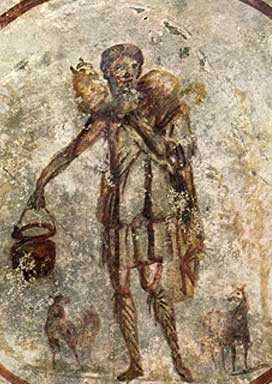
The Shepherd of Hermas, or the Good Shepherd, 3rd century, Catacombs of Rome.

So Iranaeus went through all the books of the New Testament and all the candidates (such as the magical pseudo-Gospels and the entertaining and uplifting novel, The Shepherd of Hermas). He did not simply accept or reject each book, because his enemies could have said that he was doing it to bolster his own arguments: he gave reasons for and against the canonicity of each. Iraneus’s  canon of scripture is very nearly  the modern one. He started the tradition of biblical scholarship.

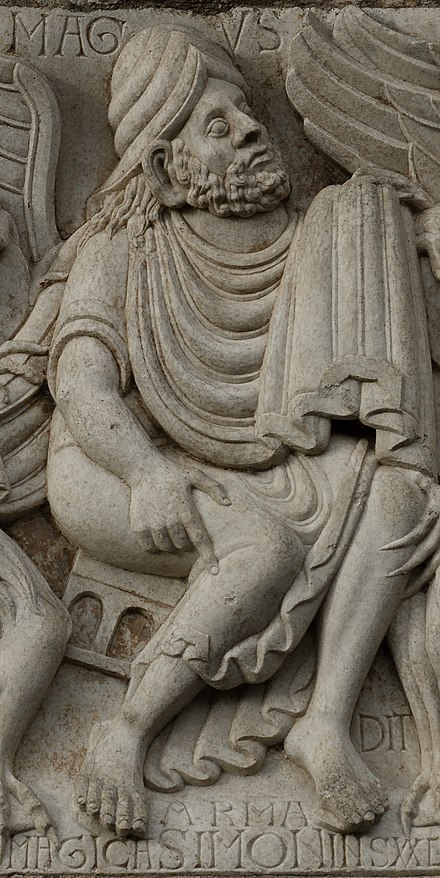
In settling on the truth, his major work was Against Heresies or Detection and Overthrow of False Knowledge. He  had to fight against Gnostics, whose predecessors, he said went as far back as the magician Simon Magus. Simon’s confrontation with Peter is recorded in Acts.. The act of simony, or paying for position, is named after Simon who tried to buy his way into the power of the Apostles.. The Gnostics believed that the material world was the creation of an evil god and that and that the world was irredeemably wicked.

Relief of Simon Magus at the gate of the Basilica of Saint-Sernin, Toulouse.

Bishop Barron has described Gnosticism as “an extreme prejudice of the spiritual over the material.”

A New age example is A Course in Miracles. Father Benedict Groeschel was a friend of Helen Schucman who channeled A Course in Miracles.

Irenaeus wrote: “Spirits without bodies will never be spiritual men and women. It is our entire being, the soul and flesh combined, which by receiving the Spirit of God constitutes the spiritual man.” 

Irenaus, in Church of St Irenaeus, Lyon.

Irenaeus also preached against Valentinians who claimed to be possessors of a secret tradition that had never been written down, but passed from master to disciple through the ages.  Valentinus was an Egyptian of great charisma whose teaching was immensely complicated.

In about the year 200 Irenaeus wrote: “The Church, though dispersed throughout the world . . . having received this faith from the Apostles . . . as if occupying but one house, carefully preserves it.

“She believes these points of doctrine, as if she had but one soul and one and the same heart, and she teaches them and hands them down with perfect harmony, as if she possessed only one mouth.

“For, although the languages of the world are dissimilar, yet the import of the tradition is one and the same.

“For the Churches which have been planted in Germany do not believe or hand down anything different, nor do those in Spain, nor those in Gaul, nor those in the East, nor those in Egypt, nor those in Libya, nor those which have been established in the central regions of the world.”

Iranaeus spoke of the unbroken sequence of the Church’s bishops, as successors of the apostles . To support that he offered the first list of Roman bishops, beginning with Peter.

In Against Heresies Irenaeus wrote of how fortunate we are:

“The Lord has given us a sign ‘as deep as Sheol and as high as heaven’, that we should not have dared to hope for. How could we have expected to see a virgin with child, and to see in this Child a ‘God with us’ (Isaiah 7. 11 & 14), who would descend into the depths of the earth to seek for the lost sheep,  the creature he had fashioned, and then ascend again to present to his Father this ‘man’  regained?”

Later he wrote: “As if God had no hands of his own! From all eternity he has with him the Word and Wisdom, the Son and the Spirit. It is by them and in them that he does all things”

Of the Eucharist he wrote: “In the same way that earthly bread, after receiving the invocation of God, is no longer ordinary bread, but Eucharist, made up of two components, one earthly the other heavenly, so our bodies that share in the Eucharist are no longer corruptible, because they have the hope of the resurrection.”

“We need to take refuge with the Church, to drink milk at her breast, to be fed with the Scriptures of the Lord. For the Church has been planted in the world as a paradise.”

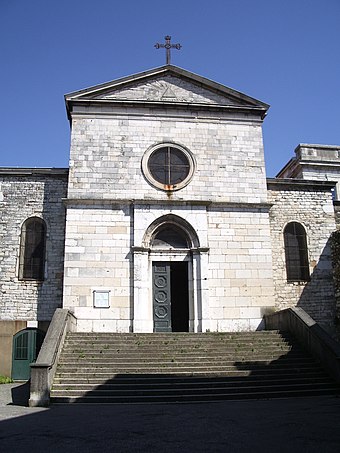
Church of St Irenaeus, Lyon.

He is regarded as a martyr by the Catholic and Orthodox Churches. He was buried under the Church of Saint John in Lyon, which was later renamed St Irenaeus in his honour. The tomb and his remains were destroyed in 1562 by the Huguenots.

It is thanks  to him that France is known as “the oldest daughter of the Church”.  Prompted by French bishops Pope Francis declared Irenaeus to be a doctor of the Church.