Inspired by:

1. "The Mystical City of God" by the Venerable Mary of Agreda

2. "The Poem of the Man God" by Maria Valtorta

3. "The Life of Mary as Seen by the Mystics" with writings by Venerable Catherine Emmerich, St. Elizabeth of Schönau and St. Bridget of Sweden.

PART 2: FROM THE CIRCUMCISION OF OUR LORD TO THE TRANSFIGURATION

Mary of Agreda: In considering the Circumcision, which Our Lady understood that Our Lord should have, although He was above the law, she asked Joseph to procure  a crystal vessel for preserving the sacred relic of the circumcision; while she prepared linen to catch the first shedding of His sacred blood.

The angels Michael and Gabriel announced that babe should be named Jesus.

When the priest, who was to perform the ceremony, first arrived, he was disconcerted by the rudeness of the cave. But when the prudent Queen spoke to him with such modesty and grace his constraint turned into devotion. The priest thereupon proceeded to his duty and circumcised Jesus. True to his human nature Jesus shed tears as other children, yet his tears were caused more by the hard-heartedness of mortals, than by the severe physical pain.

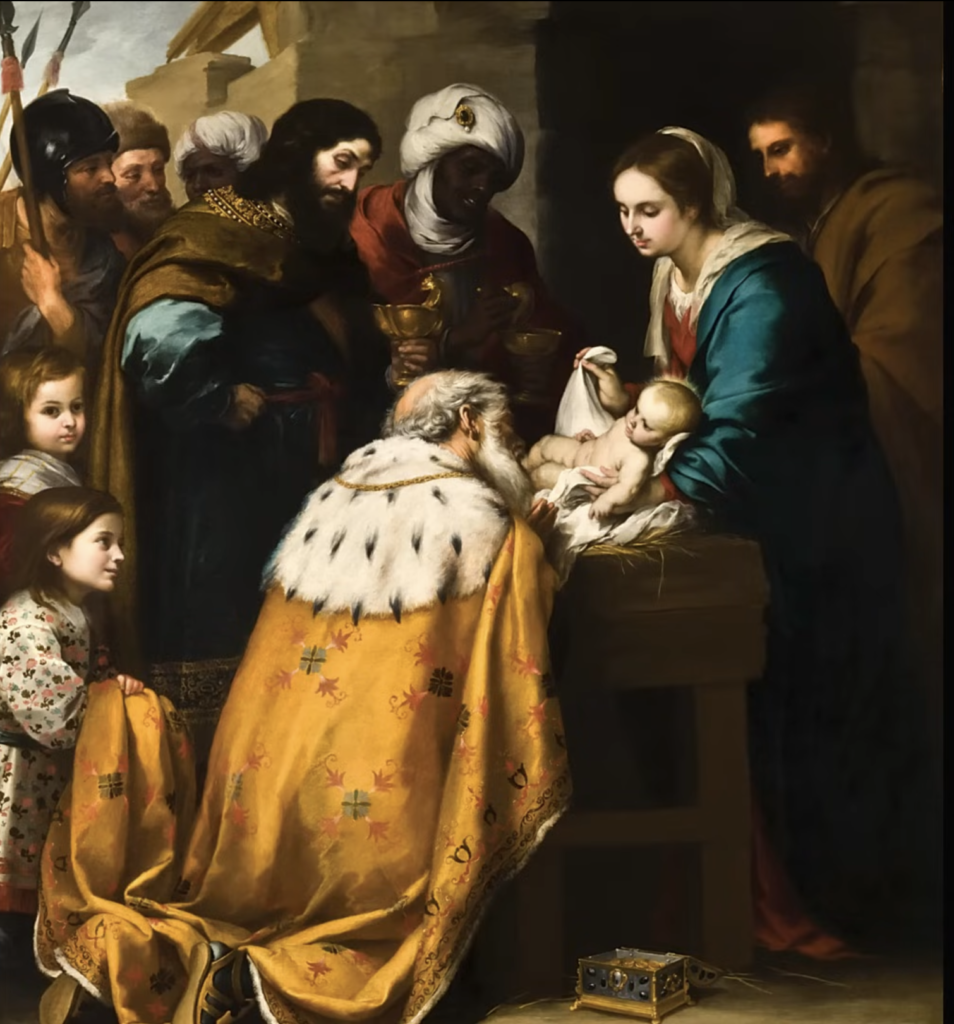
Catherine Emmerich: Three kings, Melchior of Chaldea, Caspar, who was brown, and Balthasar from Media, followed a star, in order to worship the Infant Jesus. 

Melchior fell on his knees before Mary, bowed his head and crossed his hands on his breast. He then gave gold, because he was full of love and confidence, and had always with unshaken devotion and untiring efforts, sought after salvation.

Caspar gave a golden censer, in shape like a boat, filled with small, greenish grains like resin. He gave incense, for he was the one that clung to God, voluntarily, reverently, and lovingly following His will. He knelt long in adoration.

Balthasar was old and stout. He stood bowing low, and presented a little golden ship, in which were the small white flowers of myrrh, which is typical of mortification and vanquished passions. He had had to struggle against temptations to idolatry and polygamy. He knelt and remained very long before the Infant Jesus.

The Adoration of the Magi, by Juan Carreño de Miranda (1614–1685)
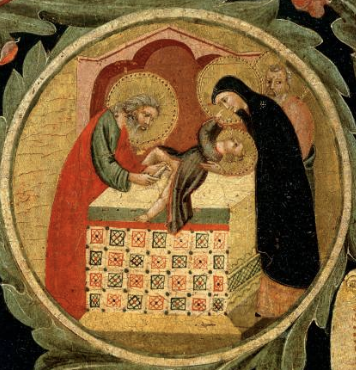
Presentation of Jesus at the Temple
by Fra Angelico

Maria Valtorta: The Presentation: The priest sprays Mary with water. Mary gives a handful of coins together with the two pigeons to him. The priest takes the Child and raises Him with arms fully stretched out. The rite is over. The child is handed back to His mother.

Simeon, a little old man bent with age, and limping makes his way leaning on a stick. He asks Mary to give him the child for one moment. Simeon is laughing, and crying at the same time. Jesus, stretches His little hands towards Simeon’s  long white beard. Simeon’s words are a prophecy.  Mary’s smile fades into paleness when Simeon mentions sorrow. Although she knows, the word pierces her soul. Pressing the child to her breast, she moves closer to Joseph to be comforted.

She takes in the words of the prophetess, Anna of Phanuel. “He, who gave a Saviour to people, will not lack the power to send His angel to console your tears. Our God will give you a heart of purest gold to withstand the storm of sorrow, so that you will be the greatest woman in creation.”

Mary of Agreda: The Lord said to Mary: “My Spouse and My Dove, Herod is seeking the life of the Child. In order to save your Son’s life, you must flee with Him and Joseph into the land of Egypt. The journey is long, hard and very tiring. Suffer it all for My sake, for I am and always will be with you.”

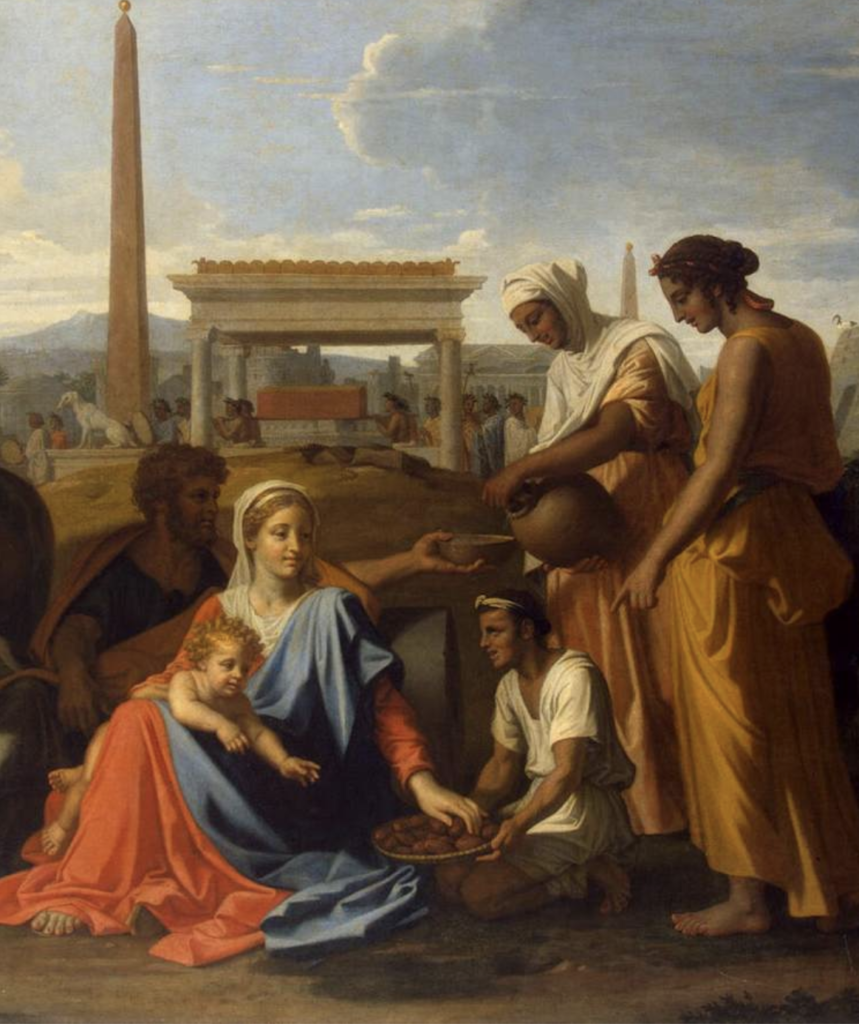
The Holy Family spent their first night in a cave in the hills south of Bethlehem, off the regular caravan route. They were thirsty and exhausted, and Mary was so sorry for her Child that she wept. But at her prayer a spring of clear water suddenly gushed forth, and a wild goat came to them and allowed Joseph to milk it. Late the next day, as they were crossing the desert near Hebron, they ran out of water, and both Mary and Joseph suffered keenly from thirst.

St. Elizabeth and John were then hiding in a cave on a hill nearby. Suddenly John felt that his Lord was close and was suffering. He fell on his knees and prayed fervently with his arms extended. St. Elizabeth sent one of her servants with generous gifts of money, food and clothing to the Holy Family, which he overtook near Gaza.

Fra Bartolomeo, Rest on the Flight into Egypt
c. 1500 (Pienza)
Massacre of the Innocents by Nicholas Poussin

Then the Holy Family set out on the long and difficult journey across the great desert between Palestine and Egypt. While it was still dark, they had to pass through a stretch of ground infested with many dangerous snakes which slithered toward them and reared up, hissing menacingly, but did not harm them.

After the Holy Family fled from Palestine, King Herod was exceedingly angry and he gave a secret order to his officers in Bethlehem to kill all male children under two years of age. The Slaughter of the Innocents took place in a large courtyard of a palace, to which the mothers and children had been summoned. Executioners armed with swords and spears proceeded to cut the throats or pierce the chests of the infants and to throw their bodies onto a pile, before the eyes of the helpless and frantic mothers, who screamed and tore their hair.

St. Elizabeth and John escaped by hiding in a cave. When John was four years old, his saintly mother died peacefully. Mary’s angels helped him to bury his mother in the desert. Young John was then supported by a holy hermit.

Catherine Emmerich: I saw the Holy Family on their way to Heliopolis. They crossed a long and very high bridge over the Nile and came to the city gate. Here stood a great idol with the head of an ox, and in its arms something like the figure of a swathed child. The idol was encompassed by a circle of  stone tables, on which worshippers laid their sacrifices. The Holy Family sat down to rest under a large tree. They had scarcely seated themselves when the earth began to quake, the idol tottered, and tilted over. The terrified crowd, with menacing and abusive words, angrily surrounded the Holy Family. Suddenly the earth heaved, the huge tree fell, its roots breaking up out of the ground, and there arose a lake of muddy water into which the idol splashed. It sank so deep that one could scarcely see its horns, and some of the most wicked of the bystanders sank with it.

The Holy Family now entered the city unmolested, and put up near an idolatrous temple, a large stone building containing many rooms.

The Holy Family in Egypt by Nicholas Poussin
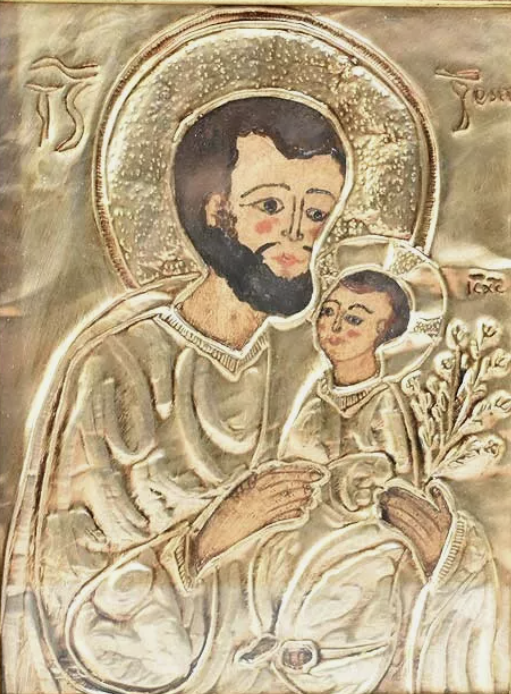
Joseph and Jesus

Maria Valtorta: The holy family has returned to Nazareth from Egypt. Mary works at her loom or at needlework.  Joseph can be heard working in the workshop. Jesus is playing under the trees with Judas (not the evil one), and James, the sons of Joseph’s brother, Alpheus.  One of the children proposes: “Let us play the Exodus from Egypt. Jesus will be Moses. I will be Aaron and you… Mary (sister of Moses and Aaron).” Jesus says: “When the Ark is passing by, one must hail it .” Mary stands up smiling, and she bows to her Son. Jesus clambers up the side of the mountain, and reads the canticle of Moses from a leaf. He then climbs further up, and after blessing Israel, Moses lies on the grass, and closes His eyes an dies. Judas, and James also prostrate themselves. Mary shouts: “Jesus, Jesus, get up. Don’t lie down like that. Your mummy doesn’t want to see You dead.”

Alpheus suggests Jesus should go to school, but Mary says: “He will not go to school.” “That is correct,” says Joseph. “There is no need for Jesus to go to school. Mary was brought up in the Temple, and she knows the Law as well as any scholar. She will be His Teacher. That’s what I want too.”

Mary of Agreda: After Jesus reached the age of twelve, the Holy Family made their yearly pilgrimage to the Temple and spent seven days with friends in Jerusalem. But this time, when Mary and Joseph left the city and were on their way back to Nazareth, the Child Jesus withdrew from them without their knowledge. Not far from the city gate He turned and hastened back through the streets. In His divine omniscience He foresaw all that was to happen, and He offered it up to His Eternal Father for the benefit of souls.

Mary and Joseph searched for him for three days.  Finally they arrived at the Temple and found Jesus just as He was finishing His last explanation. All the scholars rose in complete amazement and looked at each other, exclaiming: “What a prodigy of a boy!” Joseph humbly remained silent while Mary approached her Son and said with reverence and affection, before all those present: “Son, why hast Thou done so to us? Behold, Thy father and I have been seeking Thee sorrowing.” In a very serious tone of voice Jesus replied: “How is it that you sought Me? Did you not know that I must be about My Father’s business?”

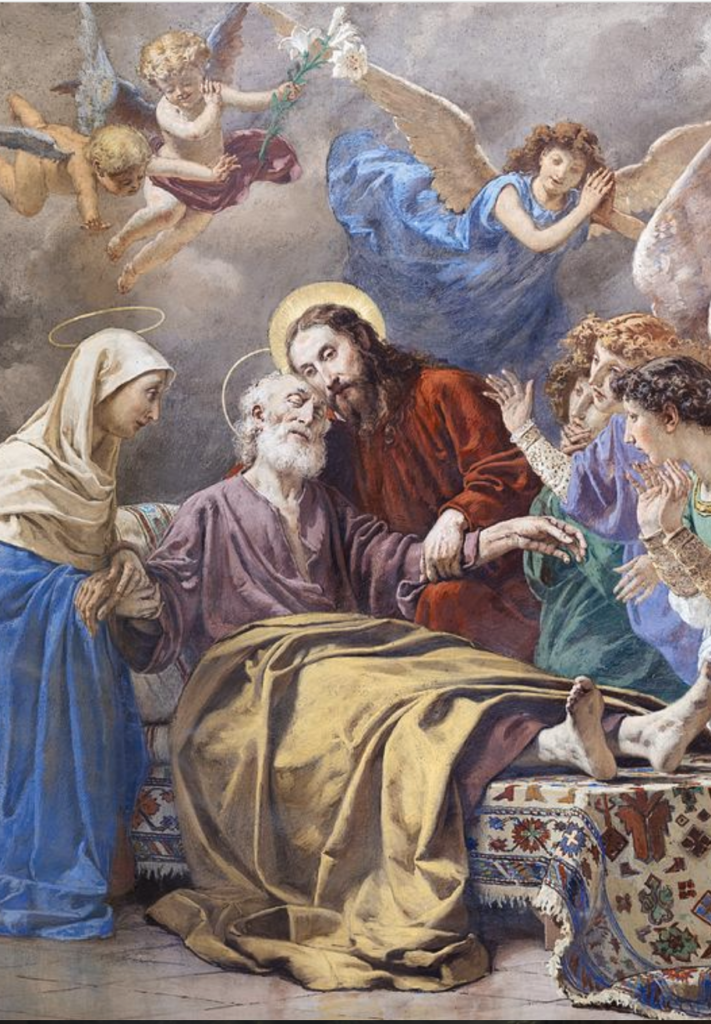
The fresco of Death of St. Joseph in the church Basilica del Sacro Monte by P. G. Gilardi (1881).

Saint Bridget of Sweden: Jesus was subject to His parents, and He acted like other children until He grew up. Nothing unclean ever touched Him, nor was the least disorder ever seen in His hair. When He grew older, He was constantly in prayer.  At home, with friends, He talked familiarly about the Law of God. He also openly disputed with learned men, so that they were astonished and used to say, ‘Joseph’s Son instructs the Scribes—there is a great spirit in Him!’ “He was also so obedient that when Joseph said to Him: ‘Do this’ or ‘Do that,’ He did it at once, for He concealed the power of His Divinity. 

At this time, although he was not very old, St. Joseph was worn out in strength and health after twenty years of hard work for his family, and the Lord now ordained that he was to spend his last eight years of life in illness and suffering, in order to increase his sanctity through the practice of patience and resignation. Mary therefore lovingly persuaded him to give up his work, which Jesus had been helping him to perform, often miraculously making it easier for him. Finally in the arms of Jesus, with Mary kneeling and weeping at his feet, in a room brightly lighted by hosts of angels, St. Joseph died a happy and peaceful death.

Jesus sets out on his mission

Maria Valtorta:

Jesus notices Mary’s eyes are full of tears. She puts dried apples, bread, and a piece of cheese in his haversack. He lays His hand on her lowered head.  “Mother get your relatives to come. Don’t stay here alone. You know how I need peace of mind to fulfill My mission. You will not lack My love. I will come quite often to see you.”

“And this hour was to come. It began when the Angel appeared to you. After we have overcome the trial, we shall have peace, and joy. First,  we must cross this desert as our ancestors did, before entering the promised land. The Lord will  nourish our souls in the moment of  trial.” He puts it on His mantle. They kiss each other at the open door.

The road is silent and solitary. Jesus starts walking away. He turns around twice to look at His mother. Mary is still weeping, leaning against the door-post.  Jesus disappears round a bend of the road.

His evangelical journey, which will end on Golgotha, has just begun. Mary also started her journey which will take her to Golgotha. The blood of Jesus, and the tears of Mary give strength to those who are destined to die a brave death.

Mary of Agreda:

Meanwhile in the desert, St. John, having reached the age of thirty, was commanded by the Lord to come forth and prepare the way for the Messiah. He was intensely devoted to the Mother of God, for until he was nine years old she had regularly sent him food by her angels. 

Now he left the desert and appeared among the people of Israel, preaching penance and baptizing on the banks of the River Jordan. He was clothed in a camel skin and his features thin and ascetical. Yet in manner he was graceful, modest and kind, though he could be terrifying to the proud, the hardhearted and the greedy.

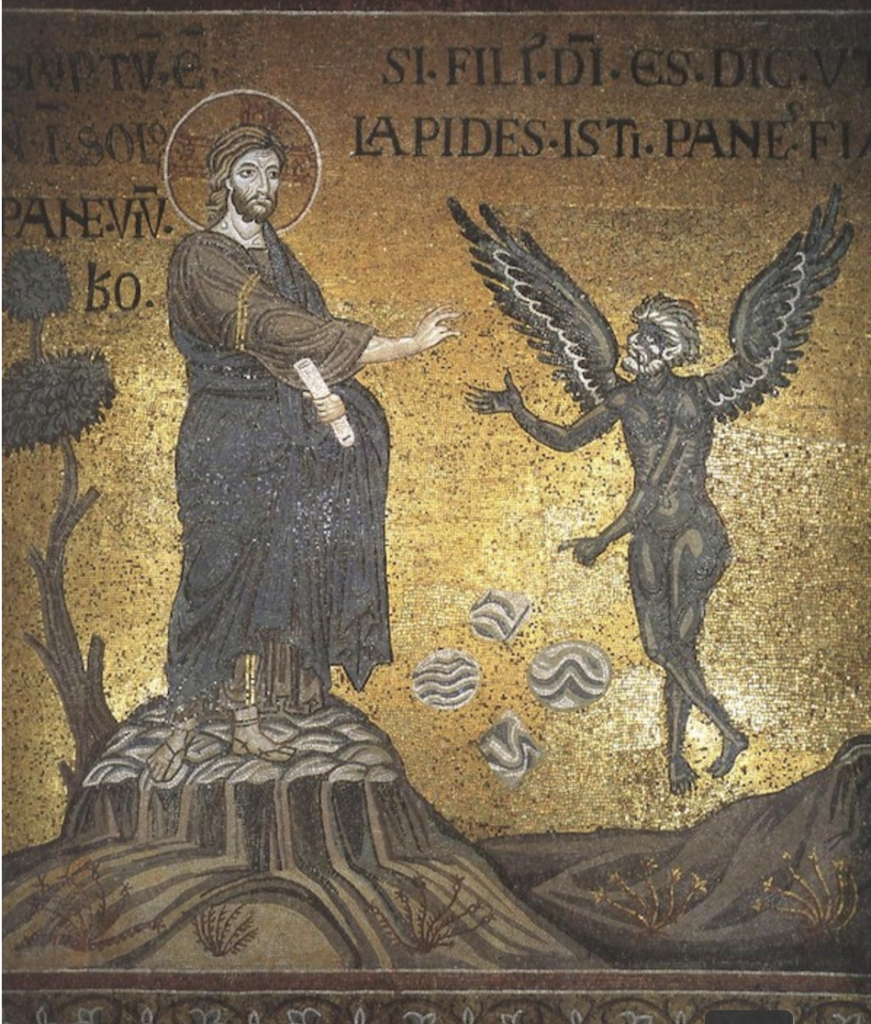
Jesus is tempted in the desert

In addition to the detailed reports of Jesus’ doings which she received from the angels, the Blessed Virgin was also able to witness in visions all the most important incidents of His public life, no matter where He was. Thus she saw Him being baptized by John and then go up into the mountainous desert and begin His forty days’ fast.

Mary entered her little oratory and began to pray and fast with her Son, imitating and cooperating with Him in His work for mankind. After forty days of uninterrupted prayer and fasting, she witnessed the threefold temptation of Christ by Satan, and from her retreat she likewise entered into conflict with the Tempter. When she saw the devil carrying Jesus from place to place she wept, but soon she rejoiced over the victory of the Lord.

Then her angels brought her some of the heavenly food which they administered to Jesus at the same time, and with them came a number of birds that had kept Him company during His fast, and they gathered around her and sang sweetly while she ate the miraculous food, which quickly restored her strength, for Jesus had sent it to her with His blessing.

Catherine Emmerich: Jesus passed through the indescribably beautiful country of Genesareth and by the hot baths of Emmaus. The meadows were covered with very high, thick grass, and on a declivity stood houses and tents between rows of fig trees, date palms, and orange trees. The road was crowded, for a kind of national feast was going on. Men and women in separate groups were playing for wagers, the prize consisting of fruit.

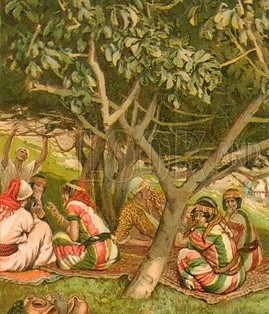
There Jesus saw Nathanael, standing among the men under a fig tree. Just at the moment when Nathanael was struggling against a sensual temptation that had seized him and was glancing over at the women’s game, Jesus passed and cast upon him a warning look.

Without knowing Jesus, Nathanael was deeply moved by His glance, and thought: ‘That man has a sharp eye.” He felt that Jesus was more than an ordinary man. He became conscious of his guilt, entered into himself, overcame the temptation, and from that time kept a stricter guard over his senses.

Nathanael under the fig tree
Jesus chooses John and James

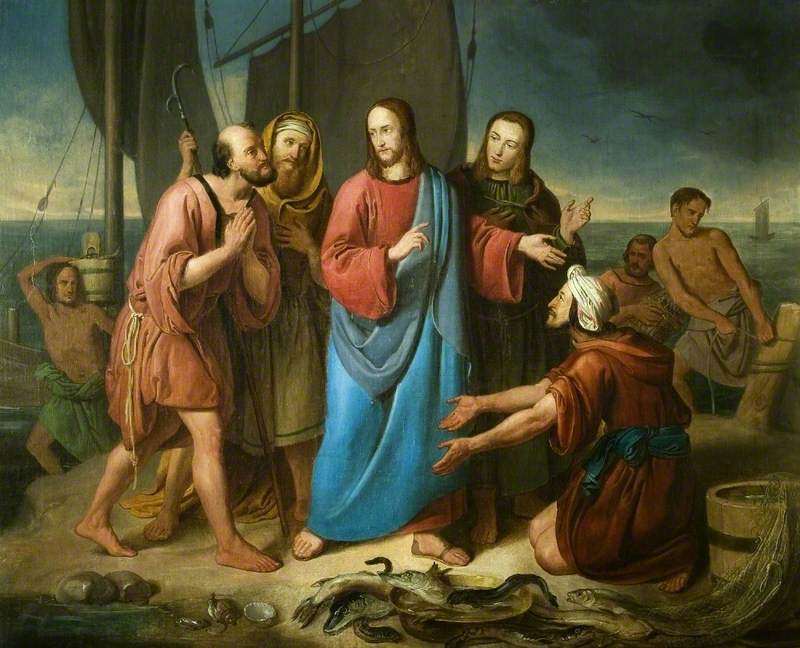
Maria Valtorta: Jesus is walking along the green strip of vegetation that borders the Jordan. When He reaches the ford, He meets a group of men, who are discussing animatedly. Among them are John, and James. John is the first to see Jesus and points Him out to his brother and companions.  He shouts: “Lamb of God, who takes away the sins of the world!” Jesus looks at him. Jesus with His serious, scrutinizing look, John with his pure eyes smiling in his beautiful, youthful face. He is about twenty years old and on his rosy cheeks there is only the sign of a blond hair.

“Who are you looking for?” asks Jesus. “For You, Master.” “How do you know I am a Master?” “The Baptist told me.” “Well then, why do you call Me a Lamb?” “Because I heard him call you just over a month  ago.” “What do you want from Me?” “I want You to tell us the words of eternal life.” “Who are you?”

“I am John of Zebedee. This is James, my brother. We are fishermen. We are also disciples of John. He spoke words of life to us, and we listened to him.  You are the Messiah. John said so, because he saw the sign of the Dove descending on You. We no longer have anyone who may guide us.” “Where is John?”

“Herod had taken him. He is in prison.” “Let us come with you, Master. Show us where you live.” “Come. But who follows Me will have to leave everything, his home, his relatives, his way of thinking, also his life. I have neither wealth nor protection. I have nowhere to rest my head. I will be persecuted by My enemies. My doctrine is not concerned so much with exterior matters, as it is with the soul. You must be reborn if you want to be My disciples. Are you willing to do that?” “Yes, Master. Only You have words that can give us light.” “Come, then. Let us go. I will teach you.”
Jesus Calling His First Disciples
by Adam Brenner
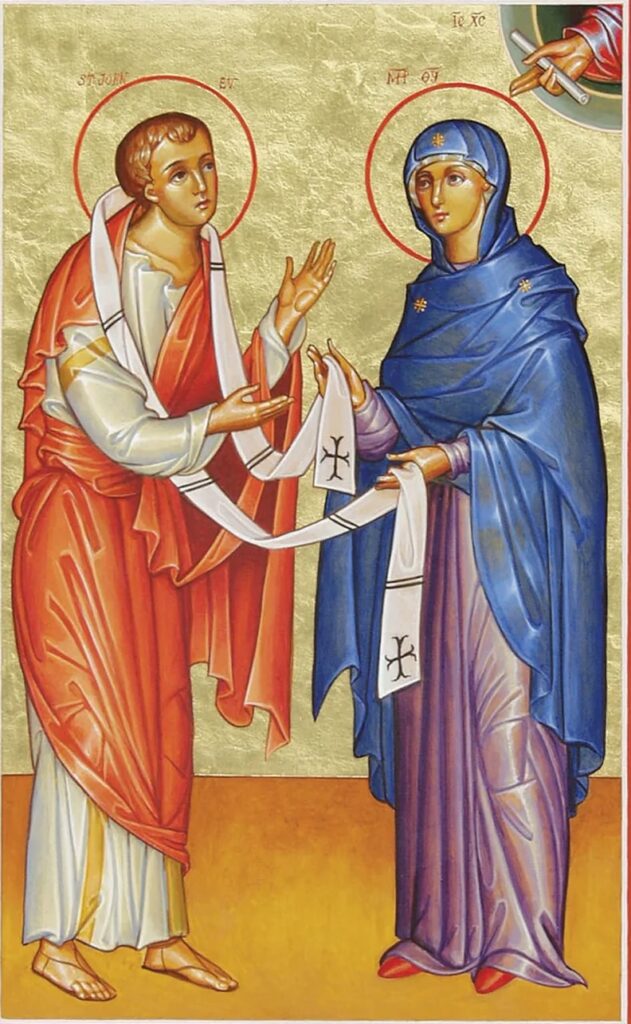
Mary vesting Saint John

Mary of Agreda:   When she saw Jesus call to His service His first Apostles, Andrew, John, Peter, Philip and Nathanael, Mary accepted them as her spiritual children in the Lord and prayed fervently for them. At the very first words of the Master concerning Mary, St. John conceived a holy love and esteem for her. 

The profound humility and reverence with which the Blessed Virgin received her Son filled the disciples with new devotion and awe for their Master. They immediately knelt before her and begged her to accept them as her sons and servants. St. John was the first to do this, and Mary welcomed him with special love, because of his extraordinary purity and humility. 

That night after the disciples had retired, Jesus prayed with His Mother in her oratory, as formerly, and He spoke to her about the Mystery of Baptism. Because He had already promised her that she would be baptized, she now asked Him whether He would administer the Sacrament to her Himself.

Then, in the presence of a multitude of visible angels, Jesus baptized His Immaculate Mother, and immediately the Voice of the eternal Father was heard saying: “Mary, My Daughter and My Spouse, offer your Son to Me as a sacrifice.”

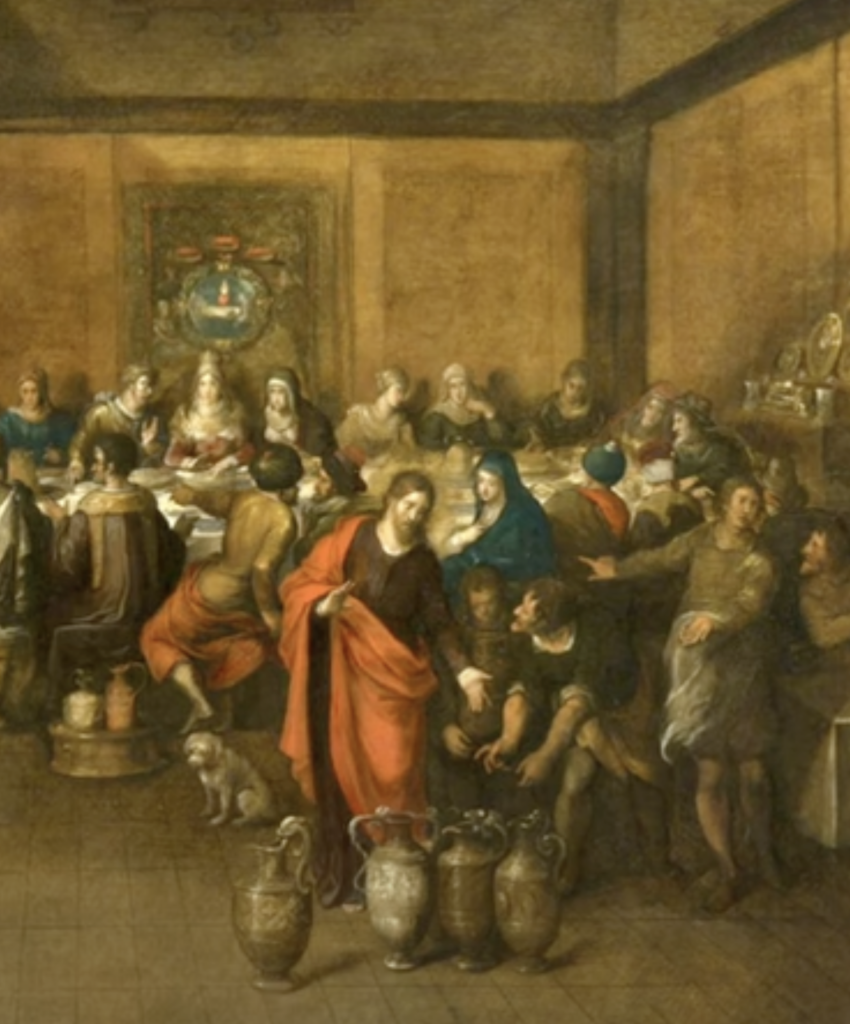
Saint Brigid of Sweden: Jesus wished to begin His public ministry by sanctifying and blessing the institution of marriage.  At the wedding feast at Cana the bridegroom in a competition won an exotic fruit.  Jesus spoke about marriage, chastity, and the hundredfold fruit which purity produces. The young man was stirred to the depths of his soul. He turned pale and, without anyone noticing it, he underwent a mystical purification in which he was supernaturally liberated from the unclean lusts of the flesh. At the same time the bride, who was sitting among the women at some distance, had a fainting spell and experienced something similar.

As the second course, consisting of bird meat, fish, honey, fruit and pastry was being served, Mary noticed that there was no more wine. She therefore immediately went to Jesus, who was instructing the guests, and whispered to Him: “They have no wine.” She also reminded Him that He had promised to supply the wine. The divine Saviour, who had just been speaking of His heavenly Father, replied aloud, with calm and loving, yet impersonal majesty: “What is that to you and to Me, woman? My hour has not yet come.” Then Mary understood that Jesus was waiting for His Eternal Father’s permission to perform His first great public miracle. Feeling entirely relieved of her anxiety for the guests and trusting that Almighty God would reveal the Lord’s power at the right moment, she went to the worried servants and said to them with quiet modesty and confidence: “Do whatever He tells you.” 

Changing the water into wine

Jesus said to the waiters: “Fill the jars with water.” When the six jars, filled to the brim with water, were brought back from the well in a nearby cellar, Jesus arose, went to them, and blessed them. Then, returning to His seat at the table, He said to the servants: “Draw out now and take to the chief steward.” The men did as He commanded. When the chief steward, who had been absent from the hall momentarily and did not know where they had obtained the wine, drank what St. John, an eyewitness, called “the water after it had become wine,” he went to the bridegroom and exclaimed in surprise: “Every man first sets forth the good wine, and when they have drunk freely, then that which is poorer in quality. But you have kept the good wine until now!”

When the bridegroom and the bride’s father tasted the miraculous wine, they too were amazed, for the servants were insisting that they had just filled the jars with nothing but water from the well. Then all the guests drank the new wine and fell silent from awe and reverence as they realized that they had indeed witnessed a striking miracle wrought by the Master, Jesus of Nazareth.

Maria Valtorta: Jesus enters the Temple. The atmosphere of a holy place has been destroyed. Some contract for lambs, shouting, and cursing because of the extortionate prices. There are blows with cudgels, bleating, curses, shouts, insults to the boys, who are not prompt in selecting animals, abuses to the purchasers, who haggle over prices, and graver insults to those who wisely brought their own lambs. The Temple functioned as a stock exchange or black market.

A rabbi asks Jesus, “Are you a scholar?” “Yes, I am.” “What do You teach?” “This I teach: to make the House of God, a house of Prayer and not an usury or market place.” Jesus is formidable. He looks like the archangel posted on the threshold of Eden. The beams from His eyes strike the impious mockers like lightning.  He scatters the coins; He turns over the benches. He snatches ropes from the stable boys, and makes a very hard lash. He lifts it, and strikes mercilessly with it. The unforeseen storm hits heads, and backs.  Pharisees and rabbis ask, “Who are You? How dare You do that? ”

“I am who is Mighty. I can do anything. Destroy this Temple, and I will raise it to give praise to God.”

Christ Driving the Money Changers from the Temple
Benvenuto Tisi da Garofalo
(c.1481–1559)
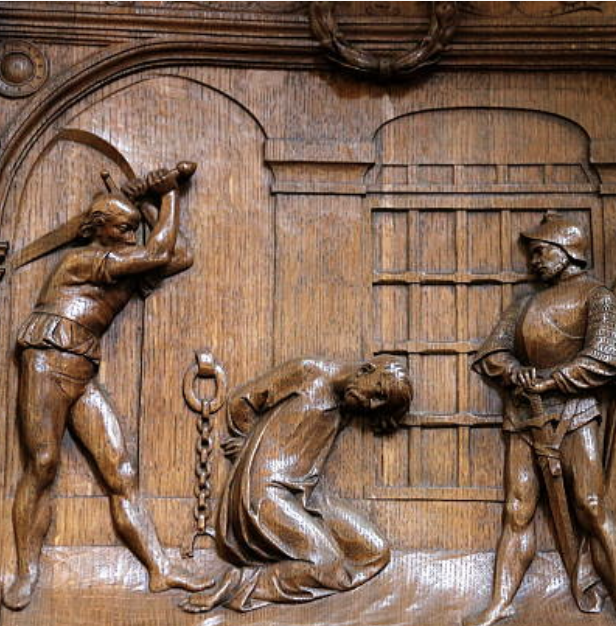
Basilica of St Denis, Stalls of the Goillon s Chapel (beginning of the 16th century), Depiction of John the baptist beheading

Bridget of Sweden: During the imprisonment of John the Baptist, the Blessed Virgin frequently sent her angels to comfort him and to bring him food. And when the day of his martyrdom came, she asked Jesus to help His Forerunner. The Saviour promised to do so, and took Mary with Him to John’s prison cell by an invisible flight.

They found the Baptist chained and lying on the ground, severely wounded from three cruel beatings. Jesus said to him: “John, My servant, I offer your life to the Eternal Father in order that Mine may still be prolonged.” John replied with humble fervor and love: “My Lord, I am altogether unworthy of this new blessing..”

At that moment several soldiers and executioners entered the cell. St. John the Baptist faced them and said: “I am ready.” And while he knelt in prayer, they quickly cut off his head, in the invisible presence of his Lord and the Mother of God, who offered this holy victim to the Eternal Father.

Mary of Agreda: The Evangelists did not think it proper to speak of the hidden miracle by which Mary was enabled to be present at the Transfiguration. For the purpose of recording this event here, I was given to understand that at the same time in which some of the holy angels were commissioned to bring the souls of Moses and Elias from their abode, others of  her own guard carried the heavenly Lady to Mount Tabor.

She considered how her eyes had seen refulgent in glory that same bodily substance, which had been formed of her blood, carried in her womb and nursed at her breast; how she had with her own ears heard the voice of the eternal Father acknowledge her Son as His own and appoint Him as the Teacher of all the human race.

With her holy angels she composed new canticles to celebrate an event so full of festive joy for her soul and for the most sacred humanity of her Son. 

The Transfiguration by George Tissot

Closing Credits:

In The Life of Our Lady part 2

Elizabeth of Schonau was Jackie Larner
Bridget of Sweden – Harriet Cornwall
Mary of Agreda – Penelope Dent
Catherine Emmerich – Suzie Rees
And Maria Valtorta – Alice Craigmyle
The lutanist was Augustin Cornwall Irving
and the guitarist Harry Long.
Hospitality was provided by Dave Minto and Harry Long
And the director was Shaun MacLoughlin

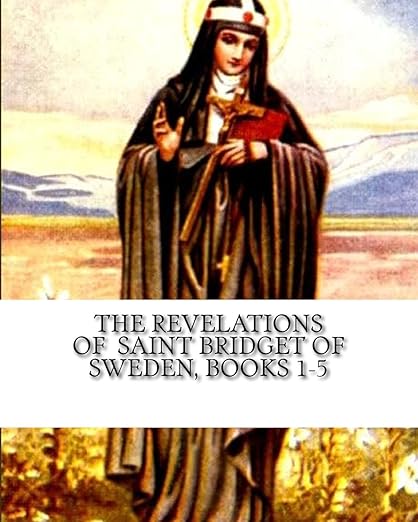
If you would like to know more about meditation we recommend the following books.  Should you consider buying any of them, we would be grateful if you would do so here, please. The commission will help us to maintain and develop the website.