Inspired by:

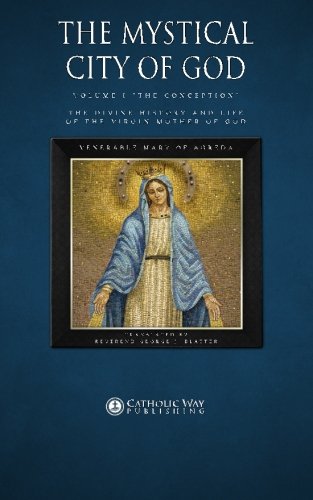
1. "The Mystical City of God" by the Venerable Mary of Agreda

2. "The Poem of the Man God" by Maria Valtorta

3. "The Life of Mary as Seen by the Mystics" with writings by Blessed Catherine Emmerich, St. Elizabeth of Schönau and St. Bridget of Sweden.

4. and an excerpt from "The Protoevangelium of James"

PART 1: FROM MARY'S CONCEPTION TO THE NATIVITY

(BRING UP LA PALOMA ON GUITAR AND TAKE DOWN AGAIN)

Narrator: We present the Life of Our Lady compiled from the visions of Saint Elizabeth of Schonau, Saint Bridget of Sweden, the Venerable Mary of Agreda, Blessed Catherine Emmerich and Maria Valtorta.

(BRING UP LA PALOMA ON GUITAR AND TAKE DOWN AGAIN)

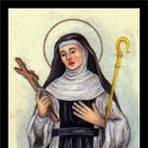
Narrator: Mary of Agreda (1602 – 1665) was a Spanish Franciscan abbess and spiritual writer, known for reports of her bilocation between Spain and its colonies in New Spain. She was a noted mystic of her era.

She wrote 14 books, including a series of revelations about the life of the Blessed Virgin Mary. Her bilocation activity is said to have occurred between her cloistered monastery in rural Spain and the Jumano Indians of central New Mexico and West Texas, as well as Tucson.

She inspired many Franciscan missionaries in the New World. In popular culture since the 17th century, she has been dubbed the Lady in Blue and the Blue Nun, after the color of her order’s habit.

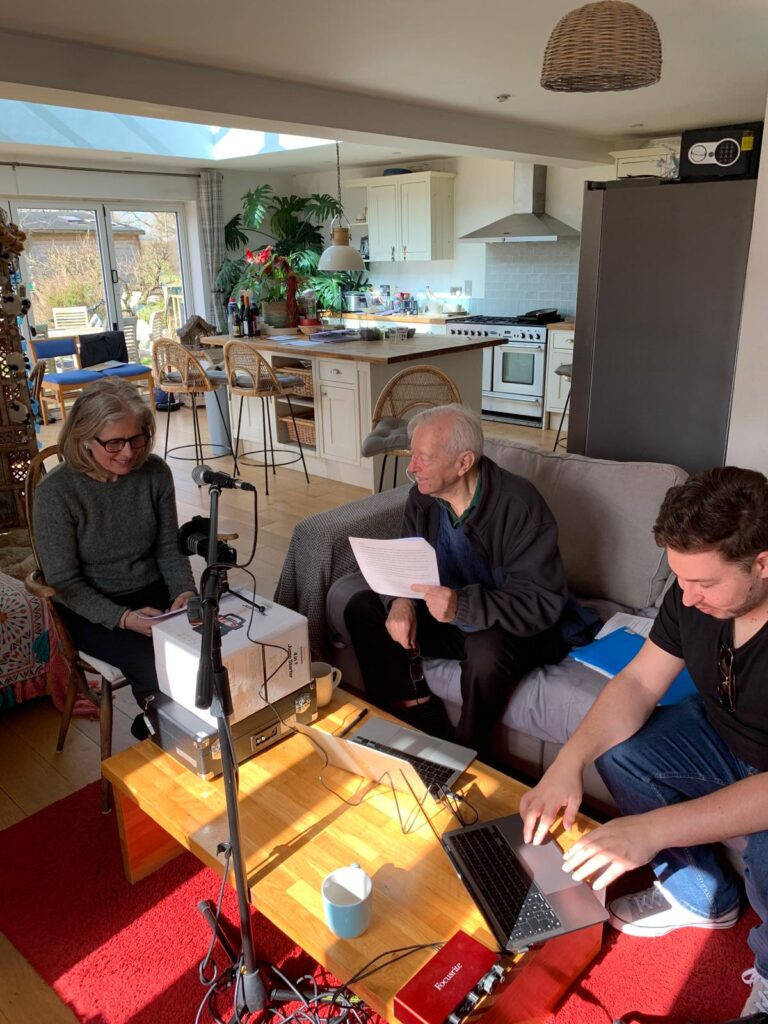
Penelope Dent reading Mary of Agreda with Shaun MacLoughlin introducing and producing and Harry Long recording.
Photo and hospitality by Dave Minto.
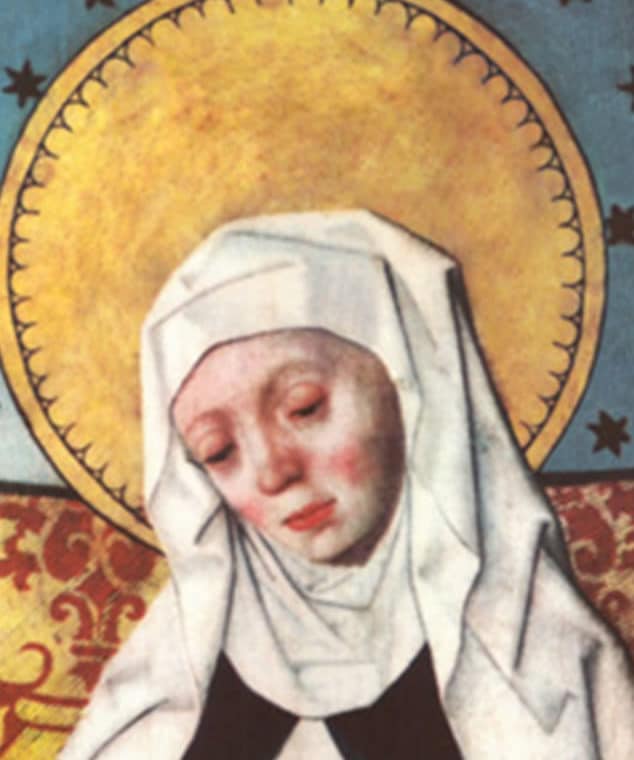
Carmelite Prioress (1602-1665)

(BRING UP LA PALOMA ON GUITAR AND TAKE DOWN AGAIN)

Firstly God the Father created His son and from their love proceeded the Holy Spirit. Secondly He created Mary, the mother of His Son. Thirdly He create an abode, where the incarnate Word and his Mother should converse and dwell.

For them primarily did He create the heaven and earth with its stars and elements. He created the sun to be a symbol of the power of the Son and the moon to be a symbol of the beauty of Our Lady. He created the rest of the beings to be subservient to them. He created Adam similar in body and soul to Christ and Eve similar to Mary in figure and appearance.

Then many years after the Fall when, thanks to Satan, pride reigned supreme and fools had become innumerable, the Most High sent into the world two luminaries: Saints Joachim and Anne.

(BRING UP THE PRAYER BY ANDREA BOCELLI, TRANSPOSED TO GUITAR BY HARRY LONG, AND TAKE UNDER) 

Narrator: Maria Valtorta (1897 – 1961) was an Italian writer and Franciscan tertiary , who reported personal conversations with and dictations from Christ. She lived much of her life bedridden in Viareggio in Tuscany, where she died. She is best known for her 5,000 page book  The Poem of the Man-God.

During the First World War she had volunteered as a Samaritan nurse, caring for wounded soldiers.
In March 1920, when she was 23 years old, the delinquent son of her mother’s dress maker (who was a fascist socialist) struck her in the back with an iron bar and shouted a slogan against the wealthy and the bourgeoisie.

As a result of the injury, she was confined to bed for a few months and although she seemed to have recovered, the complications from that incident eventually confined her to bed for 28 years, from April 1934 to the end of her life.

(BRING UP THE PRAYER AND TAKE UNDER) 

Joachim, like Solomon used to sing the praise of wisdom, such as: “It is her that I loved and sought from childhood. I have decided to make her my bride.”

Alice Craigmyle reading Maria Valtorta

Anne, the daughter of Aaron, had a heart full of all the kindness of wisdom, like a bouquet of flowers spreading their fragrance. They loved each other with a holy love. But there was one thing lacking. Anne had not yet become a mother. Even though they had grown old, to Joachim she was still his young bride. And her love for him was always as intense as a blazing fire.  

They went to the Temple to pray together. They were dreaming about a child, and what did they receive? They got the Mother of God!  In the course of time, the eternal wisdom descended into into her. The breath of the power of God and the sacred transmission of the greatness of God became the Word in the barren one.

Saint Joachim

In the Temple Anne saw a spark emanating from a light. The whiteness of the moon and the brightness  of all the gems and emeralds came together in the form of a star, from the other side of the curtain. And as it came it sung: “let what you have asked come onto you.”  Anne then said: “I am beginning to think that the child will be a girl.”

Mary of Agreda: The Angel Gabriel announced, “Love has softened the heart of the Almighty. He wishes to enrich your  family with a daughter. The Lord has chosen for her the name of Mary. From her childhood let her be consecrated to the Temple.”

Saint Anne

Narrator: Catherine Emmerich (1774 – 1824) was an Augustinian canonist, born in Westphalia, Germany.  During her lifetime she was a purported mystic Marion visionary and stigmatist. For many years she was bedridden.

The poet Clemens Brentano wrote several pages based on the notes of her visions.  Pope John Paul II beatified her in 2004, highlighting her personal virtues and Catholic piety.

Venerable Catherine Emmerich
(1774-1824)

Catherine Emmerich: I saw Joachim and Anne embrace each other in ecstasy. They were surrounded by hosts of angels, some floating over them carrying a luminous tower like that which we see in the pictures of the Litany of Loretto. The tower vanished between Joachim and Anne, both of whom were encompassed by brilliant light and glory. At the same moment the heavens above them opened, and I saw the joy of the Most Holy Trinity and of the angels over the Conception of Mary. Both Joachim and Anne were in a supernatural state. I learned that, at the moment in which they embraced and the light shone around them, the Immaculate Conception of Mary was accomplished. 

Narrator:  Saint Bridget of Sweden (c. 1303 – 1374) was a Catholic mystic and the founder of the Bridgettines. She is one of the six patron Saints of Europe. At the age of 13 she married Ulf Gudmarsson, to whom she bore eight children. After her husband died she devoted herself to a life of prayer and caring for the poor and the sick. Her records of her celestial revelations were translated into Latin and acquired a great vogue during the Middle Ages.

Harriet Cornwall reading St. Bridget of Sweden

Bridget of Sweden: The Blessed Virgin said: “I was conceived without Original Sin. A golden hour was my conception. My Son joined my father and my mother in a marriage of such chastity that a purer union has never been seen. Sensuality was extinguished in them. Thus my flesh was formed through divine charity.” After God had created Mary’s immaculate soul, He showed it to the choirs of angels in Heaven, and they felt intense joy upon seeing its unique beauty. Then, as Mary’s soul was infused into her body, her holy mother St. Ann was filled with the Holy Ghost and experienced an extraordinary devotion and happiness. Throughout the rest of her life and especially during the next nine months, she constantly received new graces and enlightenment concerning the great mystery of the Incarnation, and she frequently praised the Lord in canticles of love.

Saint Bridget of Sweden
(c 1303-1373)

At the time of the Conception of her Daughter, Anne was forty-four years old, and Joachim sixty-six.

Valtorta: “I, who am her blessed mother, rejoice.” As she speaks these words, Anne’s beauty increases. She becomes brighter, as if the soft light of the moon enters a huge furnace. And a rainbow is seen in its magnificence. It is as if it has enveloped the whole of Israel in a circle.

Saint Anne pregnant with Mary

‘On earth’, reports Agreda, ‘the Word has a mother without a father, just as in heaven He has a father without a mother.’ Within the womb Mary already possesses the virtues of faith, hope and charity and there she prostrates herself before the Almighty.

Satan inspires both neighbours and a servant to furiously attack Anne, but to no avail. Anne simply responds sweetly.

So Mary is born pure and stainless, beautiful and full of grace, demonstrating that she is free from the tribute of sin. Meanwhile God also creates a new heaven, as an eternal abode for Mary and Her Son.

Anne, Joachim and Mary

Behold! Women are bringing an infant covered in swaddling clothes! That is Mary. Her head is ivory colored, having a tint of light rose shade. Her lips, which are light red are in the natural sucking pose. Her mouth is so small that one wonders how she would drink milk. Beautifully rounded cheeks. And between them the pretty nose. The tiny eyes are two bluish dots seeming to be two pieces of the blue sky; attractive eyelashes; golden hair having a touch of red on a well- rounded head, the color of a certain honey.

The sovereign child was treated like other children of her age. Her nourishment was of the usual kind, though less in quantity; and so was her sleep, although her parents were solicitous that she take more sleep. She was not troublesome, nor did she ever cry for mere annoyance, as is done by other children; but she was most amiable and caused no trouble to anybody. That she did not act in this regard as other children caused no wonder; for she often wept and sighed (as far as her age and her dignity of Queen and Mistress would permit) for the sins of the world and for its Redemption through the coming of the Saviour.

Mary grew giving much joy to her aged parents. She possessed an immaculate heart, like that of a dove. With a bunch of flowers plucked from the field, she runs to her mother. She makes up a story for each flower. ‘This big flower is a star descended from Heaven; it has brought a kiss for the mother, from the Lord. This other one is blue, like the eyes of the Father. On its petal is written that “The Lord loves the father very much, because father is a good person.”

Do you see these red flowers? They are the pieces of cloth from the dress of David. The red flowers have originated from the clothes having blood stains from the passion of the Lord. This white flower is like soft silk; its seven cups filled with fragrance are raised to the sky. This has been made out of the clothes of Solomon. He walked wearing very precious clothes in front of the Ark of the Covenant, and the Tent of Witness. While walking, he, out of joy, sang hymns of praise and songs of joy. Like this flower I wish to spend my whole life before the tent singing hymns of praise and songs of joy.’

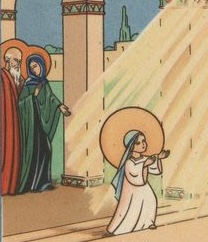
As the time approached when Mary was taken to the temple Saint Anne taught her various prayers and rules of religion. She already knew how to read. Although only 3½ she seemed like a girl of 5 or 6.

Three old priests came to Nazareth. The oldest asked, “Your father and mother promised that you would give up wine, vinegar, grapes and figs. What other sacrifice do you wish to add? Mary decided to give up fish and meat and milk and all fruits except berries. She also wished to sleep on the floor and to get up and pray three times every night. The priest insisted that she should pray only once during the night, like the other girls and that she should eat fish on all the great feast days.

One morning at dawn two donkeys were loaded with baggage and Saints Joachim and Anne set out, carrying Mary in her arms. Arrived in the Holy City they stayed with Zacharias the priest, the future father of John the Baptist. A great feast was held. Among those present was a 10-year-old girl, later to be known as Saint Veronica.

The Protoevangelium of James, an ancient text from the year 145, provides a story that is a primary basis for the feast of the Presentation of Mary:

And the child was two years old, and Joachim said: Let us take her up to the Temple of the Lord, that we may pay the vow that we have vowed, lest perchance the Lord send to us, and our offering be not received. And Anna said: Let us wait for the third year, in order that the child may not seek for father or mother.

And Joachim said: So let us wait. And the child was three years old…And the priest received her, and kissed her, and blessed her, saying: The Lord has magnified your name in all generations. In you, on the last of the days, the Lord will manifest His redemption to the sons of Israel. And he set her down upon the third step of the altar, and the Lord God sent grace upon her; and she danced with her feet, and all the house of Israel loved her.

And her parents went down marveling, and praising the Lord God, because the child had not turned back. And Mary was in the Temple of the Lord as if she were a dove that dwelt there, and she received food from the hand of an angel.

Zacharias tells Joachim and Anne not to be sad. “Your sorrow which does not shake your faith, actually teaches me how to love the Almighty. Be courageous. The Prophetess Anna will take care, and protect this flower blossomed in the tribe of David and Aaron. She is the one and only Lily from the holy tribe of David present among those in the Temple. She will be protected like a royal pearl.

Before entering the temple, Mary, kneeling and stretching her hand says, “Father, Mother, give me your blessings.” She does not cry. She is a brave girl; but the feeling of pain is reflected in her eyes. The very same face will be seen at Calvary and the tomb.

A solemn, royal procession with bugles and clouds of incense is moving towards the door. The chief priest looks at the little girl and smiles and blesses her. Has the temple ever received a victim of sacrifice more immaculate than this?

In the temple a priest clipped a few locks of her hair; and the young girls with her sang from Psalm 44: “Thou art beautiful … therefore has God blessed thee forever.” Then two priests led her up to the gallery from which the Holy Place could be seen. They put a brown veil over her head and read prayers to her, while incense was burnt on an altar. They conducted her to a hall, where ten girls welcomed her by throwing flowers before her. Having said goodbye to her parents, she proclaimed: “the Ark of the Covenant is now in the Temple.” And so she kneeled humbly before her teacher, the Prophetess Anna, and asked for her blessing.

Mary’s room was high up with a view over the holy place. It was very plain, it’s only furniture being a lamp, a round table and a rolled up carpet for her bed. Then the holy child solemnly made the vow of chastity before God; and renounced all affection for created things.

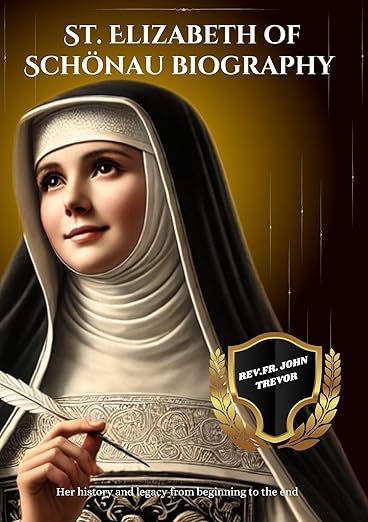
Narrator: Elizabeth of Schönau (1126 –  1164) was a German Benedictine visionary.  She reportedly experienced numerous religious visions, for which she became widely sought after by many powerful men as far away as France and England.  In the years 1147 to 1152 she suffered recurrent disease, anxiety and depression as a result of her strict asceticism. Her contemporary Hildegard of Bingen admonished her to be prudent in the ascetic life.

In 1152 Elizabeth began to experience ecstatic visions. Christ, the Virgin Mary, an angel or the special saint of the day, would appear to her and instruct her; and she recorded what she heard on wax tablets.

Mary told me of her time in the temple. She said: “I always used to rise in the middle of the night, and with much longing and love, I used to pray 7 petitions:

  1. that I love God with all my heart.
  2. that I love my neighbor according to His Will.
  3. that He make me hate and flee all that He hates.
  4. for humility, patience, kindness and gentleness.
  5. that He should let me see the holy virgin who was to give birth to the Son of God. (not realizing it would be herself)
  6. for the grace of obeying the High Priest of the Temple.
  7. that God should preserve the Temple (His Church) and all His people.
Saint Elizabeth of Schönau
(c 1129-1164)
Saint Bridget in the religious habit of a Bridgettine nun, in a 1476 breviary

Bridget of Sweden: Mary asked for a rule of life. Anna consulted the old priest and summoned Mary, who remained on her knees throughout the interview. The priest said  “pray always for the Temple of the Lord, for his people and for the coming of the Messiah. Retire to sleep at 8 o’clock and rise at dawn to praise the Lord until 9. During the day engage in manual work and study the Scriptures, take exercise before meals.  In all things become humble, courteous and obedient.

Through the years she grew in wisdom and grace and infused mystical knowledge. She often asked profound, penetrating questions of her angels. Often during her 10 years in the temple she would meditate on prophecies of Christ in the old Testament. After the death of Joachim the Lord hid himself from Mary. He allowed Satan to try her in order to increase her merit and reward. In vain he tempted her to commit even the slightest venial sin. He incited others to persecute her. Other girls became inflamed with envy against her and accused her falsely.  Eventually Anna and the priests realized what was happening and ceased to judge her.

As her mother Anne, was dying she said, “do not leave the temple before choosing your state of life with the advice of the priests. Pray that if it is God’s will to give you a husband that he may be of the race of David.

Maria Valtorta: Mary is sewing, sitting in her small room. She appears to be about 12 years old. Her  childish round face has changed to a long face, similar to that of grown-ups, indicating maturity and thought. Her golden curly hair, which was falling to her shoulders, is now braided in two strands on her back, which reaches to her waist. 

Anna enters the room and asks Mary if she was praying. Mary says; “Yes. I have no feeling that I am alone. Look! Beyond the double curtain having a mixed colour of gold and white, there is the most holy place, looked at only by the Chief Priest; yet I gaze at the altar of atonement and sacrifice. Beyond the curtain I see a tent, in which I see my heart. God in His glory shines there. He says to me ‘I love you, I love you.’  Even though I’m with you Anna, this ball of fire, encircling me, separates me from you. In this circle there is only God and me. I see you through the fire of God. Therefore I love you, but I cannot love anyone with a natural love. 

The law of Israel stipulates that all girls should become wives and mothers. When I obey this law, I must also obey the voice that whispers to me. I must live as a virgin.

The Prophetess Anna
Joseph, from the age of 12 had made and kept a vow of chastity; and his purity of soul, which was known to all, was that of an angel.

Mary of Agreda:

When Mary reached the age of 13½ God in a vision commanded her to enter the state of matrimony. Because of her intense love of chastity and her vow of virginity, this divine order meant to her a sacrifice as painful as that of Abraham, when God commanded him to offer up his son’s life.

Meanwhile the Lord spoke in sleep to Saint Simeon, the high priest and commanded him to arrange the marriage of Mary. After consulting together the priests appointed a day, in which all the bachelors of the line of David, which was also Mary’s, were to assemble in the temple. God appeared to Mary and said: “My dove, let not thy heart to be sad or disturbed. I will guide the priests by My light and I will give thee a husband, who will not hinder thy holy desires.”

This good man, who God found worthy of becoming Mary’s husband and the foster father of the Word Incarnate and who is now honoured and loved throughout the world, as Saint Joseph the Protector of the Universal Church, was at this time a humble, unmarried carpenter, who worked for a master in a small town in Galilee.

Elizabeth of Schönau: The high priest gave to each of the suitors a dry branch and announced that they were all to pray that the Lord might single out the one who He had chosen as Mary’s spouse. Joseph considered himself unworthy of such a blessing and remembering his vow of chastity, he resigned himself entirely to the will of God.

All of a sudden his branch blossomed  into a white, lily like flower and at the same time a dove of the purist, most dazzling white descended and arrested on his head for a moment, during which God said in his heart: “Joseph my servant, Mary shall be thy spouse. Receive her with all care. Thou shalt perform all that she shall ask.”

The wedding ceremony took place in a rented house on Mount Zion. Mary’s teachers and friends and relatives prepared for her a lovely blue wedding gown, though in her humility she hesitated to accept it. Saint Joseph wore a plain long robe.

Mary and Joseph's wedding

Maria Valtorta: Mary’s friends and the teachers are happy. Elizabeth is also with them. Dressed in the clothes of a bride, Mary is very beautiful. The holy bridegroom arrives in the company of Zachariah. He holds a bunch of myrtle flowers. “Peace be with you my bride.” Saying this he hands over the bunch of flowers to her. He continues: “I am a worker without education and wealth, but I offer you my treasure. This is my complete detachment. In order to stand beside you, God’s virgin, I give this to you forever.”

The Chief Priest arrives. Holding the right hand of the bride together with the right hand of the bridegroom, he solemnly blesses them, “May the God of Abraham, Isaac and Jacob be with you. May he unite you and fulfill his blessing in you.”

Jesus says, “it is not with human knowledge that Joseph viewed the mystery of virginity. He viewed it with wisdom beyond nature. Like the guardian angel of Paradise, Joseph was the guardian of the Holy Ark of God.”

Mary of Agreda:

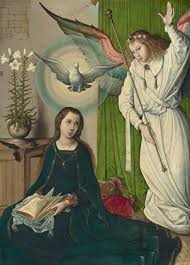
Prince Gabriel, obeying with singular delight the divine command and accompanied by many thousands of most beautiful, angels descended from the highest heaven. The heavenly mistress was at this time 14 years old. To look upon her caused feelings at the same time of joy and seriousness, love and reverential fear. The Lord Himself had assured her that His only begotten son would soon descend to assume a human form. In her heart she asked, “Is it possible that the blessed time has arrived, in which the Word of the Eternal Father is to be born and to converse with men?”

Gabriel entered into the chamber where Mary was praying. He bowed before his queen and mistress and greeted her: “Hail Mary, full of grace, the Lord is with thee. Blessed art thou amongst women.”

When she heard that salute she understood that our Lord had chosen her to be his mother. He said to her, “Do not fear for thou has found grace. Thou shalt conceive a son and they name him Jesus. He shall be the Son of the Most High. She replied, “How shall this happen since I know not man?” At the same time she interiorly represented to the Lord her vow of chastity.  Gabriel replied, “It is easy for the Divine Power to make thee a mother without the cooperation of men; and behold your cousin Elizabeth has likewise conceived a son in her sterile years and this is the sixth month of her pregnancy, for nothing is impossible with God.”

Mary said, “Be it done unto me according to thy word”; and her heart was contracted and compressed with such force that it distilled three drops of her most pure blood and these were formed by the power of the Holy Spirit into the body of Christ our Lord.

Elizabeth of Schönau: At times God sent a number of birds to visit his mother, greeting her with lively movements, as if wishing to congratulate her. They divided into harmonious choirs and chirped and sang sweetly for her. They gave her flowers and she told them to praise God.

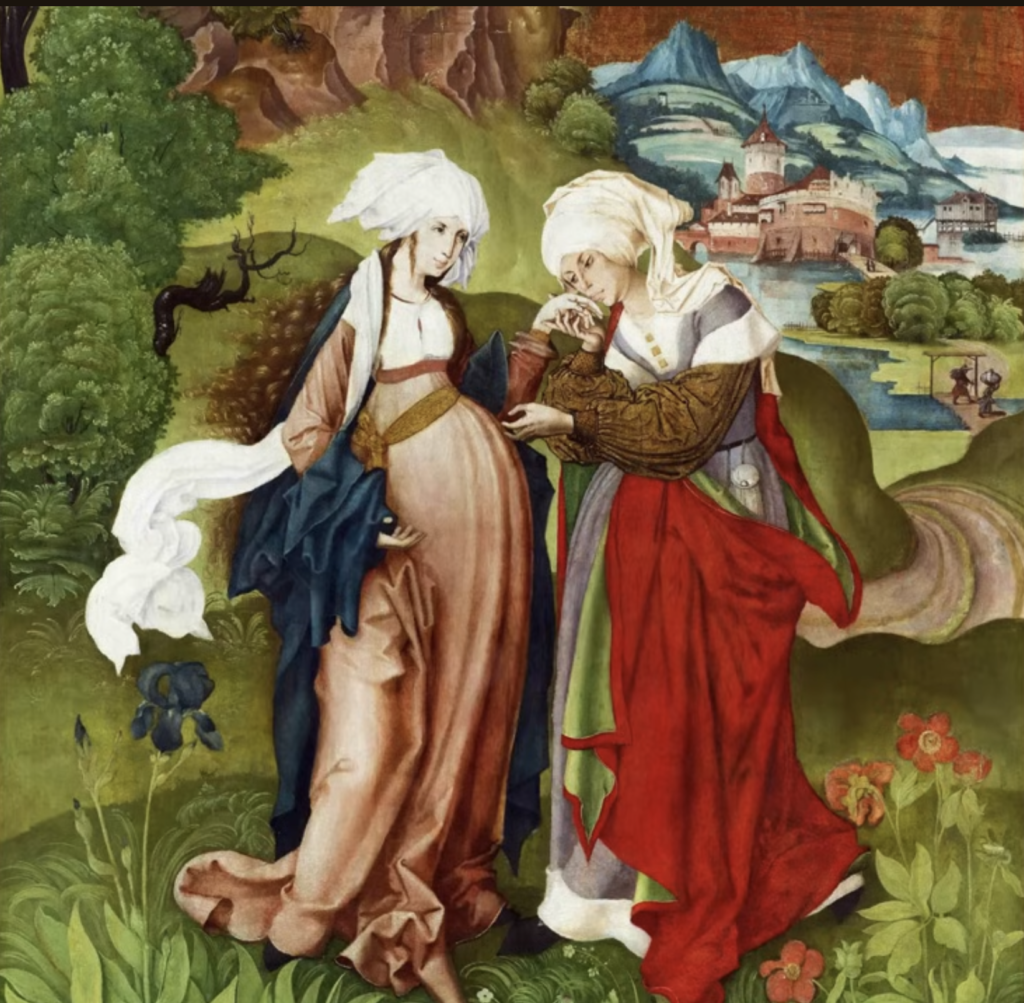
Three days after the Annunciation God revealed to Mary that she should visit her cousin Elizabeth, who was six months pregnant. Joseph agreed and borrowed a donkey and prepared some fruit, bread and a few fishes. During the four day journey, whenever she could, Mary visited the poor and the sick consoling and caring for them. At last the holy couple reached the little village of Ain-Karem in the Judean hills 5 miles west of Jerusalem.  Mary and Elizabeth met near a fountain and clasped hands.

Arrived in her house, the Holy Spirit revealed to Elizabeth the mystery of the incarnation, the unique dignity of Mary and her own son’s sanctification. “Blessed art thou among women and blessed it is the fruit of thy womb. How have I deserved that the mother of my Lord should come to me; for behold the moment that I heard the sound of thy greeting, the baby in my womb left for joy.” Crossing her hands on her breast, Mary intoned the Magnificat in the sweetest and softest voice. Thanks to a divine inspiration Elizabeth was able to recite the magnificat at the same time.

Three days later Joseph returned to his work in Nazareth, while Mary spent three months with her cousin, sewing and preparing swaddling clothes. A few times Elizabeth saw the mother of God in ecstasy, raised above the ground and radiant with supernatural splendour and beauty.

After the birth and circumcision of John the Baptist, Joseph came to fetch Mary and they returned to Nazareth.

Maria Valtorta: As Mary mounted her donkey, Joseph noticed she was pregnant, but he did not say anything.  Mary could see his suffering but was under obedience to remain silent.  She says; “After reaching Nazareth, Joseph bids farewell to me in very few words. In a little time, he had the appearance of a bent old man. He stopped coming to see me in the evenings.”

Elizabeth of Schönau: He even thought he should steal away one night. Mercifully God sent Gabriel to Joseph, while he slept and Joseph awoke with the overwhelming sensation that his wife was the Mother of the Messiah.  After this Joseph was changed spiritually into a new man.

Mary of Agreda: His doubts and anxieties of the past few months had laid in him deep foundations of humility, necessary for one trusted with the highest mysteries of the Lord. The remembrance of his experiences taught him a lesson which lasted all his life.

Elizabeth of Schönau: A Roman edict ordered that all heads of families should register in their native cities. Although she was heavily pregnant, the Lord told Mary: “My dearest dove, accompany Joseph on the journey to Bethlehem. I shall assist you.” They left Nazareth on a cold, wet mid-winter morning. 10,000 dazzling angels, visible only to the Queen, marched with them. The first evening Joseph pitched their tent in a windy uninhabited valley. God miraculously warmed Mary and she placed her hands in her husband’s to share the warmth with him.

Then they climbed through hills to a comfortable inn, and rested on the Sabbath. There Mary instructed children in religion. Next they rested with shepherds, avoiding busy caravan routes. The 5th night in freezing rain a heartless innkeeper turned them away; and Joseph found a shed. 

On the last night before Bethlehem they stayed in a large farmhouse, where the conceited young farmer’s wife was jealous of Mary’s beauty. (30 years later Our Lord found her all bent over and blind and after reproaching her for her vanity and heartlessness, he healed her.)

Maria Valtorta: They meet a Shepherd from whom Joseph takes a bowl of milk and gives it to Mary. He tells them, “It’s difficult to find lodging. Bethlehem is overcrowded. If you can’t find a room at an inn, you can go towards the country, where  there are stables in the mountains. They are used by merchants to keep their animals. They are damp and cold, but they are always a shelter, because your wife can’t be left on the road.” 

The whole day Joseph searched for a house to stay. He implored many people. Eventually they find a little den. Joseph hangs a little lamp on a nail. The vault is covered with cobwebs, the soil is strewn with straw, there is ramshackle earth with holes, rubbish excrement. An ox looks at them with his large quiet eyes. Joseph takes some hay and makes a bed for Mary. “Sleep now,” Joseph says, “tomorrow should be better.”

Joseph and Mary search for an inn

Much time has passed. As if there was a celestial call, Mary lifts her head and sits up. A thin ray of moonlight creeps in through a crack in the vault and falls on Mary’s head. Her hands and face are becoming clear blue, as if they were placed under the glare of a huge pale Sapphire. The vault full of crevices of cobwebs, of protruding rubble, the smoky repellent vault, now seems the ceiling of a royal hall. Each boulder is a block of silver, each crack and opal flash, each cobweb the most precious canopy interwoven with silver and diamonds.

A huge green lizard, hibernating between two stones, seems an emerald jewel forgotten there by a queen. The hay from the manger is no longer grass blades. It is pure silver quivering in the air with the grace of loose hair. The soil is crystal lit up by white light, its protrusions are like roses thrown in homage of the soil. The holes are precious cups from which perfumes and scents arise.

Elizabeth of Schönau: Then, in the twinkling of an eye, the infant God was born, glorious and transfigured as on Mount Thabor. There the God-Man lay, naked, utterly clean and pure. And from Him radiated such marvelous light and splendor that the sun could not be compared to it. The angels could be heard gently singing canticles of wonderful sweetness.

When the holy Mother of God perceived that she had been delivered — for her child came forth without any pain or injury to her — she immediately bowed her head, placed a cloth over His tiny body, and adored Him with the greatest respect and reverence, saying: “Welcome, my God, and my Lord, and my Son!”

Then the divine Child suspended the effects of His transfiguration and assumed the appearance of one capable of suffering. The Babe moved, shivered with cold, and stretching forth His little arms, cried out. Bending down, Mary tenderly clasped Him to her heart and with great joy warmed Him against her cheek and breast, while thousands of angels knelt and adored their incarnate Creator. 

Ukrainian Nativity

Bridget of Sweden: Mary said: “And when I gave birth to Him, I brought Him forth without pain, just as I had also conceived Him with such great joy of soul and body that in my rapture my feet did not feel the ground on which they were standing.

And as He had filled my soul with happiness on entering my body, so did He come forth in such a way that my body and soul exulted with indescribable joy and in such a way that my virginity was not impaired. 

When I looked at the places where the nails would be driven into His hands and feet, how my heart was torn with grief! And when my Son saw the tears in my eyes, He was sad unto death. But when I contemplated the power of His Divinity, I regained confidence, for I knew that it was His Will and that it would be for the good, and I made my whole will conform to His. Thus my happiness was ever mixed with sorrow.

Mary of Agreda: Joseph was wrapped in ecstasy at his first sight of the divine Child in the arms of the Virgin Mother. He kissed His feet in great joy. Then Our Lady placed Jesus in the crib. The humble ox and donkey warmed Him with their breath.
Shepherds in nearby fields were suddenly bathed in the celestial radiance of an angel, who announced: “I bring you tidings of great joy. You shall find the Redeemer Christ, our Lord, in the city of David.  You shall find Him as the Infant wrapped in swaddling-clothes and placed in a manger.” They entered the cave .

Prostrating themselves on the earth they adored the Word made flesh. Not any more as ignorant rustics, but as wise and prudent men they adored Him, acknowledged and magnified Him as true God and man, as Restorer and Redeemer of the human race.

Adoration of the Shepherds by El Greco

(BRING UP “JESU JOY OF MAN’S DESIRING” AND THEN PLAY UNDER THE CLOSING CREDITS)

Closing Credits:

In The Life of Our Lady part 1

Elizabeth of Schonau was Jackie Larner,
Bridget of Sweden was Harriet Cornwall,
Mary of Agreda – Penelope Dent,
Catherine Emmerich – Suzie Rees
and Maria Valtorta – Alice Craigmyle.
The lutanist was Augustin Cornwall-Irving
and the guitarist Harry Long.
Hospitality was provided by Dave Minto and Harry Long
and the director was Shaun MacLoughlin

If you would like to know more we recommend the following books.  Should you consider buying any of them, we would be grateful if you would do so here, please. The commission will help us to maintain and develop the website .