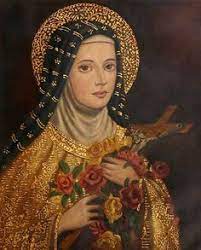
She was born in Avila and entered the Carmelite convent there at the age of 20, not because she was very devout, but because it seemed a sensible thing to do. Carmelite convents were comfortable places. One was well looked after, had much contact with the outside world and could keep one’s own possessions. With time and despite ill health she made great progress in contemplative prayer and had a number of mystical experiences, which she treated with great suspicion. She felt she was not nearly holy enough to be accorded them by God.
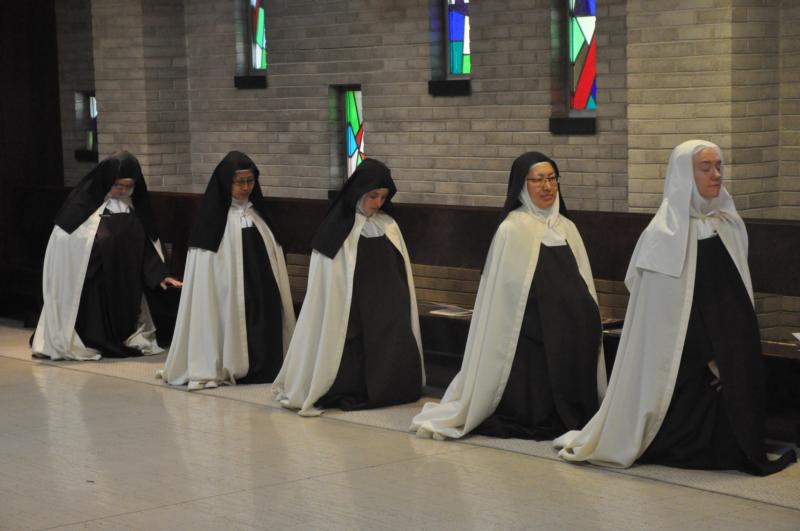
Her prayers led her to seek a more perfect life and in 1562 she founded a convent of Discalced Carmelite nuns. “Discalced” (“shoeless”) signified devotion to poverty. Although she was opposed by unreformed Carmelites, in 1566 the General of the order approved her foundation and committed her to make new ones.
However in 1575 the chapter of the order decided to dissolve them all, and for the next five years every effort was made to destroy her reforms. Many of her followers (including St John of the Cross) were imprisoned and cruelly treated. At length in 1579 and with the help of King Philip II, the Discalced Carmelites were made independent, and Saint Teresa was able to found more new convents. She died worn out by her efforts on the 15th of October 1582
St Teresa is an outstanding example of how the contemplative life can well up and overflow into action. In addition she wrote much on contemplation and her writings are still standard works today. She was declared a Doctor of the Church by Pope Paul VI in 1970.
A favourite story about her illustrates the intimate relationship that the Saints have with God. When she was on one of her innumerable journeys across Spain, a horse threw her as she was crossing a river. Soaked to the skin she looked up to heaven and said, “if this is how you treat your friends no wonder you have so few of them.” We should bring everything to God in prayer, even our reproaches. For reproach, in the end, is simply our way of opening up to God our incomprehension of what He is giving us.
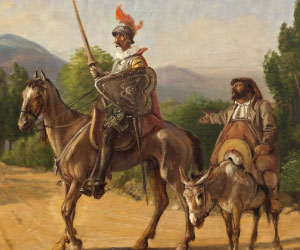
Her autobiography is the story of a most remarkable woman’s entry into the religious life, and at the same time a literary masterpiece. After Don Quixote it is the most widely read prose classic of Spain. It is a piece of candid self-revelation, written in the liveliest conversational prose. The saint herself states that it was composed in the first place at the request of her confessors, who required some account of her rare experiences to be circulated among those religious of a like bent, and who needed it also, in a day when accusations of heresy were frequent, as proof positive of her complete orthodoxy and utter obedience to the teachings and dictates of the Church.
Although she protests that she lacked the time and leisure for her unwelcome task, and that she would have been better employed spinning or doing the household work in her poor convent, she was undoubtedly a born writer to whom words came freely and fast, and who took a craftsman’s delight in them.
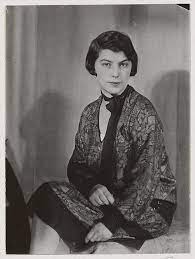
In his preface to the book Andre Maurois wrote: “Marcelle Auclair, the author of Teresa’s most outstanding biography, was a delightful, sparkling woman of many achievements. She strikes one as being nearly as versatile and enterprising is her favourite saint. Though born in France she grew up in Chile, where Spanish ways of life and thought became second nature to her. On her return to France at the age of 20 she married the novelist Jean Prevost, brought up three children, travelled extensively, published several novels and founded and edited Mary Claire , the successful woman’s journal.
All through her life Marcel Auclair assidiously studied the writings of Teresa of Avila. She admired in her an essentially “modern” woman, inventive, practical, gallant and intrepid with tremendous organisational capacities, whose genius permitted her to break through the restrictions of her time. Madame Auclair decided to retranslate the Saint’s writings and to write her life.
With characteristic determination she attempted to obtain the seemingly impossible authorisation from the Holy See to enter the Carmelite cloisters in Spain to gather authentic background material for her projected work. The permission was granted. On her return to Paris she gave up all her professional obligations and for two years virtually went into retreat, devoting her entire time to the accomplishments of what is no doubt the most vivid existing biography of this great saint.

Glory
“On Wednesday, the 28th of March 1515 about half an hour after 5 o’clock in the morning with the first glimmers of the light of day, Teresa my daughter was born”, wrote Don Alonso Sanchez y Cepeda.
All the bells of Avila, San Juan, San Pedro, San Isidro, San Gil, San Vincente, Santiago and many, many, many more churches, monasteries and convents rang out. The old stones gave back the echoes of the bronze voices of all the saints of the city.
The godather, Don Francisco Nuñez Vela, was a man who thought of nothing except going overseas. It was the dawn of a new era. Scarcely 20 years had passed since Christopher Columbus offered King Ferdinand and Queen Isabella the Catholic dominion over a continent. Spain was like a caravel dancing on the open seas; Spanish hearts, looking towards the west where these promised lands blazed in splendour, swelled with a feeling of possession.
Mexico, discovered and conquered by Cortes was named ‘New Spain’.”
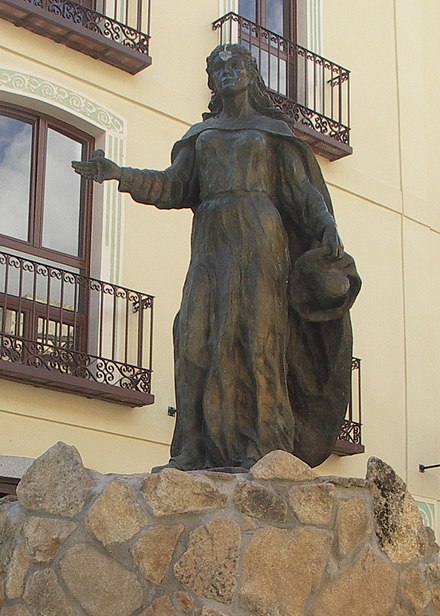
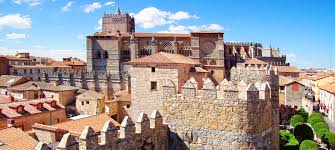
Avila was famous for its warriors. Among them was a woman, Ximena Blasquez. As a child Teresa never tired of hearing the story of how in the absence of a husband, the governor, and of his troops, she defended the ramparts against the Moors. Dona Ximena went up on the towers leading the women who were disguised as warriors by means of false beards and large hats; there they they played such a tumultuous comedy of defence that the Moors took fright and raised the siege. Were great dreams open to everyone? The little Teresa dreamed that it was so.
When in 1522 the Turks conquered the island of Rhodes, Teresa, aged seven, longed for sacrifice. She imagined it would be easy to be beheaded and become a martyr and thus enter heaven. Not having much sense of geography, she persuaded her older brother, Rodrigo, aged 10, to set out with her for Greece, carrying a few crusts of bread. A few miles down the road they were met by their uncle, who brought them home.
Love
At 15 Teresa was very beautiful and charming. She was a great reader of romantic tales, especially of the 13th Century classic The Quest of the Holy Grail. Frustrated in her attempt to find glory in martyrdom she now aspired to literary fame. She was also disappointed that although there were many French and English romances there were very few Spanish ones. She decided to set the record straight ; and thus on the cover of an exercise book she wrote the title, The Knight of Avila by Doña Teresa de Ahumada and Don Rodrigo de Cepada. During the winter months the sheets of paper piled up.
But Spring whispered when she was fifteen and life became more exhilarating than writing, even when one is writing about the struggle between passion and honour.
She was to spend time with several of her cousins. Amongst them it is implied that she might have fallen in love with one of her admirers.
She became extremely self critical:
“I had a great leaning towards everything evil. In addition there were servants and I found them quite ready to encourage me in anything wrong.”
However it is too often forgotten that if sexual attraction is a natural instinct, virginity’s defense is just as instinctive.
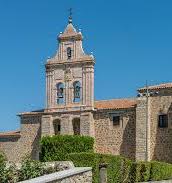
When she was 16 her father sent her to the convent of Our Lady of Grace.
The First Knock
At the convent Mother Maria de Briceno took Teresa in hand and she was a changed being. “I began to find pleasure in this nun’s good and holy conversation and was delighted to hear her speak so beautifully of God. Her good companionship gradually rid me of the habits which bad company had given me and the awakend in me afresh the desire for what was eternal.”
Spiritually Theresa was attracted to the convent but the things of sense drew her away from it; sense struggled against spirit and made her heart a battlefield. Why was she not a man! In the new world there was so much gold and silver that it was used for the floors of houses, but the f conquistadors put the emphasis on the souls to be saved rather than on the wealth to be gained. The spoils of the conquest were set out in round figures: 21,300,000 gold crowns, the treasures of Montezuma brought back by Cortes, 1,200,000 baptisms between 1524 and 1532.
Teresa’s interior struggle made her ill. At the end of winter when she was 17 she was sent back to her father and in the Spring she stayed in the countryside with her devout uncle Pedro. He chose the letters of Saint Jerome for her to read. She wrote: “I only remained with my uncle a short time, but the words of God, both those I read and those I heard, and his good influence, made such a deep impression on me that I understood the truth which I had a dimly sensed as child: ALL THINGS ARE NOTHING.”
She pondered over the joy of the thirsty earth, when watered and this made her alarmed at the aridity of her soul, but she remembered that Christ is ‘a good gardener’.
Reason, Not Love
“I began to be afraid that if I died I should go to hell, and although I was not yet prepared to become a nun I saw that it was the best and safest state of life and so gradually I determined to force myself to enter religion.”
My father loved me so much that I could not obtain his consent; the most he would concede was that I could do as I wished after his death.”
However she was inspired by St Jerome’s letter to Heliodorus to disobey her father; and stole into the Carmelite convent that Dona Beatriz de Higuera had erected outside the walls Avila, on the site of a former Jewish cemetry.
“I do not believe that I shall suffer more when I come to die than when I left my father’s house.”
In this way Theresa entered into a bond with her heavenly Bridegroom, but guided by reason not by love.
Love and Glory
Teresa had crossed the bridge outside the walls of Avila and committed herself to the Convent of the Incarnation. Her father knew that if she were to give way and return to him, he could not in the future enjoy without remorse the company of the daughter he loved so much. Meanwhile Teresa began to realise that it was only by loving others that she could make any spiritual; so she nursed a nun who suffered from terrible sores. She had to dress the ulcerous stomach which discharged pus, blood and excrement at the same time. Teresa’s repugnance was changed to compassion. This made her ill.
In spite of her illness her profession took place on November 3rd 1537. She prostrated before the grille, now open onto the sanctuary, touching the ground with her forehead. The prioress put the traditional question: “What do you ask?” “I ask God’s mercy and the company of my sisters in perpetual enclosure.” Meanwhile she began to suffer from a mortal illness that doctors could not understand.
Saint Joseph
For her illness she was given injections, poultices, was bled, given pills which had to be taken in odd numbers – this gave her devotion, because the number of pills reminded her of the seven gifts of the Holy Ghost or the five wounds of Jesus.
She visited her uncle who gave her the book The Spiritual Alphabet by Francisco de Osuna, in which she read: “Happy are those who pray before they slumber and who promptly return to prayer on waking. Such people, like Elias, feed, sleep, feed again and remain nestled in God’s arms, as children sleep on their mother’s breast after having drunk her milk.” In this way Teresa began her initiation into mental prayer.
She was now so ill that she asked for the last sacraments; and so she returned to the convent, where for three years she lay in the infirmary, completely paralysed. Then she prayed to Saint Joseph; and one day she was able to stand upright again.
The World or God?
Once nearly fully recovered, Teresa later judged herslf for spending far too much time in the parlour entertaining and being entertained by myriads of admirers. It was only when her father died and that she went to confession with the Dominican, Padre Vincent Barron, that she took his advice:
She saw her faults of vanity more clearly, but she wrote: “all the things of God gave me great pleasure, but I was held captive by those of the world. I was trying to reconcile these two extremes to bring contraries together.”
The Wounded Christ
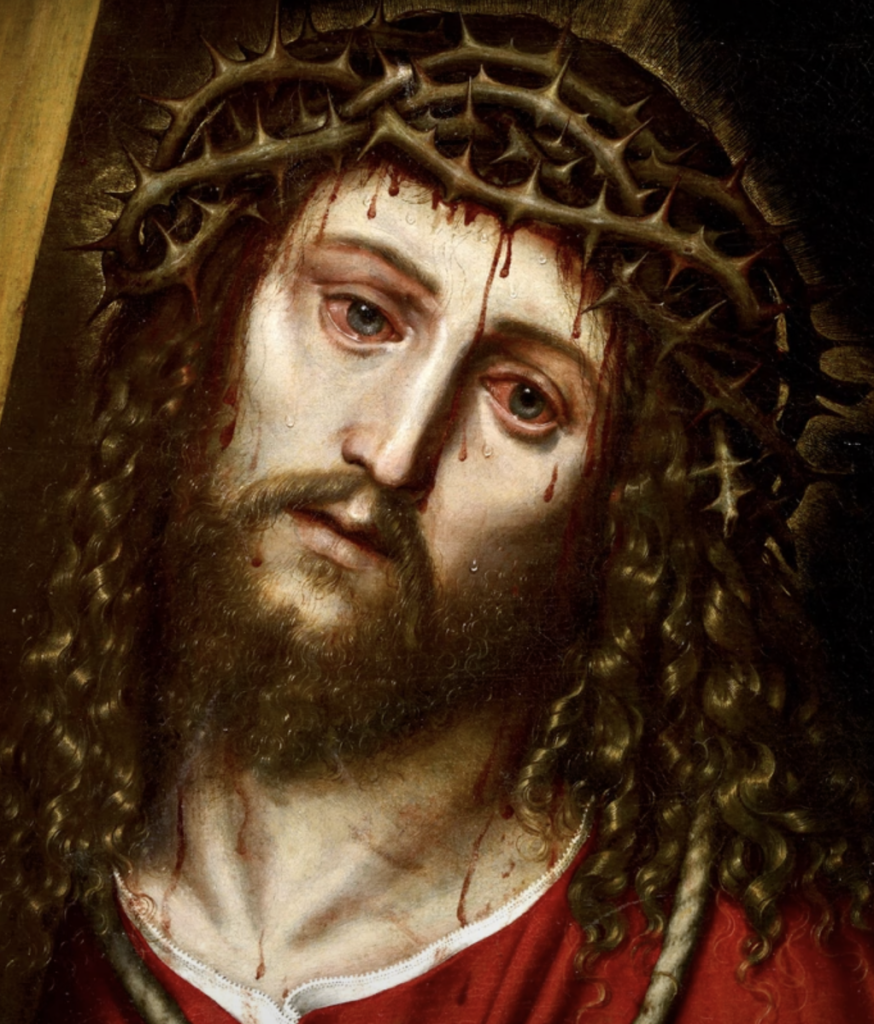
One day in 1553 as she was passing through the oratory, Dona Teresa de Ahumada noticed a bust, an Ecce Homo. “From the very first glance I was moved at the thought of his sufferings for us, Christ covered with wounds. My heart was shattered with remorse when I thought of those wounds and my ingratitude. I threw myself on my knees before him, in tears, and begged him to strengthen me that I might not offend him for the future.”
At the beginning of 1554 she was given Augustine’s Confessions. As a result she wrote: “Up till now it has been my life. Now God lives in me.”
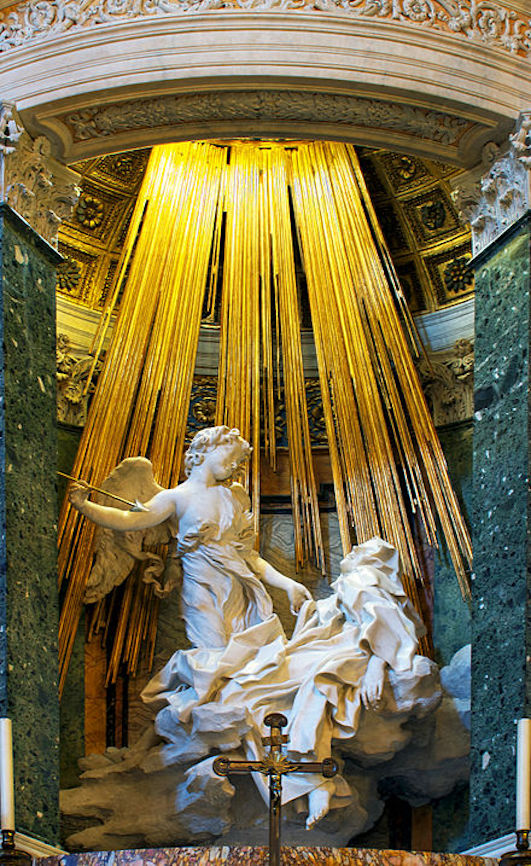
One day when she was praying the Veni Creator she was suddenly rapt in ecstasy for the first time and heard Our Lord’s voice: “Henceforward it is my will that you no longer converse with men, but with angels.”
She descibed the experience: “the poor soul does not realise what he’s going to happen to it …. The being rapt in ecstasy takes the form of a sudden call on the part of His Majesty in the very depth of one’s soul, it rushes upon one so swiftly that it seems to raise the soul its very apex, so that it almost leaves the body. Great courage is then necessary to abandon oneself into Our Lord’s arms and to allow oneself to be rapt, until the moment when his Majesty sets you down in peace, where he wanted to communicate the highest revelations to you. Any attempt to resist seemed to me impossible.”
Once the ‘novelty’ had died down a little, she experienced great joy. In an another experience of religious ecstasy she describes her encounter with an angel:
“I saw an angel Close to me on my left. He had a long golden lance in his hand and I thought its tip was all flames. He seemed to plunge it several times into my heart right to the very depths of me. When he drew it out he seemed to pluck my heart out with it, leaving me all on fire with an immense love of God. The pain was so sharp that I moaned, but the delight of this tremendous pain is so overwhelming that one cannot wish it to leave one, nor is the soul any longer satisfied with anything less than God.
Heaven and Hell
As Teresa was at prayer on Saint Peter’s day, she felt Christ near her. She didn’t see him with the eyes of the body; but she was certain he was there and that he was speaking to her. “Knowing nothing about this kind of vision, I was very much afraid. At first I did nothing but weep. A few words from him sufficed to reassure me and then I was at peace, happy, free from all fear.”
From then onwards she felt Our Lord near her always. Instead of being ‘full of distractions’ she was constantly aware of his presence at her right hand. She was now in a state, in which her prayer never ceased even during sleep.
One day Christ showed her his hands, so wonderfully beautiful that one couldn’t describe them. She was very much afraid, but was not this the case with the disciples? The gospel is full of their fears and terrors.
Henceforward it was impossible for Teresa to resist the supernatural visitations which occurred even in public. As a giant lifts a straw, so the force of ecstasy raised her from the ground and held her suspended in the air. One day after communion the congregation saw her raised two or three palms height above the ground. She strove to prevent this happening with immense fatigue, like someone, who is struggling with a strong giant, she held on with both hands to the communion grille, but to no avail.
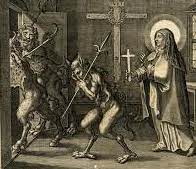
She was also plagued by devils. She knew perfectly well that the devil used no disguise when he wanted to play at ball with her soul; she saw close to her ‘a most vile little black creature’, or perhaps a tiny imp sat on her missal making faces at her. “I snap my fingers at devils! They frighten me no more than flies. It is they are afraid of me. I don’t understand why people are afraid of them. Why should we say ‘devil devil’ when we can say ‘God God’ and make them tremble? Come on all you Devils. I am God’s servant and I’m curious to see what you can do to me!”