In Preparation
Accounts of seemingly impossible phenomena abounded in the early modern era – tales of levitation, bi-location and witchcraft – even as skepticism, atheism and empirical science were starting to supplant religious belief in the paranormal.
Carlos Eire explores how a culture increasingly devoted to scientific thinking grappled with events deemed impossible by its leading intellectuals.
Carlos Eire is the T. L. Riggs Professor of History and Religious Studies at Yale University.
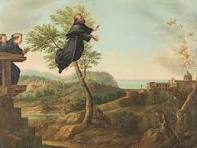
While strolling in the garden one day …. a priest said to him, “Father Joseph, oh, how beautiful God has made heaven!” Then Joseph, as if he had been called to heaven, gave a loud shriek, leapt off the ground, flew through the air, and knelt down atop an olive tree, and – as witnesses declared in his beatification inquest – that branch on which he rested waved as if a bird were perched upon it, and he remained up there about half an hour.
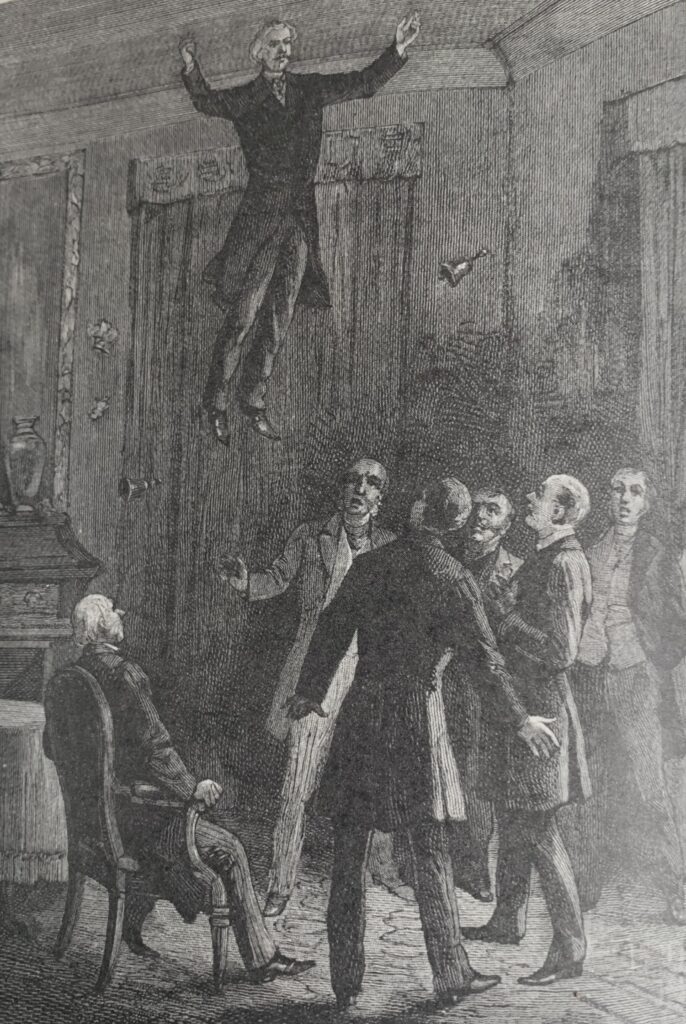
In Western Europe at the peak of modernity reports of flying humans and of bilocations – the same person being in different locations at the same time – reached a peak.
Despite the existence of high-speed trains that employ magnetic levitation to hover and fly forward while suspended just a few centimetres above the tracks, the existence of human levitation is disparaged.
Bilocation is a phenomenon found in many religions from ancient times to the present. Spiritualists in the 19th century believed that the human body had an “astral double”, a spiritual component that could leave the physical body and appear elsewhere.
By the 13th century bilocation and levitation accounts begin to appear regularly in Western hagiographies. Many supernatural phenomena were believed to be signs of sainthood. However magic, religion and the demonic were too closely intertwined to allow Church authorities to approve of such seeming miracles instantaneously.
With the arrival of Protestantism from the early 1520’s, its adherents argued that miracles ceased after the Early Church and that supernatural phenomena associated with holiness in the Middle Ages were in fact the work of the devil.
Demonic levitations and bilocations are still considered possible, but have received much less attention since the 19th century.
However the shocking truth is that both Protestants and Catholics professed belief in human flight and tried to sort out the airborne among them. No one can deny that the sorting took place at the very same time that calculus, empirical science and atheism emerged in Western culture. This was the age of Galileo, Descartes, Newton and Leibniz,
“Like a traveler exploring some distant country the wonders of which have had to be known only through reports and rumours of a vague or distorted character, so for four years, I have been occupied in pushing an inquiry into the territory of natural knowledge which offers almost virgin soil to a scientific man.” – William Crookes.
The history of levitation began to be written largely by critics such as Olivier Leroy, whose Levitation from Antiquity to Cupertino and Beyond, an Examination of the Evidence was published in 1928.
However among Catholic and Orthodox Christians levitation remained a very serious subject. They could not be thrown into the ash heap along with spiritualism. In the Orthodox tradition were Seraphim of Sarov (1754-1833) and Saint John the Wonderworker (1896-1966). In Catholicism four of the best known Catholic levitators from modernity were Saint Alphonsus Liguori (1696-1787), Blessed Anne Catherine Emmerich (1774-1824) Saint John Vianney (1786-1859) and Saint Gemma Galgani (1878-1903). In the 20th Century the best known Catholic levitator was Saint Padre Pio of Pietrelcina (1887-1968), who during the Second World War was credited with intercepting allied bombers in mid air and preventing them from pulverizing the town of San Giovanni Rotondo.
In Asia Indian traditions have accepted levitation as a fact for millennia. A contemporary of Jesus, Apollonius of Tyana, said that he saw Indian Brahmins: “levitating themselves two cubits from the ground, not for the sake of miraculous display, for they distain any such ambition, but they regard any rites they perform in quitting earth and walking with the Sun, as active homage acceptable to God.
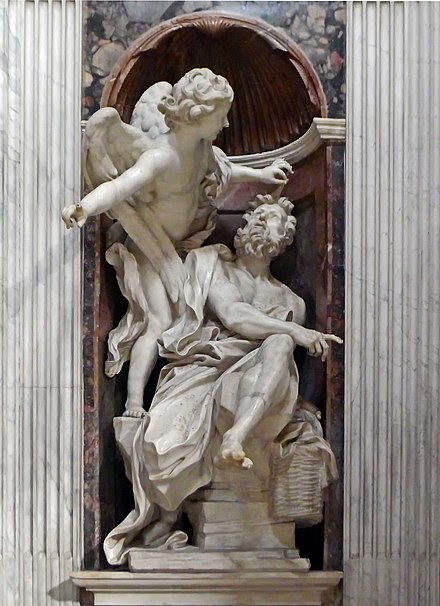
Jewish accounts of levitation are rare. The Old Testament contains only two accounts of airborne men. The first is Elijah who is snatched up to heaven in a fiery chariot and therefore conveyed off the ground by a vehicle, much like some present day airline passenger. The second is Habakkuk, who was flown from Judea to Babylon and back by an angel, who grabbed him by the hair, just so he could provide Daniel with lunch in the lion’s den.
Mary Magdalene is said to have levitated many times later in life, after she moved to Gaul, but this claim can only be found in mediaeval legends in Jacob de Voragine’s extremely popular Golden Legend, which told of the Magdalene being born aloft by angels every day during the seven Canonical Hours.
The apocryphal Acts of Peter (second century) relates how Simon Magus “amazed the multitudes by flying” and how Peter reacted to it: “And beholding the incredible spectacle, Peter cried to the Lord Jesus Christ: “if thou allow him to do what he has undertaken, all who believed in you shall be overthrown and the signs and wonders which you have shown to them through me, will not be believed. Make haste, O Lord, show your mercy and let him fall down and become crippled but not die; let him be disabled and break his leg in three places.” And he fell down and broke his leg, and they caught stones upon him and each went to his home having faith in Peter.”
The legend of Simon Magus is evidence that the earliest Christian community could see levitation in a negative light ,as a dark art associated with malevolent spirits.
The Emperor Julian, known as “the Apostate” (331-363), fell under the spell of Neoplatonic philosopher-theurgist Maximus of Ephesus (310-372). The great theologian Gregory Nazianzen (329-370), who had attended school in Athens with Julian, was convinced that his former school mate was bent on gratifying the demons. who often possessed him.
Gregory could only attribute Julian’s levitation to demonic forces, including one that took place during his initiation into the mysteries of the Goddess Artemis by Maximus of Ephesus:
“As if he had embraced the invisible being, Maximus spread out his arms, bent his head backward, rose in the air and remain suspended, motionless, wrapped in a luminous cloud. … Julian moved towards him unhesitatingly, as drawn by an overpowering force … Maximus clutched his hair, pulled him up to himself and they began whirling around the cave, several feet above the ground, with a rapidly increasing speed.”
For Christians, as the centuries passed, demonic levitation had to have a divine counterpart.

The Great monastic pioneer Saint Anthony (ca 250-350) and a monk, Amun, were among the first to be lifted up in the air. Mary of Egypt (344-421) was a penitent whore who had become a hermit. According to Sophronius of Jerusalem she rose forearms distance from the ground and stood praying in the air. Later she crossed the River Jordan to receive communion, walking on the surface of the water just as Jesus had done on the sea of Galilee.
Dunstan (908-998) was an abbot and monastic reformer, who served successively as Bishop of Worcester, London and Canterbury and as a minister for several English kings. He said to have risen all the way to the ceiling of the cathedral at Canterbury, in the presence of many witnesses. The great height of his astounding flight is among the first of its kind to be recorded in Catholic hagiography.
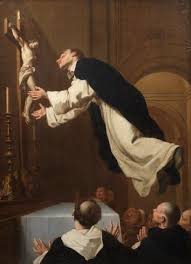
Among the most notable levitators from the 12th Century were Bernard of Clairvaux (12th Century), Christina the Astonishing, who levitated up to the rafters of a church, later explaining that she could not bear the smell of the sinful people below (12th-13th Century), Dominic Guzman in the picture opposite, Francis of Assisi, Anthony of Padua, Elizabeth of Hungary, Bonaventure, Albert the Great, Thomas Aquinas , witnesses testified to his levitating during meditation. A sacristan once saw him levitate in the sanctuary at the basilica while conversing with the Lord.(13th Century) and Catherine of Sienna was said to have levitated while in prayer, and a priest claimed to have seen the Holy Communion’s Eucharist wafer flying from his hand straight to Catherine’s tongue (14th Century)
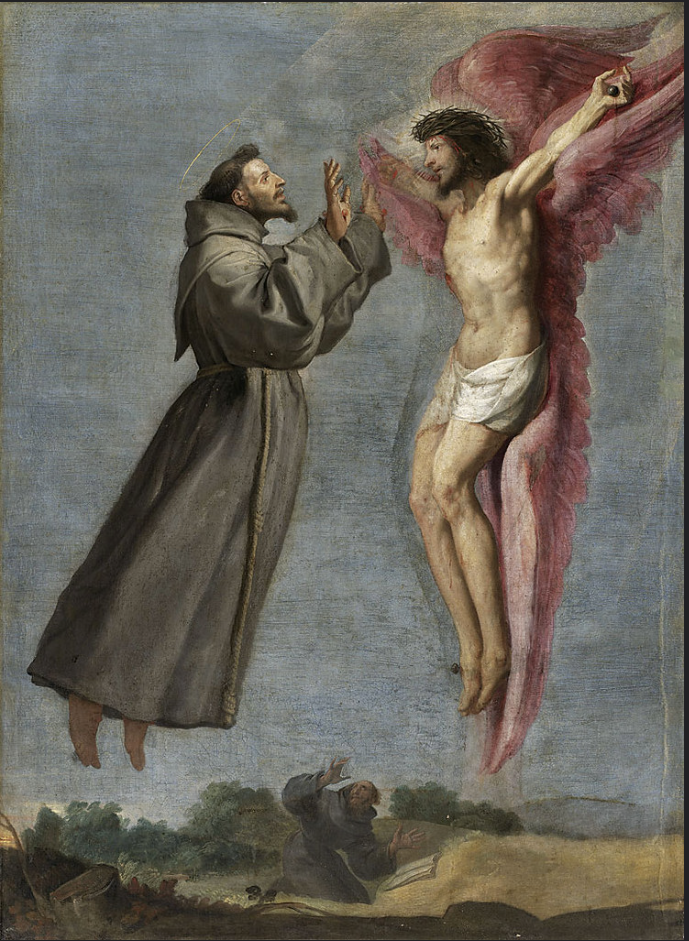
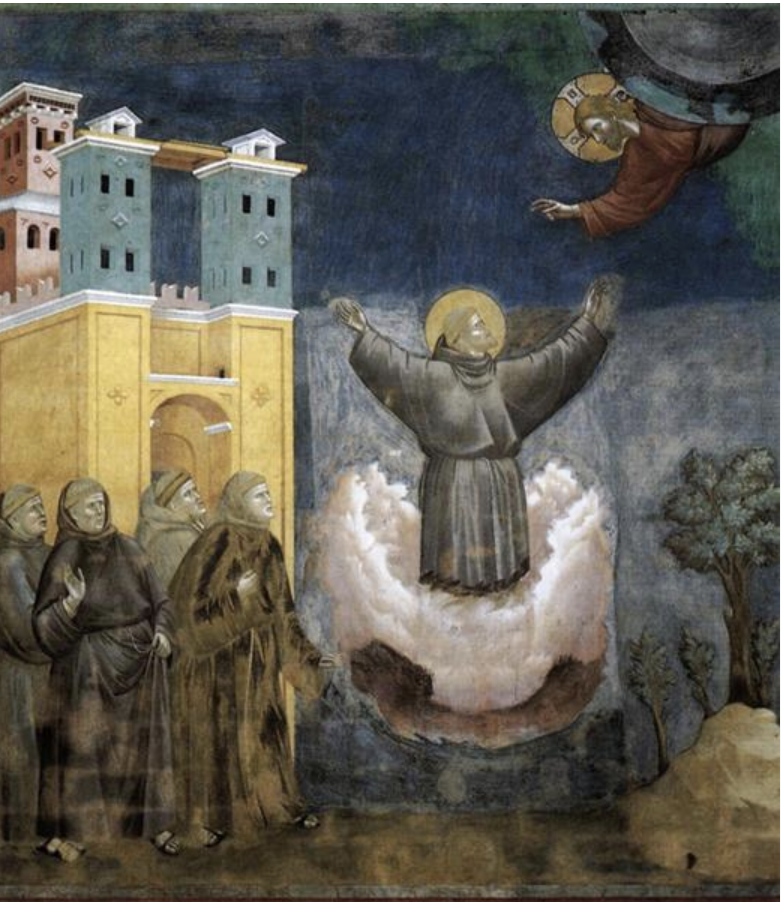
The stigmatist Saint Francis of Assisi was also known to levitate. His levitations were recorded in multiple hagiographies and played an immense role in the history of the miraculous, making this ancient and extremely physical mystical phenomenon more widely known and acceptable and more paradigmatic of sanctity for subsequent generations of mystics.
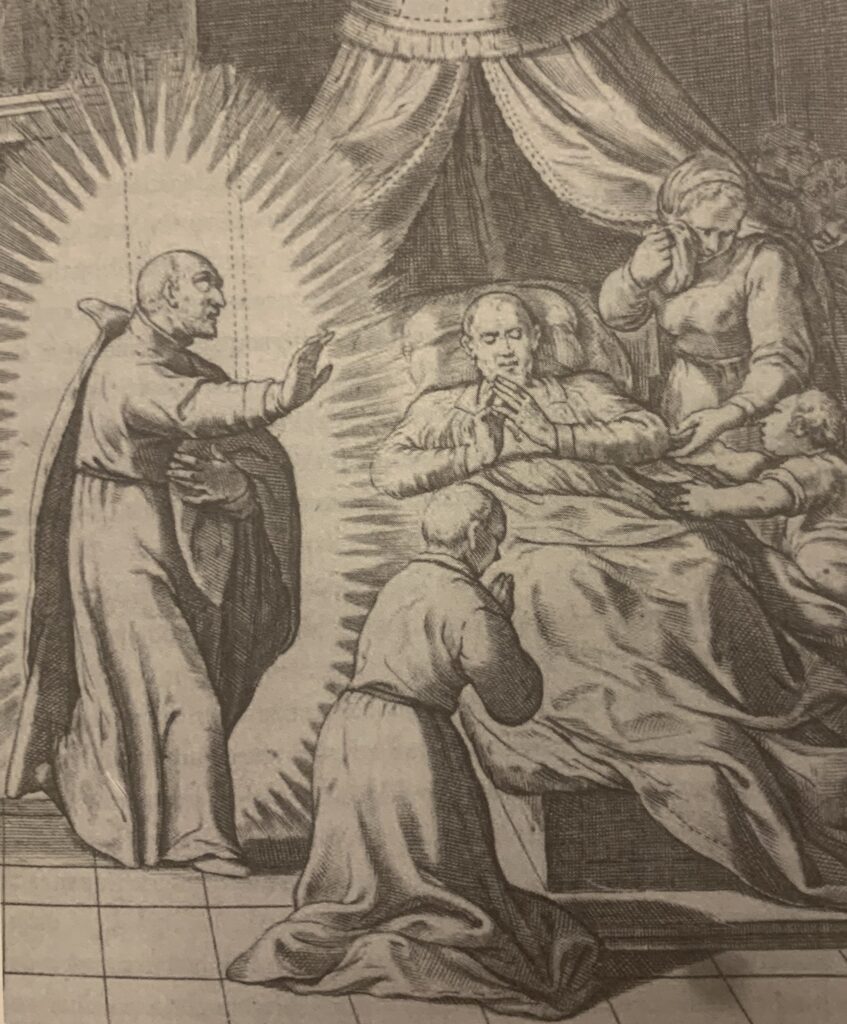
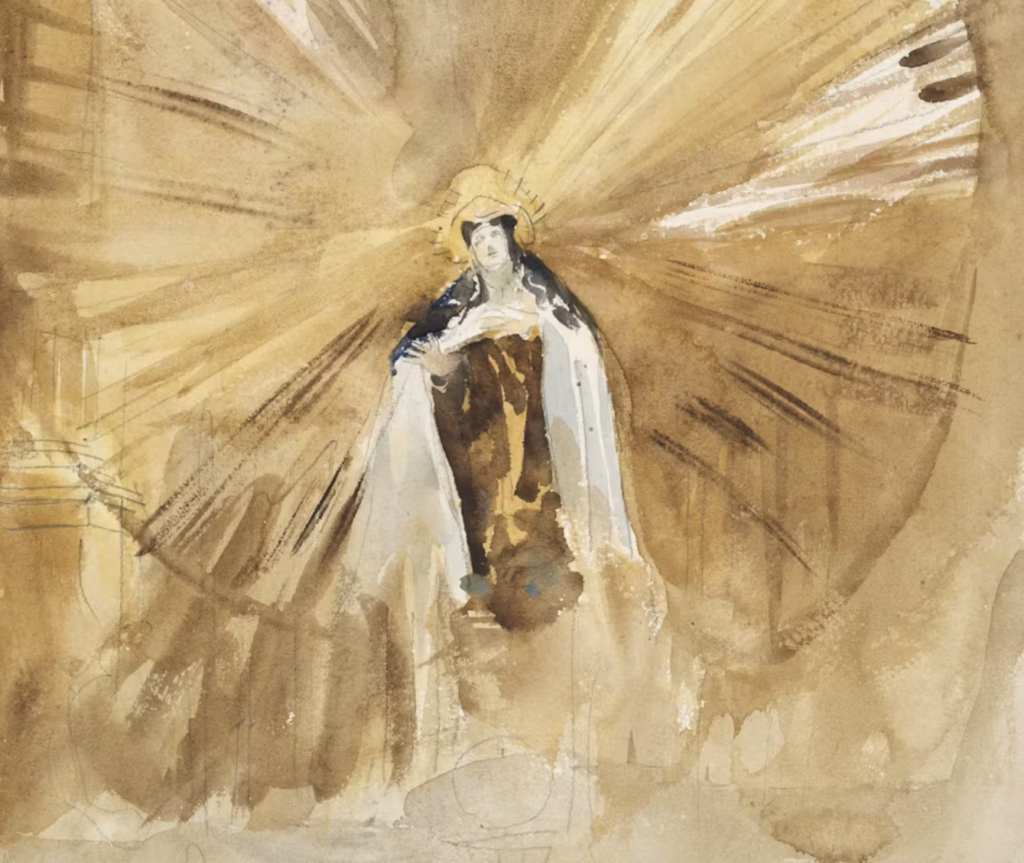
Saint Bonaventure in his Legenda Major writes: “He was occasionally seen raised up from the ground and surrounded with a shining cloud, as he prayed at night with his hands stretched out in the form of a cross …. the brilliance that enveloped his body was a sign of the miraculous light which flooded his soul.”
Ignatius Loyola (1491-1556), the founder of the Jesuit order, was observed levitating various times, wrapped in ecstasy with his knees bent and his arms outstretched, four or five palms above the floor. He was also known to fill a room with dazzling light, when he was aloft. Due to the fact that several illustrated hagiographies of Saint Ignatius were published around the time of his beatification and canonization, we have three different depictions of these events.
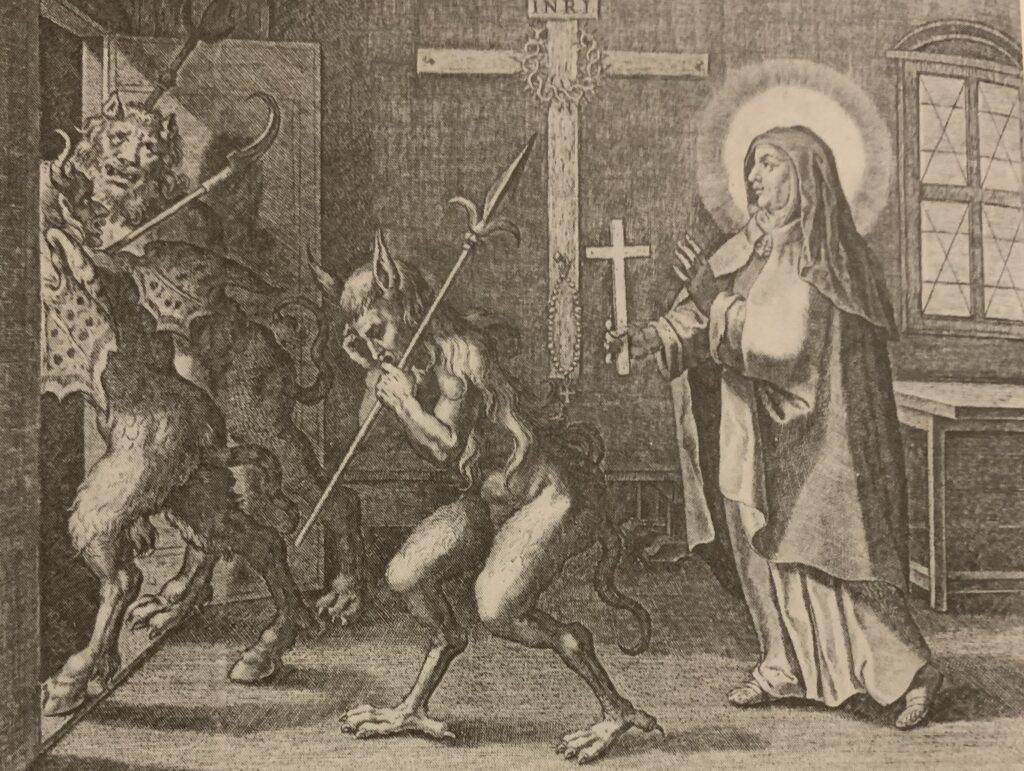
Protestants claimed that any supposed miracles since Biblical times, were manifestations of the demonic. In a debate with the English Protestant William Tyndale in the years 1529-1532, Thomas More in his Dialogue concerning Heresies argued for the necessity of miracles, which hinged on their role as proof of divine power, and of its presence in the true church. He argued that God “hath from the beginning joined His Word with wonderful works”, and “that God still causeth His church to do miracles in every age.” He added that miracles were the surest proof of the church’s divine origin, confirming time and time again “that the doctrine of the same church is revealed and taught unto it by the spirit of God.” Conversely the lack of miracles among Protestants proved beyond a shadow of doubt that the only true thing about their bickering, newfangled churches was their demonic origin.
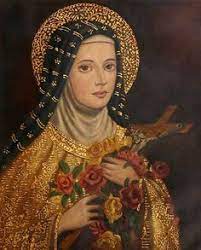
Teresa of Avila , the Carmelite prioress, was a reluctant aethrobat. She was one of the best known levitators of the early modern age and one of the most unwilling. One of her nuns wrote: “the holy mother was very humble and she dearly wished not to be considered a saint, so she constantly begged me and her other daughters to pull down hard on her vestments, whenever we saw her rising into the air and whenever she’d begin to feel that the Lord wanted to elevate her, she’d grab onto floor mats and the grilles in the choir. At the same instant, she’d also beg Our Lord to stop bestowing such favours on her from now on; and one day she eventually attained this from our Lord.
Was Teresa genuinely engaging with the divine or was it fraud? Could it be that her experience involved the devil rather than God? Her superiors commanded her to write her autobiography to examine these questions. In it she wrote:
“I would like, with the help of God, to be able to describe the difference between union (union) and rapture (arrobamiento) or elevation (elavamiento) or what they call flight of the spirit (vuelo de espiritu) or ravishment (arrabatamiento) – which are all really one. I mean that all these different names referred to the same thing, which is also called Ecstasy (estasi).”
Her writing paid off, for her autobiographical account convinced those who scrutinised the text that she was neither a fraud nor a demoniac.
Teresa says: “At the highest point of rapture one will neither see, nor hear, nor receive”; and this is because “the soul is so closely united with God that none of the souls faculties are able to perceive or know what is taking place. Even if the eyes remain open one neither perceives nor notices what one sees.”
In The Interior Castle she comments that to be in such a state requires courage, “because the soul truly feels that it is leaving the body when it sees the senses leaving it and it does not know why they are going away.” Elsewhere she also highlights the effects of this new death experience on the body, not only while the event is unfolding but also afterward. “Occasionally I come close to losing my pulse altogether, according to those of my sisters, who have found me with my ankle jointed and my hands so stiff.
Sometimes I cannot even clasp them together.”
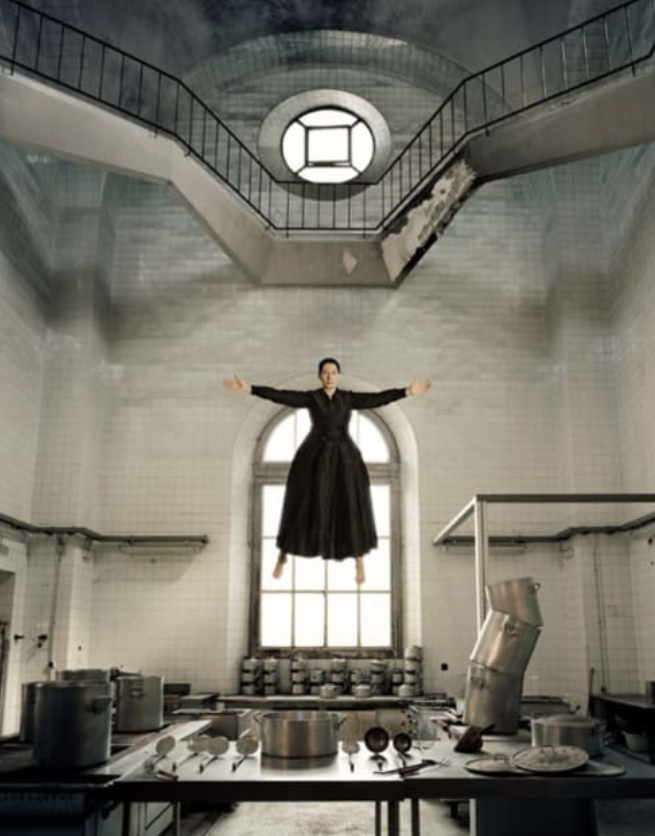
The Jesuit, Francesco. de Rivera recounted, “One day upon entering the kitchen the nuns found her totally elevated and transfixed, her face beautifully aglow with the frying pan in her hand, suspended above the flames; and she was gripping the frying pan so tightly that it couldn’t be wrestled from her hand.
“Isabella Santo Domingo often did kitchen duty alongside Teresa. Obeying her orders on how to deal with her levitation, Isabella attempted to pull Teresa down, but failed, and then struggled to remove the frying pan from Teresa’s hands, because she feared that the oil in it would spill out and be lost. This vigourous tug-of-war between Isabel and the enraptured levitating Teresa lasted a while, but the oil did not spill and the cooking resumed as soon as the rapture ended.”
Diego de Yepes relates, in his popular hagiography, a levitating episode that took place at Teresa’s new newly founded convent of Saint Joseph and it involved Alvaro de Mendoza, Bishop of Avila, and several other eye witnesses:
“The force of this arrobamiento was so tremendous that without being able to resist it, Teresa rose up higher than the window through which the bishop was about to give communion.”
Intertwining metaphorical swagger with theological physics, Yepes concludes: “So her soul was so full of this divine fire, that, as if her soul were a flame, it rose up high, and passed onto the body its lightness and agility.”
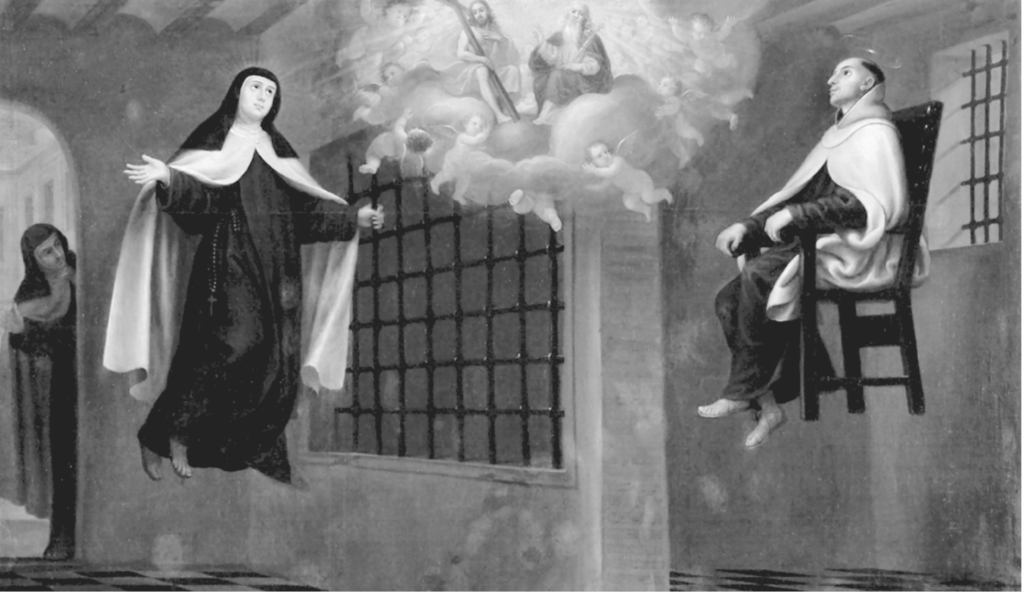
In 1570 Saint John of the Cross became Confessor to Teresa. The two mystic bonded intensely and it was in Avila that one of the most remarkable levitations in Christian history occurred in the tight space of the convent parlour. This space was really two rooms, not one, separated by a thick wall, where the nuns in one room communicated with visitors in the other through a grille-covered window. Like Teresa, John tried to hide his raptures as much as possible, but on one occasion, while visiting Teresa in the parlour on Trinity Sunday, neither John or Teresa could control a spectacular arrobamiento that suddenly sent them both up into the air while conversing about the topic of that day, the Holy Trinity.
Holding onto his chair, as he felt the rapture coming, John suddenly shot up in the air, all the way to the ceiling, “still in his chair, as in a chariot of fire in imitation of his great patron, Elijah.” Teresa, who was kneeling, immediately shot up alongside John. The event was witnessed by one of the convent’s nuns, Beatriz Jesus, who had been tasked with delivering a message to Teresa and happened to walk into the parlour at that moment.