Based on “The Fathers of the Church” by Hubertus Drobner
INTRODUCTION
The New Testament
The first five Christian centuries yielded multiple works of the four literary genres (Gospels, Acts of the Apostles, Letters and Apocalypses) of the New Testament; all of them with the initial intention of providing a literary record of the authentic teaching of Christ.
Not all writings demonstrated the same quality and reliability, with the result that individual communities with local variations admitted only a portion of these writings for publication in the liturgy and acknowledge them as Holy Scripture. By the middle of the Second Century an initial consensus emerged from tradition, forming a decisive criterion in the formation of the new Testament Canon.
They continued to relate to the NT in terms of their attribution, content and form. Beginning with the second century there are three types to be distinguished:
The Old Testament
The Hebrew Canon was not established until close to the end of the first century, when the differentiation between Judaism and Christianity was already progressing. The Greek translation of the Hebrew text was called the Septuagint on the basis of the tradition that 72 inspired scribes from Palestine translated the Pentateuch on behalf of the Egyptian King Ptolemy II. The Septuagint included a number of OT writings that subsequently were not adopted in the Hebrew canon.
Christianity considered these as so-called deuterocanonical works. They comprise the Greek additions to Daniel and Esther, Baruch, the Epistle of Jeremiah, 1 and 2 Maccabees, Judith, Tobit, Sirach and the Wisdom of Solomon. Protestantism removed them again, but the Catholic Church at the Council of Trent reaffirmed them.
A. Literary Genre
It originated in Egypt in the second half of the second century and was later expanded. The Western Church rejected it as apocryphal in the Decretum gelasianum (circa 500) with a result that it fell into oblivion. The Eastern Church however continued to cherish it. Since it deals with the prehistory of the birth of Jesus, chronologically it would’ve been ordered as the first gospel.
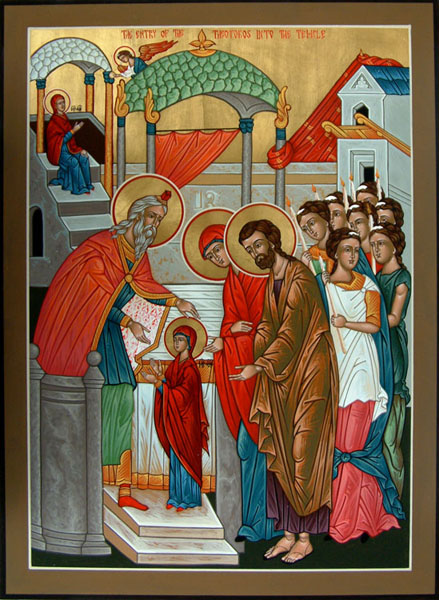
Part one narrates the origin, birth and childhood of Mary up to the conception of Jesus. Joachim and Anna a wealthy and devout couple suffering childlessness are miraculously granted a daughter. From age 3 they have her raised as a virgin in the temple of Jerusalem, where she is fed by an angel. At 12 she is entrusted to Joseph, who already has adult sons and whom God chooses through a miraculous sign. A dove comes out of Joseph’s walking stick and flies onto his head. Together with the other temple virgins Mary weaves a veil for the temple. This is followed by the angel’s annunciation, her visit to Elizabeth and Joseph’s consternation, when he finds Mary six months pregnant. An angel instructs Joseph about the divine origin of the child.
Part two starts with the birth of Jesus. On the way to Bethlehem, Joseph has to leave Mary behind in a cave, because her time has come and he proceeds to look for a midwife. The midwife shares the marvellous birth of the child and to her amazement discovers Mary’s unchanged virginity. After the birth she shares this with a second midwife named Salome, who re-examines Mary in unbelief and whose hand withers as a result. The infant Jesus however heals her.
Part three tales of the martyrdom of Zachariah. Because Herod was deceived by the Magi and is not able to seize either Jesus or John, he has Zachariah murdered,
C. Coptic Gospel of Thomas
Not to be confused with the Infancy Gospel of Thomas or with the Book of Thomas the Contender, it contains 114 dominical sayings.
E. Gospel of Nicodemus
It is composed of two parts: The Acts of Pilate and Christ’s Descent into Hell. The compilation of 425 is made up of earlier material.
The Acts of Pilate were further divided into two parts. Chapters 1 to 11 is an account of Jesus’s trial before Pilate, his crucifixion and his burial. Theologically they are intended as a defence of Jesus’s virgin birth over against the Jewish slander that Jesus was the son of Mary from an illegitimate relationship with a Roman soldier called Pantera. Pilate is depicted as an opponent of Jesus’s crucifixion to the extent that the Syrian church venerates him as a saint. To this day he has a place in the calendar of saints of the Coptic church.
It was written that after his death he was not able to find peace either in the Tiber or in the Rhone. His grave was surrounded by raving spirits from hell, until he was finally cast into a mountain lake. The mountain named after him to this day is by Lake Lucerne in Switzerland.
In chapters 12 to 16 there is a meeting in the Sanhedrin in Jerusalem after the death of Jesus, in which the resurrection is proclaimed. Nicodemus and Joseph of Arimathea testify for Jesus, albeit without being able to persuade the Jews.
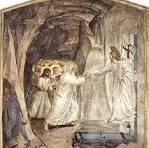
In the final part of chapters 17 to 21, two sons of Simeon in their deceased state encounter Jesus in Hades. They are then raised with him and write this down in the presence of the high priest in Jerusalem. The account begins with the first ray of light penetrating the darkness of Hades thus raising the patriarchs, the prophets and John the Baptist. Their predictions concerning the Messiah are now being fulfilled.
Satan and Hades up in a feud because the insatiable Hades swallowed up Jesus, although Jesus had demonstrated his divine power in his miracles. The gates of the underworld open and Hades and Satan are conquered. The OT saints are raised, baptised in the Jordan and led into paradise with Christ.
II. ACTS OF THE APOSTLES
A. Literary Genre
The apocryphal acts may have been classified as popular literature, intended to provide readers with Christian entertainment, edification and instruction. They are probably associated with ancient novels whose five major elements were:
B. Acts of Peter
C. Acts of Paul and Thecla
They they were written by a presbyter in Asia Minor circa 185 – 195 and relate the deeds of Paul in the framework of a major travel story. As Paul travels from Damascus through Jerusalem, Antioch in Syria, Iconium, Antioch in Pisidia, Myra, Sidon, Tyre, Smyrna, Ephesus, Philippi, Corinth and Italy and finally to Rome, he preaches on the Resurrection and Chastity. This evokes unrest because wives turned away from their husbands and leads to his resultant persecution and miraculous rescue.
In Iconium the virgin Thecla is persuaded by Paul’s preaching and leaves her betrothed, who together with other men, whose wives also left them, bring charges against Paul before the proconsul. Paul is imprisoned, but at night Thecla gains access to him by bribing the guards. When this becomes public both are taken to court .
Paul is banned from the city and Thecla is condemned to be burned, but the fire does not touch her. In the next city, Antioch, she escaped death in the arena because none of the beasts attack her. Indeed a lioness defends her, until the lioness itself perishes. Thecla then steps into a pit full water and baptizes herself. Finally she is officially set free.
Correspondence between Paul and the Corinthians deals with questions concerning gnostic herisies, namely the rejection of the OT and the denial of God’s omnipotence, of the resurrection of the flesh of God as the creator of the world and of Christ as a son of God incarnated through Mary.
The Acts concludes with Paul’s martyrdom in Rome, where he arrives as a free man in contrast to the Lucan acts. Here his martyrdom is not the consequence of a sermon on Chastity, but, rather, of the proclamation of Christ as ruler of the aeons, so that Emperor Nero sees his power jeopardized.
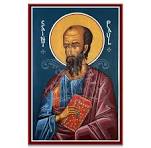
Paul’s description as “a man, small of stature with a bald head and crooked legs, in a good state of body, with eyebrows meeting and nose somewhat hooked”, became the determinative for early Christian iconography, in which he is typically depicted as narrow-faced, goateed and bald.

III. LETTERS
A. Literary Genre
Many of them are handed down within larger works, as for instance 3 Corinthians in the Acts of Paul or Jesus’ correspondence with King Abgar of Edessa. Mention should be made of the Epistles of Paul and Seneca which made a considerable impression upon antiquity.
B. Letter of Barnabas
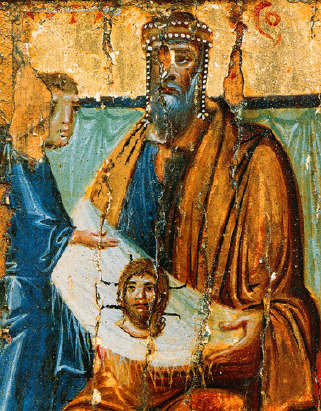
Eusebius and Jerome thought that it was thought that it was falsely attributed to Barnabas. It is believed to have been written in Egypt between 130 and 132. It constitutes the first comprehensible, spiritual interpretation of the entire OT as prophecy pointing to Christ and the Christian lifestyle, albeit in unprecedented radicality. Accordingly there never existed a covenant between God and the Jewish people, their understanding of the holy scripture being a fundamental misunderstanding. Christians alone are the recipients of the covenant and Scripture. They therefore discern scriptures christological and spiritual meaning behind the literal.
IV. APOCALYPSES
A. Literary Genre
The literary genre originated in Judaism and produced the book of Daniel as it’s most significant OT Apocalypse. Among the Christian apocalypse that of John is a accorded a special place. They have the following features:
From the second century among Christian Apocalypses and Christian revisions of Jewish Apocalypses were the Testament of Abraham , the Greek Apocalypse of Ezra and 2 Enoch (Slavonic apocalypse).
The most significant Christian apocalypses are the Apocalypse of Peter, the Martyrdom and Ascension of Isaiah, the Apocalypse of Paul and the Apocalypse of Thomas.
It was the most popular non-canonical writing of the early Christian centuries. It was written by Hermas a freed slave and small businessman between 130 and 140. In his first vision after his release he sees his mistress bathing in the Tiber. Seeing her beauty he wishes he had a woman such as this as his wife. Later on his way to the dwelling of the Sybil Cumae, he is translated by the spirit into a desolate area. There his former mistress appears to him and informs him that his desire was already sinful adultery in thought. Then there appears an old lady in brilliant garment, whom he assumes to be the sybil, but later learns she represents the personification of the Church. She calls Hermas and his entire family to repentance.
In the second vision, a year later, the old lady hands Hermas a heavenly letter, allowing Christianity a final period of repentance. She prompts Hermas to copy it and further visions and send them to Rome and other cities.
In the third vision the old lady becomes younger and shows Hermas the construction of a tower, which symbolizes the Church and whose perfection has to be delayed, until all Christians are perfected through repentance.
Finally in vision 5 a second revealer appears, an angel of repentance, in the form of a Shepherd, who in parables shows what ideal Christianity is.
C. Christian Sybillines
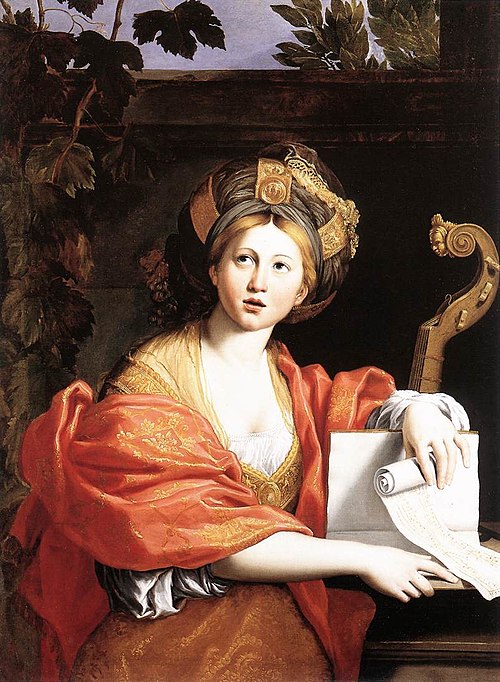
Traced back to the seventh century BC, initially the sybil was a mythical prophetess of superhuman age, of oriental, perhaps Persian origin. From the fifth century BC her oracles began circulating in Greece. Their prophecies contained promises of threat and misfortune and announced a new kingdom through liberation from the present oppression. In this way the oracles developed into political and anti-Roman propaganda.
The oracles were collected in 12 books between 180 BC and the third century AD. The Sybiellines were cited by many Church fathers and their influence continued into the Middle Ages, as seen in the hymn, Dies irae, Dante’s Devine Comedy and Michelangelo’s portrayals in the Sistine Chapel.