He was an Italian Christian monk, writer, and theologian who is venerated in the Catholic Church, the Eastern Orthodox Church, the Oriental Orthodox Churches, the Anglican Communion and Old Catholic Churches. He is a patron saint of Europe.
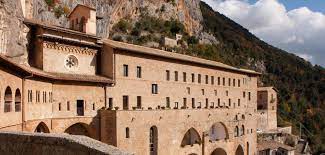
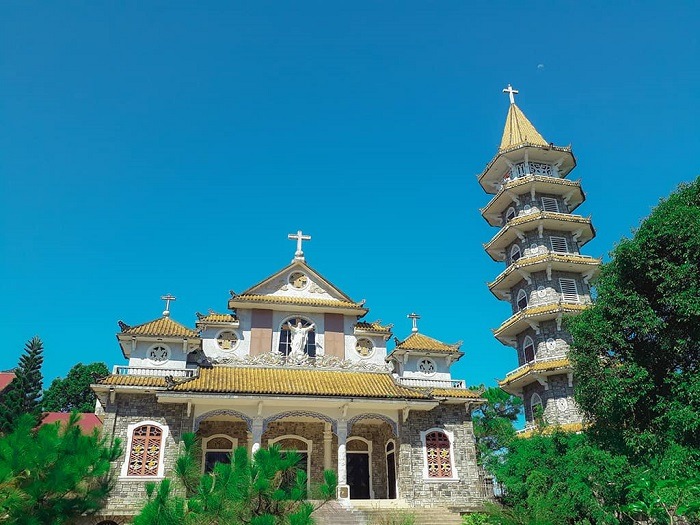
Benedict founded twelve communities for monks at Subiaco, Lazio, Italy (about 65 kilometres (40 mi) to the east of Rome), before moving to Monte Cassino in the mountains of central Italy. The Order of Saint Benedict is of later origin and, moreover, is not an “order” as is commonly understood, but merely a confederation of autonomous congregations.
Benedict’s main achievement, his Rule of Saint Benedict, contains a set of rules for his monks to follow. Heavily influenced by the writings of John Cassian, it shows strong affinity with the Rule of the Master, but it also has a unique spirit of balance, moderation and reasonableness, which persuaded most Christian religious communities founded throughout the Middle Ages to adopt it. As a result, his Rule became one of the most influential religious rules in Western Christendom. For this reason, his biographer, Giuseppe Carletti regarded Benedict as the founder of Western Christian monasticism.

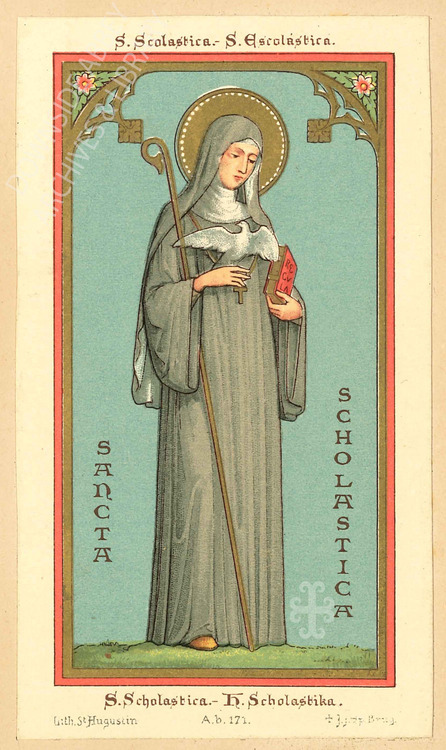
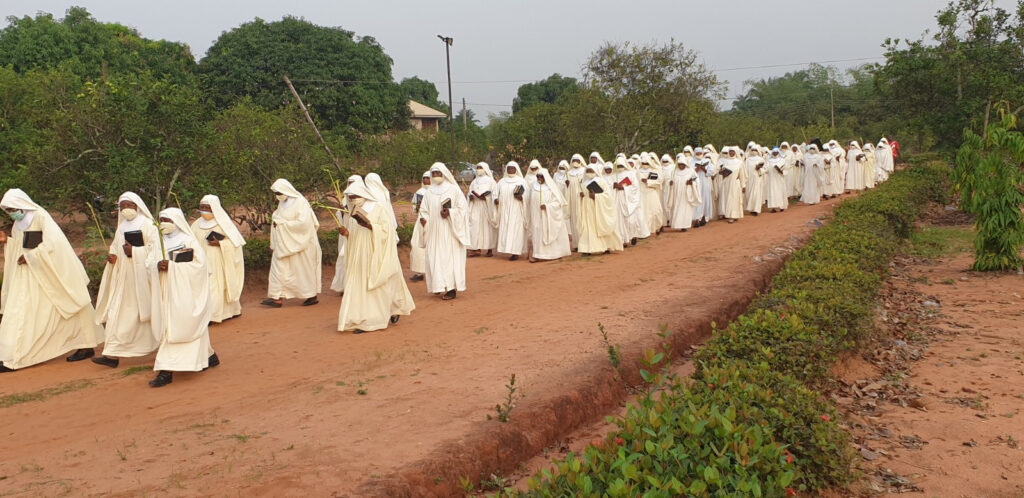
His twin sister was Saint Scolastica. Tradition holds that she established a hermitage about five miles from Monte Cassino, the monastery that her brother had founded, and that this was the first convent of Benedictine nuns. However, it is possible that Scolastica lived in a hermitage with one or two other consecrated virgins in a cluster of houses at the base of Mount Cassino where there is an ancient church under her patronage, Monastero di Santa Scolastica.
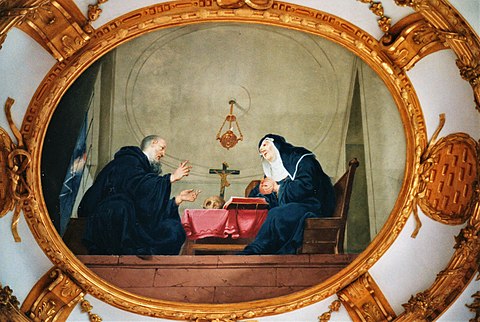
The most commonly told story about her is that she would, once a year, visit her brother at a place near his abbey, and they would spend the day worshiping together and discussing sacred texts.
One day they had supper and continued their conversation. When Benedict indicated it was time for him to leave, Scolastica, perhaps sensing that the time of her death was drawing near, asked him to stay with her for the evening so they could continue their discussions. Not wishing to break his own Rule, Benedict refused, insisting that he needed to return to his cell. At that point, Scolastica closed her hands in prayer, and after a moment, a wild storm started outside of the guest house, in which they were staying.
Benedict asked, “What have you done?”, to which she replied, “I asked you and you would not listen; so I asked my God and he did listen. So now go off, if you can; leave me and return to your monastery.” Benedict was unable to return to his monastery, and they spent the night in discussion.
Three days later, from his cell, he saw his sister’s soul leaving the earth and ascending to heaven in the form of a shining white dove. Benedict had her body brought to his monastery, where he had it laid in the tomb which he had prepared for himself.
Scholastica is the patron saint of Benedictine nuns, education, and convulsive children, and is invoked against storms and rain. Her feast is celebrated on February 10.
The life of St Benedict is known from the Dialogues of St Gregory, written about forty years after Benedict’s death and based, for all their abundance of miracles, on the memories of actual witnesses. Benedict was born in 480 near Nursia in Central Italy into a family of the lesser nobility. He was sent to Rome to study rhetoric and law, but took flight without warning to the ‘desert’ of Subiaco, where he lived for a long time in complete solitude.
Disciples then came to him and prevailed upon him to found a dozen small monasteries of the Pachomian type, each with its own superior, Benedict reserving to himself the formation of the novices. Twenty years passed in this way. Then opposition on the part of the local clergy, perhaps also of his monks, caused Benedict to withdraw once again. He founded accordingly a completely communitarian monastery on the top of Monte Cassino. He evangelized the surrounding countryside.
In Gregory’s account of him he appears as endowed with the spiritual gift of healing and as a mystic, who had a vision of the whole universe gathered together in a ray of divine light. He died about 547, after having completed his Rule, which was adopted during the sixth century by all the West and was to make him the father of the monks of the Latin Church.
Hubertus Drobner in his The Fathers of the Church adds some entertainng facts from Saint Gregory’s biography.
After his brief period of study he was so disgusted with the unrestrained hustle and bustle of Rome that he withdrew together with his nurse to Enfide in the Anio Valley. There he performed his first miracle. His nurse broke a clay sieve, but because of Benedict’s prayer it was joined together again.
He remained in Subiaco for three years and subsisted on the food that the munk, Romanus lowered to him in a basket. Because of his reputation a monastic community close by asked him to assume its leadership. He failed because its members refused to accept his strict demands. They attempted to kill him by giving him a poison drink.
He escaped this plot because he had blessed the glass with the sign of the crosses as was his custom and the glass shattered. As a result he withdrew to his cave again.
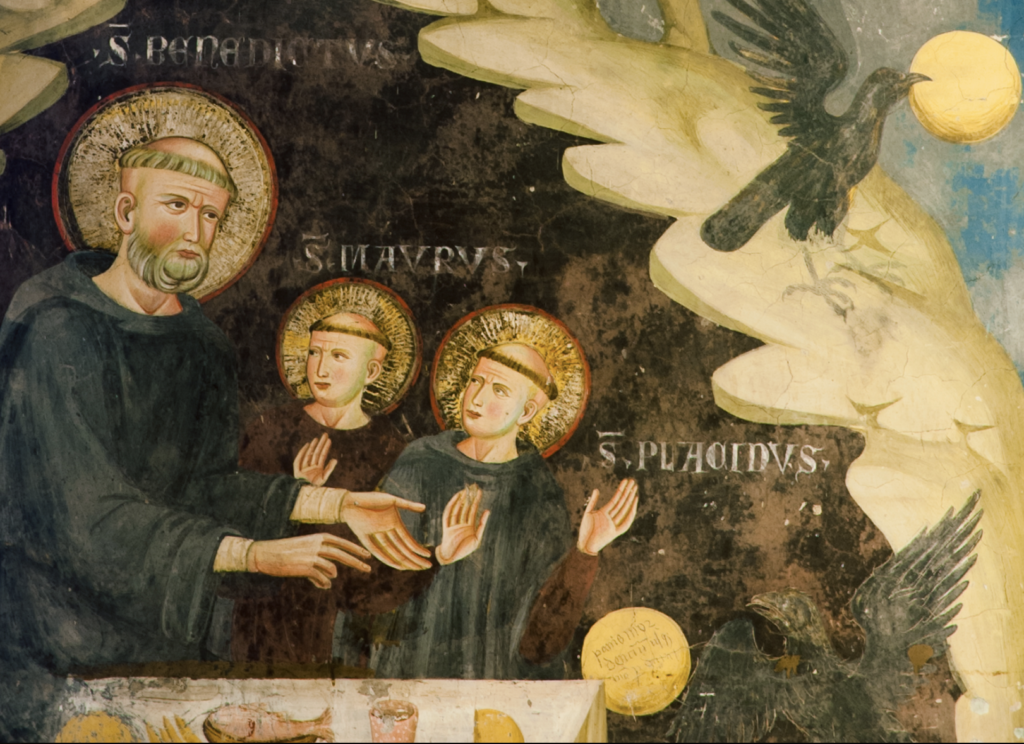
Florentius, another monk, tried to poison him with laced bread, but a raven carried it away on the divinely inspired command of Benedict. Florentius, since he could not corrupt Benedict’s body, attempted to corrupt his soul by sending nude female dancers into the monastery’s court. Benedict simply withdrew.
At Mons Cassino Benedictine encountered an ancient cult of Apollo and so his founding of a monastery there became a missionary endeavour. At the same time against the opposition of demons he replaced the temple with the church dedicated to Saint Martin and the altar on the mountaintop with a chapel dedicated to Saint John.
St Benedict’s Rule or ‘Rule for Monasteries’ draws its inspiration from an anonymous text received from tradition, the ‘Rule of the Master’. Benedict, having practised this Rule at Subiaco, remodeled it, transforming a diffuse text into a sober and balanced document of great spiritual toughness and flexibility.
The monastery is a ‘school of the Lord’s service, entirely directed towards the coming of the Kingdom. The monks, who are committed to a lifelong ‘stability’, owe obedience to the abbot whom they have elected for life. The abbot, who is at once administrator and spiritual director, has to adapt the ascetical training to each person’s vocation, in accordance with a love that includes ‘discretion’.
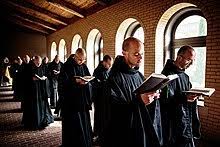
The monastery, where relationships between the brethren strictly follow the grades of the hierarchy, forms a more or less self-contained society that is organized for sharing and welcome. Manual work, the recitation of the Divine Office, and times of solitude and silence, in which prayerful meditation on Scripture (the lectio divina) holds a prominent place, make up the monk’s life.
There is a large measure of continuity with Eastern sources of monasticism, either directly quoted from St Basil or transmitted by Cassian, whose Conferences and Institutes are mentioned at the end of St Benedict’s Rule. The opening of one’s heart to the abbot, the control of one’s thoughts, the registering of spiritual progress by the degrees of humility, the fundamental theme of ‘peace’, resembling Eastern hesychia, all these are marks of fidelity to the spiritual Orient, and make Benedictine monasteries still today places of the undivided Church. Moreover, the Rule, in its conclusion, defines itself as a ‘beginning’ and makes reference to the great witness of the original sources.
The Rules of Saint Benedict
What are the he rules for living a good life?
In the first place to love the Lord with all one’s heart, with all one’s soul and with all one’s strength.
Then to love one’s neighbour as oneself.
Then not to kill. Not to commit adultery. Not to steal. Not to covet. Not to bear false witness. To respect all people.
And not to do to others what one would not wish to have done to oneself.
To deny oneself in order to follow Christ.
To be master of one’s own body … To help the poor.
To clothe the naked. To visit the sick. To bury the dead.
To assist those in distress. To console the afflicted …
Not to let anything come before the love of Christ.
Not to give rein to one’s wrath. Not to meditate revenge.
Not to harbour deceit in one’s heart.
Not to offer a pretended peace. Not to forsake charity.
Not to swear, for fear of perjury.
To speak the truth from heart and mouth.
Not to render evil for evil.
Not to commit injustice, but to bear patiently what is done to oneself.
To love one’s enemies. Not to render cursing for cursing, but rather blessing.
To endure persecution for righteousness’ sake …
To place one’s hope in God.
If one sees any good in oneself, to ascribe it to God, not to oneself.
To fear the day of judgment. To dread hell.
To desire eternal life with all one’s heart and soul. Every day to keep death present before one’s eyes … Not to hate anyone.
Not to entertain jealousy. Not to give oneself up to envy … To respect the aged. To love the young.
In the love of Christ to pray for one’s enemies. After a disagreement, to make peace before the sun goes down.
And never to despair of God’s mercy. Such are the tools of the spiritual art.
Humility
Leon Clement writes: Obedience, patience, silence: these are attitudes appropriate to monks, but also to all those who are trying to practise an ‘interior monasticism’.
Benedict writes: “If we wish to attain the summit of humility, we must by our actions set up the ladder that appeared in a dream to Jacob and on which he saw angels descending and ascending. This descent and ascent show us that by trying to climb we descend and by humility we ascend.
Now, this ladder thus set up is our life in this world, and when the heart is humbled the Lord raises it to heaven. The sides of the ladder are our body and soul, and on these sides God’s call has fixed the steps of humility for us to climb.
… The first degree of humility consists in always keeping present in the mind the fear of God and absolutely avoiding forgetfulness of it …
The second degree of humility is not to love one’s own will, not to take pleasure in fulfilling one’s own desires, but in one’s actions to imitate the Lord when he says: ‘I have come down from heaven, not to do my own will, but the will of him who sent me’ (John 6.38) …
The third degree of humility is to subject oneself in all obedience to a superior for the love of God, imitating the Lord of whom the apostle says: ‘He became obedient unto death’ (Philippians 2.8).
The fourth degree of humility consists in keeping patience and tranquillity of spirit, even when hard and repugnant commands are given or one is unjustly treated …
The fifth degree of humility consists in disclosing to the abbot in humble confession the evil thoughts that come into the heart, or the wrong done in secret …
The sixth degree of humility is when the monk is happy in the worst of conditions, and whatever requests are made of him he still sees himself as a bad and unworthy worker …
The seventh degree of humility is to know oneself the meanest and most despicable of men, not merely by saying so but by believing it with heartfelt conviction …
The eighth degree of humility is when the monk does nothing save what is commanded him by the common rule of the monastery and the example of his seniors.
The ninth degree of humility is when the monk has control of his tongue and remaining silent only speaks when he is questioned …
The tenth degree of humility is when we are no longer disposed to laugh easily; for it is written: ‘A fool raises his voice when he laughs’ (Ecclesiasticus 21.2.0).
The eleventh degree of humility is when the monk utters but few words when he speaks, words, however, of wisdom spoken quietly without scoffing, humbly and with gravity; for it is written: ‘The wise man is recognized by the fewness of his words.’
The twelfth degree of humility is when the monk not only in his heart but also in his outward bearing suggests humility to those who see him …
Once these steps have been climbed the monk will soon come to that perfect love of God which drives out fear. Thanks to this love he will begin to observe, as though naturally and from habit, everything which at first he was afraid to look at; no longer for fear of hell, but for love of Christ, and through good habits and delight in virtue.
Ascesis
Leon Clement: Ascesis enables us to pass from a state ‘contrary to nature’ to a state ‘in harmony with nature’, in harmony, that is, with that human (and cosmic) material united in Christ with the godhead, without separation or confusion. This is the testimony of St Benedict, the father of Western monasticism, and of an Amma, a ‘mother’ of the desert, St Syncletica, whose teaching is marked by a very feminine directness, and always close to real life. Benedict wrote:
“If justice leads us to propose some mild constraint in order to correct vices and to preserve love, do not at once fly in dismay from the path of salvation, which one cannot enter except through a narrow gate. For as you advance gradually in a holy life and in faith, your heart is enlarged and you run the way of God’s commandments in an ineffable sweetness of love. “
Clement: It is especially profitable not to boast, not to put oneself forward, carefully to refrain from speaking about one’s own ascetic practices, to give the glory to God, and not to oneself, for every good thing that seems to happen in or because of oneself. In this way any narcissistic tendencies will be converted into self-forgetfulness and trustful self- abandonment.
Benedict: “Those who fear the Lord do not boast of their good observance. They consider that everything good in them comes not from themselves but from the Lord. They glorify him who is acting in them, saying with the prophet: ‘Not to us, O Lord, not to us, but to thy name give the glory.’” Benedict of Nursia Rule, Prologue.
“While the disciples were still sleeping, Benedict, the man of God, was already keeping vigil, anticipating the hour of the night office. Standing in front of his window in the dead of night he was praying to the Lord Almighty when suddenly he saw a light shining, and it dispelled the darkness and sparkled with such brilliance that it would have outshone the light of day. While he was watching it something extraordinary happened.
As he described it later, the whole world was gathered up before his eyes as if in a ray of sunlight … How is it possible for the whole world to be seen in this way by a human being? … To one who sees the Creator, the whole of creation is limited. But one glimpse of God’s light makes everything that has been created seem too narrow. The light of interior contemplation in fact enlarges the dimensions of the soul, which by dint of expanding in God transcends the world. Should I say this? The soul of the contemplative transcends itself when, in God’s light, it is transported beyond itself.
Then, looking below itself, it understands how limited is that which on earth seemed to it to have no limits. Such a seeker … could not have had that vision except in God’s light. It is not surprising that he should have seen the whole world gathered up in his presence, since he himself in the light of the Spirit was lifted up out of this world. When it is said that the world was gathered up before his eyes that does not mean that heaven and earth were contracted. No. The soul of the seer was expanded. Enraptured with God he was able to see without difficulty everything that is under God.
Together with Ignatius of Antioch, Therese of Lisieux and Francis of Assisi, Benedict is a patron of the Community of the Sons and Daughters of God.