
He was the bishop of Rome from 3 September 590 to his death. He is known for instigating the first recorded large-scale mission from Rome, the Gregorian mission, to convert the then largely pagan Anglo-Saxons to Christianity. Gregory is also well known for his writings, which were more prolific than those of any of his predecessors as pope. The epithet Saint Gregory the Dialogist has been attached to him in Eastern Christianity because of his Dialogues.
A Roman senator‘s son and himself the prefect of Rome at 30, Gregory lived in a monastery he established on his family estate before becoming a papal ambassador and then pope. Although he was the first pope from a monastic background, his prior political experiences may have helped him to be a talented administrator. During his papacy, his administration greatly surpassed that of the emperors in improving the welfare of the people of Rome, and he challenged the theological views of Patriarch Eutychius of Constantinople before the emperor Tiberius II.


Gregory regained papal authority in Spain and France and sent missionaries to England, including Augustine of Canterbury and Paulinus of York. The realignment of barbarian allegiance to Rome from their Arian Christian alliances shaped medieval Europe. Gregory saw Franks, Lombards, and Visigoths align with Rome in religion. He also combated the Donatist heresy, popular particularly in North Africa at the time.
He did not want to give up his monastic lifestyle and was so feeble and sick throughout his pontificate that he spent most of his time in bed and was not able to preach in public any longer. However he did not shy away from his obligations. His 857 letters provide vivid information about the complex, extensive and difficult task he had to deal with during the 14 years of his pontificate until his death on March 13 604.
Throughout the Middle Ages, he was known as “the Father of Christian Worship” because of his exceptional efforts in revising the Roman worship of his day.
His contributions to the development of the Divine Liturgy of the Presanctified Gifts, still in use in the Byzantine Rite, were so significant that he is generally recognized as its de facto author.
Gregory is one of the Latin Fathers and a Doctor of the Church. He is considered a saint in the Catholic Church, Eastern Orthodox Church, Anglican Communion, various Lutheran and other Protestant denominations. Immediately after his death, Gregory was canonized by popular acclaim. The Protestant reformer John Calvin admired Gregory greatly and declared in his Institutes that Gregory was the last good pope. He is the patron saint of musicians, singers, students, and teachers.
Gregory’s spirituality is a monastic spirituality of the traditional type, with emphasis on the ‘heart’, on ‘pure prayer’, a humble and serious experience of light, and on peace (the equivalent of the Greek hesychia). But this spirituality was made dramatic by the unrest proceeding from a gigantic crisis of civilization, from Augustinian influence, and from the difficult alternations of a troubled career between the urgent demands of service and a taste for the interior life. It was all resolved for him in the immense patience of Job, with the certainty that Job is a figure of Christ, and that therefore the trial leads to resurrection. (The Commentary on the Book of Job is one of Gregory’s masterpieces.)
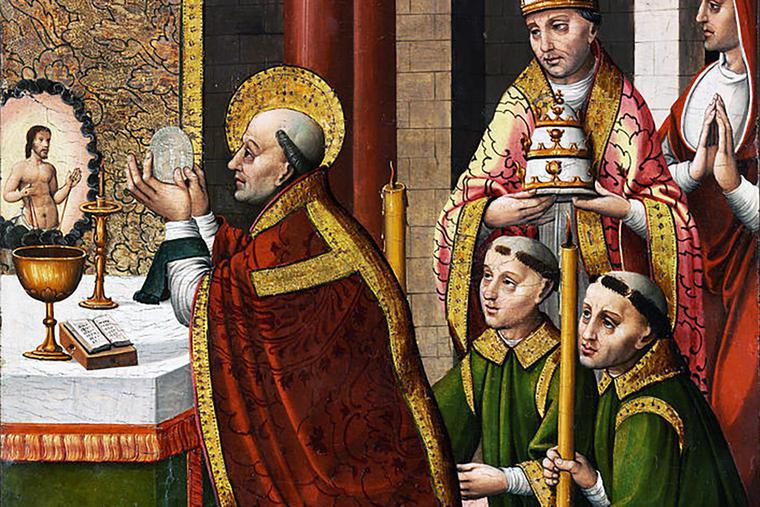

He did not have to struggle against heresies (apart from Donatism in Africa)– intellectual thought in the West was too feeble by that time to give rise to any – so his basic aim was teaching the faith. He was anxious to make available to all, monks, pastors and also laity, the wisdom of Scripture in Tradition. Hence his homilies on the Gospel and on Ezekiel, his Pastoral Rule for the use of clerics and particularly preachers, his endeavour to combine rather than separate the active and the contemplative life, his recourse to outstanding examples both biblical and contemporary, since God never ceases revealing himself. (It is through this that we know of St Benedict, from the second book of Gregory’s Dialogues.) He developed the use of singing in Church, so that it was to him that ‘Gregorian’ chant was ascribed,” although it is, in fact, much later in date.
In his homily on the Gospels he wrote:
In the two angels [who appeared in Christ’s tomb] we can recognize the two Testaments … They have come together where the Lord’s body is, because, by announcing in convergent fashion that the Lord took flesh, died, and rose again, the two Testaments are as it were seated, the Old at his head and the New at his feet. That is why the two cherubim who protect the mercy seat face each other … Cherub indeed means fullness of knowledge. And what do the two cherubim signify but the two Testaments? And what does the mercy seat represent but the incarnate Lord, of whom John says that he was made the propitiation for our sins?

When the Old Testament foretells what the New Testament declares accomplished in the Lord, they face each other like the two cherubim, their gaze fixed on the mercy seat, because they are looking at the Lord between them and they … are recounting in harmony the mystery of his loving purpose.

Olivier Clement wrote: “For a Christian, Scripture is not a matter for esoteric study. It is a Word of life for everyone; its concrete, direct language can touch the simplest souls, sometimes the simplest especially. And the mystery of it all will always be beyond the most erudite.
“There is a diversity of approaches to suit all conditions. Equally there are different stages on one and the same route. That is why we need to know how to carry along with us, without trying too hurriedly to explain them, the words that so far remain closed to us. Life, the partial deaths that life brings, the better reception of grace, all these may one day make us capable of understanding them.”
In his Commentary on the Book of Job Gregory wrote: “Sacred Scripture … tests the strong with its more obscure sayings and gives satisfaction to the simple by its concrete language, … it is intelligible to readers who have little culture, and educated people continually find new meanings in it. However, it also transcends all knowledge and all teaching by the very way in which it expresses itself. For it unveils the mystery in one and the same language throughout all its writings.
Those who are truly humble and really instructed are able, when they approach the heavenly secrets, both to understand certain of them that they have studied and to venerate others that they have not understood in order to protect what they have not yet understood.”
Also in his Commentary on the Book of Job he wrote:
“There are three stages in the life of those who are converted: the beginning, the middle, and perfection. At the beginning, those converted encounter the enticements of sweetness; in the middle, battles against temptation; at the end, the perfection of fullness. Sweetness at first to strengthen them; then bitterness to test them; finally the delight of the ultimate joy to establish them.”
Meditation
From his Commentary on Ezechiel: “In the contemplative life there is a great straining of the soul when it is lifting itself towards the heavenly heights, endeavouring to transcend all that it can see with the body, and pulling itself together in order to expand. Sometimes it is victorious and overcomes the resistance of the darkness of its own blindness. Then it attains, briefly and in a covert manner, something of the light that knows no bounds. Yet it quickly falls back into itself, and quits that light, repulsed, and returns within sighs to the darkness of its own blindness.

The Difficult Love
In his Great Pastoral Rule he wrote: “While the abbot is preoccupied with exterior matters he must not lessen his solicitude for the interior. Nor when he is preoccupied with the interior may he relax his watch on the exterior.
Otherwise, by giving himself up to pressing duties from outside, he would experience an interior collapse; or by keeping himself busy solely on interior matters, he would be neglecting his external duties towards his neighbour. Gregory the Great Pastoral Rule, 1,7 (PL 77,38)
A Paradoxical Morality
Those who humbly choose what is folly in the eyes of the world clearly contemplate the wisdom of God himself … What could be more foolish in the eyes of the world … than to abandon one’s possessions to thieves? To return no wrong for the wrongs one has suffered? … By virtue of this wise folly, one catches a glimpse of God’s wisdom, not indeed in all its completeness but already in the light of contemplation
Dialogues
Whereas the Moralia in Job addresses monks and the Regular Pastoralis pastors, Gregory’s Dialogues is directed at all the Italian people. Its intent is to edify them with examples of the saints of their native country, to encourage their imitation and through the miracles of the aints to demonstrate to the people of God that God is also manifesting his power in the world in their present difficult history.