
Saint Therese of Lisieux became a Carmelite nun at the age of 15 and died of tuberculosis at the age of 24. She said she would spend her time in heaven doing good on earth. In 1997 Saint John Paul II declared her a doctor of the Church.
Her older sister requested her to write her spiritual autobiography, which she called The Story of a Soul.
She described it as the “Springtime story of a little white flower written by herself and dedicated to the Reverend Mother Agnes of Jesus (my sister Pauline, the current prioress of the Carmelite Convent of Lisieux)”
Like Dante, she wondered why not all souls might be equal in heaven and why it seemed that some received greater grace than others. She wrote:


“Jesus consented to teach me this mystery. He placed before my eyes the book of nature; I understood that all the flowers that He created are beautiful. The brilliance of the rose and the whiteness of the lily don’t take away the perfume of the lowly violet or the delightful simplicity of the daisy……
“So it is in the world of souls, which is Jesus’ garden He wanted to create great Saints who could be compared to lilies and roses. But he also created little ones, and these ought to be content to be daisies or violets. Destined to gladden God’s eyes when he glances down at His feet. Perfection consists in doing His will, in being what He wants us to be.
When Therese was four her mother wrote of her and her eight year old sister. “The other day Celine was saying, ‘How is it that God can be in such a little Communion host?’ Little Therese said ‘That is not surprising since God is “all-powerful” It means He can do what he wants.’
Therese writes: “I remember a dream I had at that age. I saw two horrible little devils dancing on the rim of a barrel of lime. They were dancing with surprising agility. Suddenly they cast their flaming eyes on me, but at the same time, more scared than I was, they jumped off the barrel and went and hid in the laundry. When I saw how unbrave they were I went to the window and peered at them. The poor little devils were running around trying to escape my looks.
God allowed me to remember this dream to prove to me that a soul in a state of grace has nothing to fear from demons, who are cowards, and who will run away from a child’s glance.”


When she was four, her mother died of breast cancer. Later Therese wrote: “I understood that only in heaven would joy be without clouds”. Her older sister, Pauline (who was later prioress at Therese’s convent) became as a second mother to her and her father, whom she called “the king” was very close to her.
“Pauline was the one who heard my most intimate confidences, who enlightened all my doubts …. One time I was expressing surprise that God should not give equal glory in heaven to all His elect, and I was afraid that everyone would not be happy. Then Pauline asked me to get Papa’s big glass and to put it next to my little dice cup, and to fill them with water.Then she asked me which was the most full. Thus my dear second mother helped me understand that in heaven, God would give to each of His elect as much glory as they could hold, and so the last would have nothing to envy about the first.”
Dante in his Paradiso conveys the same thought.
Therese’s next oldest sister was Celine and just before Celine’s first communion, Therese recalled: “the New Year’s gifts that Pauline used to give to her little girls weren’t worth a lot but they gave them great joy. It is just that at that age we weren’t blasé. Our souls in all their freshness were opening like flowers that are happy to receive the morning dew…. The same breeze caused our petals to flutter, and what gave joy or sorrow to one, did the same thing at the same time to the other. Yes, our joys were shared.”
She was deeply disturbed after her mother died when she was four. But then when she was seven she wrote: “My First Communion remains engraved on my heart like a cloudless memory. It seems to me that I could not have been better disposed than I was, and then the troubles of my soul left me for nearly a year. Jesus wanted to cause me to taste as perfect a joy, as is possible in this valley of tears.”
After these delightful and unforgettable festivities, my life went back to being ordinary. That is, I had to go back to the life of a boarding school girl that was so painful to me.
At the time of my First Communion I loved that existence with children of my age, all full of good will, having made, like me, the resolution to practice virtue seriously. But I had to get back into contact with very different students, self-indulgent, not wanting to follow the rules, and that made me very unhappy. I was of a cheerful nature, but I didn’t know how to give myself over to the games of my age.
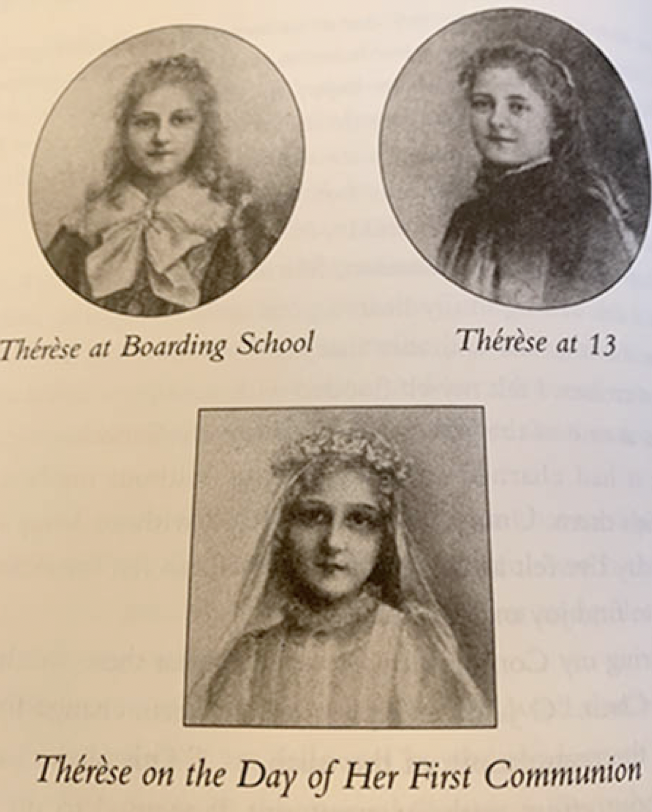
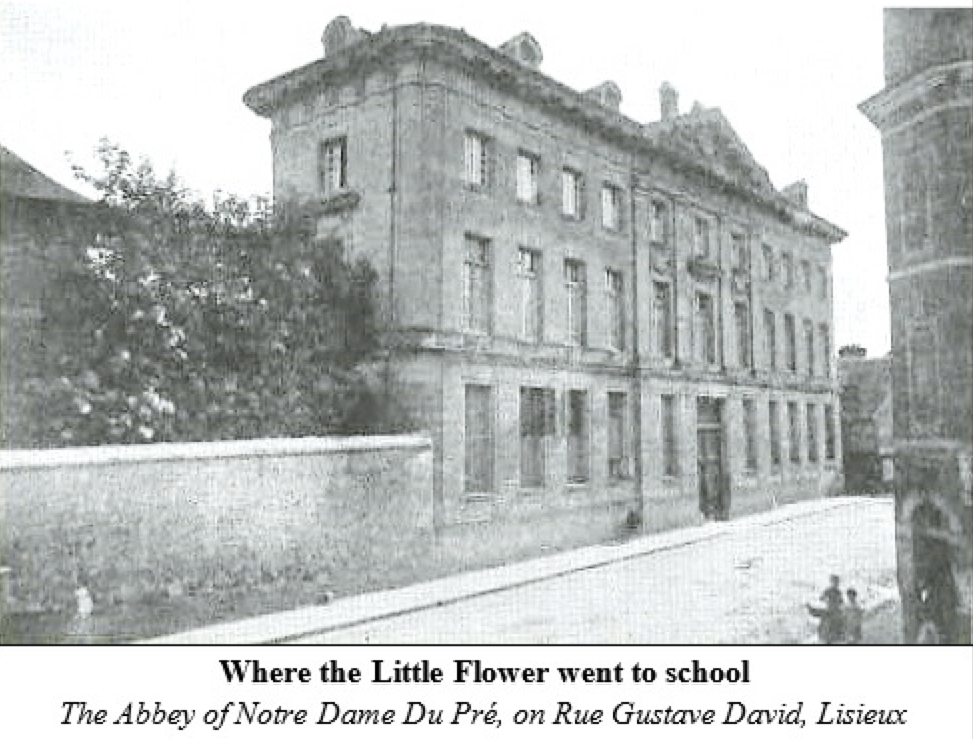
Often during recess I would lean against a tree, and there I would give myself over to serious reflections! I had invented a game I liked. It consisted in burying the poor little birds that we used to find dead under the trees.
Lots of students wanted to help. So our cemetery became very pretty, planted with trees proportionate to the size of our little feathered friends.
Often when I felt alone, I would walk in the courtyard I would often repeat these words that brought peace and strength in my heart: “life is your ship and not your dwelling!”
“One Sunday, as I was looking at a picture showing Our Lord on the cross, I was struck by the blood that was falling from one of His divine hands “(like the angels in Perugino’s picture).
“I felt great pain that this blood was falling to the ground without anyone hurrying to collect it, and I resolved to keep myself in spirit at the foot of the Cross in order to receive the divine dew that was flowing down from it, understanding that I must then spread it over souls. . Jesus’ cry on the cross also resounded continually in my heart: “I am thirsty!” These words set on fire within me a keen fervor that I hadn’t known before.
I wanted to give something to drink to my Beloved, and I felt myself consumed with thirst for souls. . . . It was no longer the souls of priests that attracted me, but those of great sinners. I was burning with the desire to snatch them from the everlasting flames. . .


In order to stir up my fervor, God showed me that my desires were pleasing to Him. I heard about a terrible criminal, who had just been condemned to death for some horrible crimes. Everything would lead one to believe that he would: die without repenting. I wanted at all cost to prevent him from going to hell. In order to do that I used every imaginable means: sensing that in myself I could do nothing, I offered to God all the infinite merits of Our Lord and the treasures of the Holy Church. Finally I begged Céline to have a Mass said for my intentions, not daring to ask myself, for fear that I would be obliged to admit that it was for Pranzini, the terrible criminal.”
Just before his execution “Pranzini had not confessed; he had climbed up onto the scaffold and was getting ready to put his head into the ominous opening in the guillotine, when gripped with a sudden inspiration, he turned back, grabbed a crucifix that the priest was holding up to him, and kissed its sacred wounds three times.
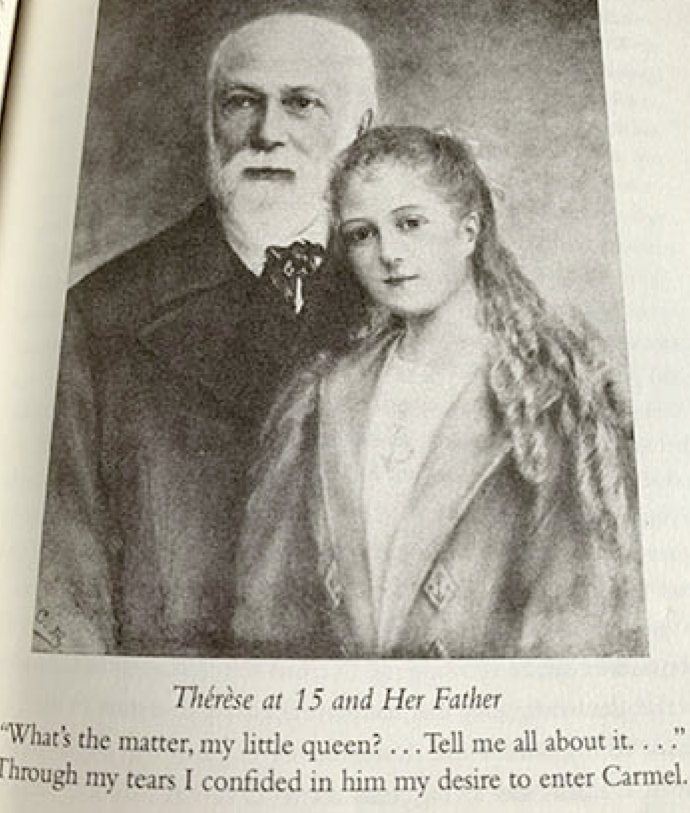
Therese told her father she wanted to enter Carmel and he approved. “Papa talked to me like a saint, and I would like to remember his words in order to write them here, but I have retained only a memory that is too sweet to be able to write it down.
“What I do remember perfectly was the symbolic act that my beloved king accomplished without knowing it. Approaching a low wall, he showed me some little white flowers that looked like miniature lilies, and taking one of those flowers, he gave it to me, explaining to me with what care God had caused it to grow and had preserved it until that day. And hearing him talk, I thought I was listening to my story, so much resemblance there was between what Jesus had done for the little flower and little Thérese.”

At this time she had this thought: “One night, not knowing how to tell Jesus that I loved Him and how much I desired that He be everywhere loved and glorified, I was thinking with sorrow that He could never receive in hell a single act of love. So I told God that to please Him I would willingly consent to find myself plunged into hell, so that He might be eternally loved in that place of blasphemy. . . . I knew that that couldn’t glorify Him, since He desires only our happiness, but when one loves, one experiences the need to say a thousand foolish things. If I spoke that way, it wasn’t because heaven excited my desire, but that my personal heaven was none other than Love, and I felt like St. Paul that nothing could separate me from the divine object that had stolen my heart! [Rom. 8:35-39] …”
In order to enter the convent of Carmel at only 15 she needed to travel to Bayeux to seek the Bishop Hugolin’s permission. She was very nervous but she wrote : “Love never meets with impossibilities, because it believes everything is possible and everything is permitted.”
At the age of 15 she put up her hair to look older as she wanted to convince Bishop Hugolin that she was grown up enough to become a nun. He did not however give permission and suggested she waited another four years. Three days after their interview she and her father and her sister Celine travelled to Rome for the jubilee of Pope Leo XIII.
Before their papal audience they explored the Colosseum: “Celine, who was more more farsighted than I, remembered that that the guide had indicated a paving stone in the form of a cross, as being one on which the martyrs had died. Finding it and kneeling on the sacred ground, our souls joined in one single prayer……….. My heart was pounding when my lips approached the dust that was tinged with crimson by the blood of the first Christians. I asked for the grace to be a Martyr for Jesus, and I felt in the depths of my heart that my prayer was being granted.”


On the day of the audience, “before entering the pontifical apartments I was quite resolved to speak, but I was told that we were forbidden to speak to Leo XIII since the audience was going on too long …. I turned to my beloved Celine to ask her opinion. “Speak,” she told me.
“A moment later I was at the Holy Father’s feet and kissed his slipper, and he was extending out his hand to me. But instead of kissing it, I joined my hands together and, lifting towards his face my eyes bathed in tears, I cried out, “Most Holy Father, I have a great grace to ask of you! . . . The Supreme Pontiff lowered his head toward me in such a way that my face almost touched his, and I saw his dark and deep eyes fix on me and seem to pierce me to the depths of my soul. “Most Holy Father,” I said to him, “in honour of your jubilee, allow me to enter Carmel at the age of fifteen!”.. He looked at me fixedly and pronounced these words, emphasizing each syllable: “All right ….. All right ….. You will enter if it is God’s will.’
“During our trip to Rome we had stayed in princely hotels. I had never been surrounded with so much luxury. I would have been happier under a thatched roof with the hope of entering Carmel, than surrounded by gilded paneling, with white marble staircases and silk carpets. Joy isn’t found in the objects that surround us; it’s found in the innermost recesses of the soul. One can possess it as well in a prison as in a palace. My soul had had enough of contemplating the beauties of the earth, the beauties of heaven were the object of its desires, I wanted to become a prisoner!” [that is a cloistered nun.]
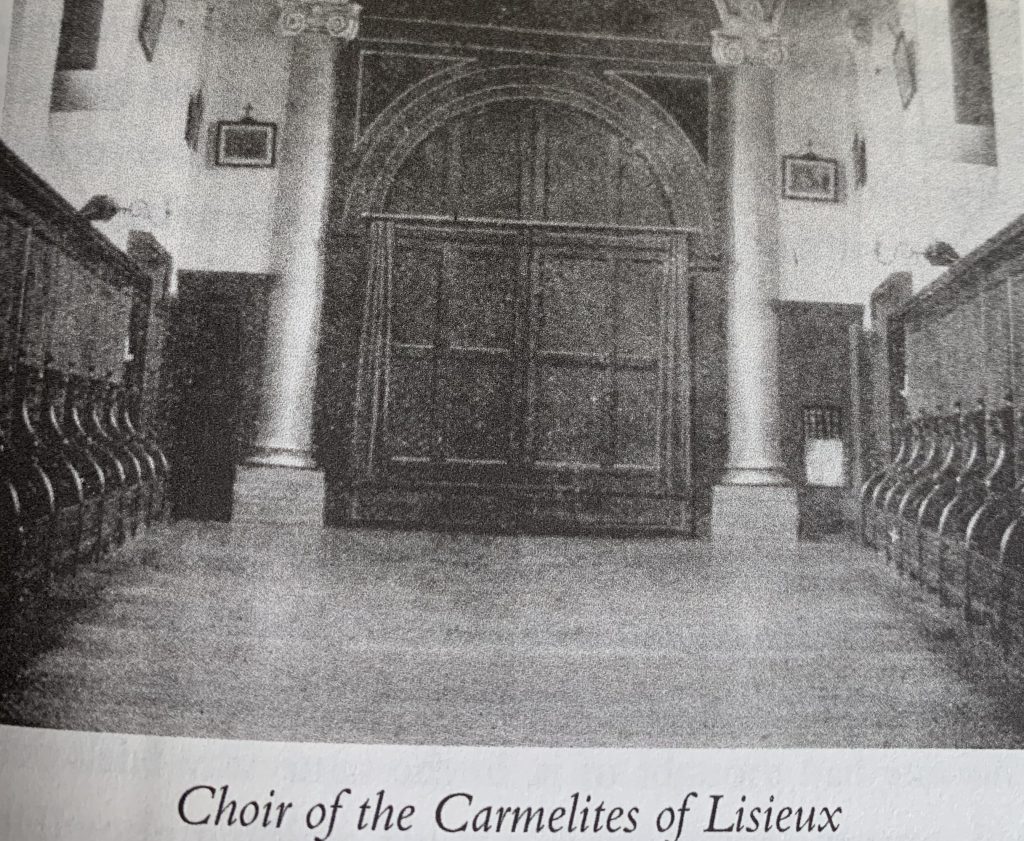
She entered the Convent of Carmel in Lisieux on 9th April 1888 on the Feast of the Annunciation. “Finally my desires had been accomplished, and my soul felt such sweet and such deep PEACE that it would be impossible for me to express it. And for seven and a half years that inner peace has remained my lot; it hasn’t abandoned me amidst the greatest trials.”
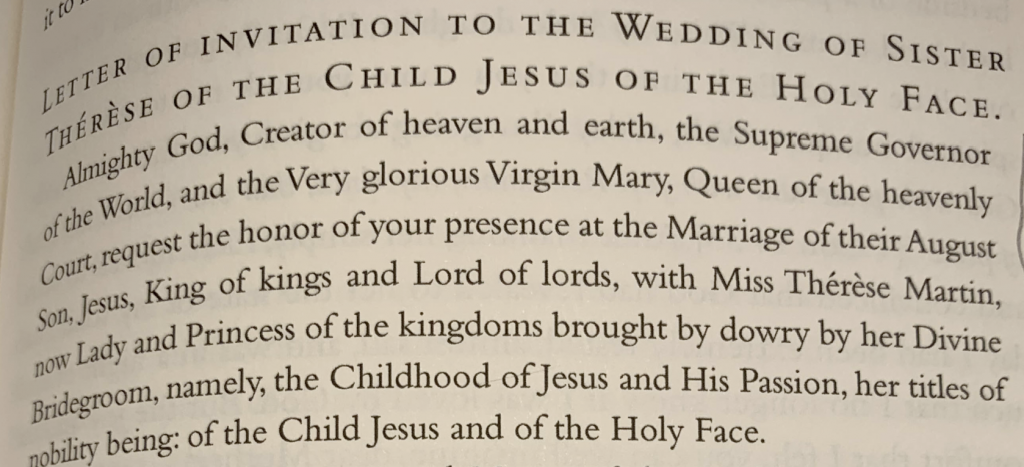
Two years later her cousin Jeanne was married: “I listened eagerly to everything that I could learn, because I didn’t want to do less for my beloved Jesus than Jeanne for Francis, who was no doubt a perfect created being, but who was, after all a created being.
I even had fun composing a letter of invitation to my final vows in order to compare it to hers:

Therese wrote of Mother Genevieve, Prioress when Therese first joined the order; and who died shortly thereafter:
“The day she departed for heaven I was particularly touched. This was the first time I was present at a death, and truly this was a delightful sight……. I was placed at the foot of the bed of the dying saint. I could see perfectly her slightest movements. It seemed to me that during the two hours that I spent in that way my soul ought to have felt full of fervour. On the contrary, a sort of insensitivity had taken hold of me, but at the very moment of the birth in heaven of our saintly Mother, my inner disposition changed. In a twinkling of an eye, I felt myself filled with an unutterable joy and fervour. It was if Mother Genevieve had given me a part of the bliss that she enjoyed, because I’m quite persuaded that she went straight to heaven.”

“The things of of heaven don’t belong to me any more than those of earth. They’ve been lent to me by God, who can take them away from me without my having the right to complain. However, the good things that come directly from God — upward risings of the mind and the heart, deep thoughts – all those things form riches to which one can become attached as much as to a material thing that no one has the right to touch.
“Mother, I’ve learned a lot by fulfilling the mission that you entrusted to me. Especially, I’ve found myself forced to practice what I taught others. So now I can say it: Jesus has given me the grace not to be more attached to the things of the mind and heart than to those of earth.
“I don’t spurn the deep thoughts that nourish the soul and unite it to God, but for a long time I’ve understood that I mustn’t lean on them and make perfection consist in receiving many spiritual illuminations. The most beautiful thoughts are nothing without works.”
“It’s true that others can gain a lot of profit from them, if they make themselves humble and show God their gratitude that He’s allowing them to share in the feast of a soul that it pleases Him to enrich with His graces.
“But if this soul takes delight in her beautiful thoughts and prays the prayer of the Pharisee (“I thank you that I am not like other people” [Lk. 18:1 1), it becomes like a person who’s dying from hunger, even though he’s sitting in front of a table laden with food, all the while watching his guests taking an abundant meal from it and sometimes throwing a glance of envy at him, the one who has so many possessions.
“Oh! There’s no good possession except God alone, who knows the depths of the heart. . . .”


“What stunted thoughts created beings have! . . . When they see one soul that’s more enlightened than others, instantly they conclude from this, that Jesus loves them less than that soul and that they can’t be called to the same perfection. Since when does the Lord no longer have the right to use one of His creatures to distribute, to the souls that He loves, the food that is necessary to them? In the time of Pharaoh, the Lord still had that right, because in Scripture He said to that ruler, ‘But I have raised you up for this very purpose, that I might show you my power and that my name might be proclaimed in all the earth” [Ex, 9:16]. Centuries and centuries have passed since the Most High pronounced those words, and since then, His behaviour hasn’t changed:
“He has always used His creatures as Instruments for doing His work in souls.”
“Beloved Mother, I’m a little brush that Jesus has chosen to paint His image on the souls that you’ve entrusted to me. An artist doesn’t use just one brush, he needs at least two. The first one is the most useful – with it he gives the general colours, completely covering the canvas in a short time. The other smaller one he uses for details.
“Mother, you represent for me the precious brush that Jesus grasps with love, when He wants to do a big work in the soul of your children. And I’m the very little one that He deigns to use afterward for the slightest details.”
Later on the subject of teaching novices she writes: “By teaching others I have learned a great deal. I saw first of all that all souls have just about the same struggles, but they’re so different from another point of view that I have no trouble understanding what Father Pichon said: “There’s a much greater difference among souls than there is among faces.””

About prayer she wrote: “There are so many prayers! And some are more beautiful than others. I wouldn’t know how to recite them all. Not knowing which one to chose, I do as children do who don’t know how to read: I very simply tell God what I want to tell Him, without making beautiful phrases and He always understands me.
“For me, prayer is an upward rising of the heart, it’s a simple glance toward heaven, it’s a cry of gratitude and love in the midst of trials as much as in the midst of joys. In short, its something big, something great, something supernatural, that expands my heart and unites me to Jesus.”
Finally Saint Therese has some advice on how to overcome distractions and irritations. She talked of another sister at evening prayers;
“As soon as she arrived she would make a strange little noise that sounded like two shells being rubbed together. I was really suffering from that noise. I was seeking a way to undergo it, not with agitation but with joy and peace, at least in the innermost part of my soul. So I made every effort to love that little noise that was so unpleasant. Instead of trying not to hear it (which would be impossible), I placed all my intention on hearing it well, as if it had been a delightful concert.”
“Another time I was doing laundry with a sister who kept throwing water in my face every time she picked up handkerchiefs. My first thought was to draw back and dry my face in order to show the sister what she was doing, but immediately I thought that I was silly to refuse such treasures that had been given me so generously. I made every effort to receive a lot of dirty water, so that in the end I had really taken a liking to this new form of sprinkling with holy water.”
At the age of 14 Therese had decided to dedicate her life in the Carmel to praying for the souls of priests. “I lived in the company of many saintly priests and I learned that, though their dignity raises them above the angels, they are nevertheless weak and fragile men.”
The year before she died Therese learned of Theophane Venard, a French missionary to Indo China, publicly executed in Hanoi in 1861 at age 31. During her last year Theophane became Teresa’s ideal priest. He was young when he happily died a martyr’s death, wrote cheerful letters to his family, had a sense of humour and was the missionary she could never be. During her final month she kept his picture taped to her bed curtain.


Driven literally underground Théophane had to breathe through holes in the ground. His letters, written from this hideout, convey a lilting quality and vivid details reminiscent of Therese’s style. He lived, he said like “a poor plant with spiders, rats and toads for companions; the only news being the daily reports of the torture of Christians.
“I live on without being too bilious. My only weakness is my nerves. I need something strengthening like wine, but we have barely enough to say Mass, so I must not think of it.”
When Theophane was captured, he was chained by the neck and ankles in a bamboo cage and taken to Hanoi. After two months in his cage he wrote home:
“Can you picture me sitting quietly in the middle of my wooden cage, born by eight soldiers, besieged on all sides by a huge crowd, who almost barred the passage of the troops? ‘What a pretty little fellow that European is’, I heard some of them saying, ‘he is gay and cheerful, as if he were going to a feast. He doesn’t look a bit afraid.’
13 days after he wrote these words Theophane was paraded through the streets removed from his cage and executed publicly by means of a cruel, slow beheading.
It was not his martyr’s death which appealed so much to Therese, but Theophane himself a real human, being brought alive through his letters. A few months before he died, Therese composed an entirely personal poem in Théophane’s honour:
Your brief exile was a sweet canticle
Whose accents know how to touch hearts
And for Jesus your poet’s soul
At each instant made flowers spring to life
Rising towards the celestial sphere
Your charm of farewell was still full of spring
You murmured: “Me the little ephemeral one
In the heavens I’m going to be the first.”
… to suffer for God seems to you a delight
smiling you knew how to live and die ….
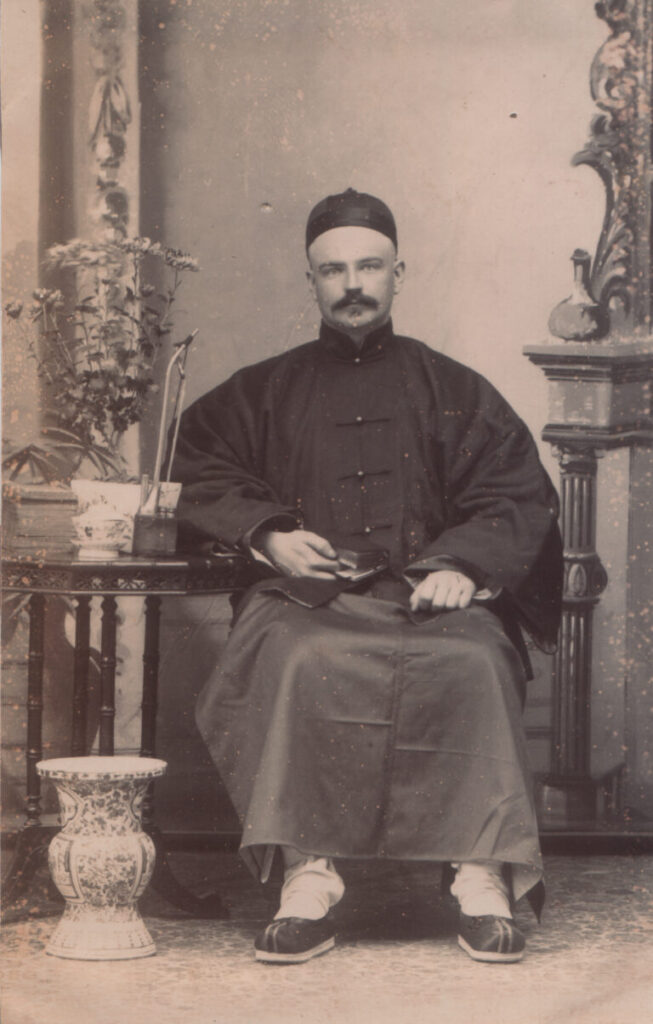
The year before Therese’s death Mother Marie de Gonzague assigned her a spiritual brother scheduled to be ordained within weeks and to leave for China that summer. Once arrived, Father Adolphe Roulland wrote to her:
“From one day to the next we might be stabbed. We should not be martyrs in the full sense of the term, but if we direct our intention right, if we say for instance, ” my God it is for love of you that we have come here. Accept the sacrifice of our lives and convert our souls,” should we not be martyrs enough to go to heaven? One young man was strangled and cooked in a pot. They offered this dish to the person, who told us the story and saw the victim’s two legs. If the brigands murder me and I’m not worthy to enter immediately into heaven, you will haul me out of Purgatory and I shall go and wait for you in Paradise.”
Therese replied: “I do not understand my brother why you seem to doubt of your immediate entry to heaven, if the infidel took your life.”
At the start of their friendship, Roulland had given her a photograph of himself. She poured out her delight: “Our Mother allowed me to keep my brother’s photograph. It is a very special privilege. A Carmelite does not have even the portraits of her nearest relations, but Our Mother said yours, far from reminding me of earthly affections, will raise my heart to regions far above. The picture you gave me lies always on my heart in the book of the Gospels, which never leaves me.”
In a postscript she had written: “please pray for a seminarian who wants to be a missionary. His vocation has been shaken by his year of military service.” This was Maurice Belliere, her first spiritual brother. They Exchanged several letters which I summarize:

Belliere:
Therese:
Belliere:
Therese:
Belliere:
Therese:
I have done some extraordinarily stupid things, but still want to be a priest.
I assure you, Monsieur l’Abbe, that I’m doing all the lies in my power to obtain the grace you need. Those graces will surely be granted, for Our Lord never ask for sacrifices beyond our strength
I love the poem Vivre l’Amour that you sent me.
My dear little brother, my heart refuses to go calling you Monsieur l’Abbe.
I love your poems in which you talk of spear, helmet and armour. I smile at the thought of you being so armed.
As a child I dreamt of fighting on battlefields… Joan of Arc’s exploits enchanted me. It seemed to me that Our Lord destined me to great things I was not mistaken but in place of voices from heaven, inviting me to battle, I heard in the depths of my soul a voice sweeter, more powerful still, calling me to other exploits in the solitude of Carmel. I realized that my mission was not to get a mortal King crowned, but to get the King of heaven loved.
Therese detected in Bellière a common belief that the nuns in Carmel were all great souls. “My dear little brother”, she wrote..”God did not give you a great soul for your sister, but one that is very small and very imperfect.”
Meanwhile his mood had changed. He began, “I have never chanted with more enthusiasm than yesterday the first stanza of the canticle of love.” He planned to leave the 1st of October for Algeria to train as a missionary. But the letter closed with the attitude Therese detected more and more – self-laceration: “How I must bore you, distract you with all this verbiage, which it seems that I speak of myself to excess. Pardon me in truth. I assure you I am a wretch.”
Therese replied: “never think that you bore or distract me. Would it be possible for a sister not to take an interest in all that touches her brother. I know their are saints ewho spent their lives in the practice of astonishing mortifications to expiate their sins, but what of it? In my Father’s house there are many dwellings.”
Finally grasping that his cheerful correspondent is dying Maurice Bellière is stunned by what he termed this blow. As sick as she was Therese wrote him three more letters, including the sentence: “I am certain that I shall aid you better to walk that delightful way, when I’m free of my mortal envelope”
To learn more of Maurice Belliere go this page of the
Missionaries of Africa White Fathers

Therese said to Our Lord: “After earth’s exile, I hope to go and enjoy you in the fatherland, but I do not want to lay up merits for heaven. I want to work for your love alone…. In the evening of this life, I shall appear before you with empty hands, for I do not ask you, Lord, to count my works. All our justice is blemished in your eyes. I wish, then, to be clothed in your own justice and to receive from your love the eternal possession of yourself.”
Together with Benedict of Nursia, Ignatius of Antioch and Francis of Assisi, Therese is a patron of the Community of the Sons and Daughters of God.