John Hu’s son wrote: “My father wanted to give Chinese culture, which he viewed as a sleeping giant, a much-needed spiritual and intellectual impetus. He believed that the cultural recovery of Asia would come through the West. And while in the West, he saw this as part of his own calling. Though Beyond East and West is a deeply personal spiritual odyssey, it is also a work of vast cultural and intellectual importance.”
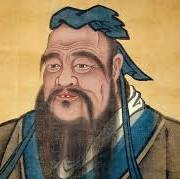
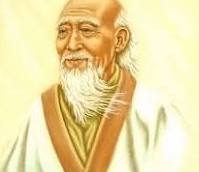
Viewing history as a continuous unfolding of the drama of salvation, my father seemed to be saying in his autobiography, “If Augustine of Hippo and Thomas Aquinas could make copious use of the Greeks in penetrating the Heart of Christ, I too am at liberty to see Christ through Confucius, Lao Tzu, and other Chinese sages!”
My father sought long and hard for a Christ whose signature was that of the divine heart, because he felt a mind acting without a heart is absolutely incapable of penetrating deeply into the sublime regions of life itself.
As a son and child—being the tenth and fourteenth, respectively—I shall always be grateful to both of my parents for letting us share in their charmed and saintly lives.
John Wu, Jr. January 31, 2017
Prologue
Intellectually, I wobbled between scepticism and animal faith; morally I was a full-fledged libertine. I sneered at what I could not understand; I gave rein to the wanton appetites of sense. A slave to the world, I made myself an apostle of liberty. A well with no water in it, a cloud driven before the storm, I thought myself a clever man.
To be born a Chinese in my generation is to run the gauntlet of an endless series of births and deaths. Customs and ideologies have changed with furious rapidity.
The awareness that I was nearing forty, but had not yet attained to the Truth to which I could give my heart without reserve, that awareness was at the source of my misery. I felt like a middle-aged maiden who had had many a disappointment in love affairs and was afraid that she would remain a spinster for life.
It seemed as though God was playing hide-and-seek with me. But my failure to find Him was due entirely to my fault. Instead of seeking Him according to His way as revealed by Christ, I was seeking Him according to my own way.
When I wrote these things, I was, from the worldly and material standpoint, in the most prosperous period of my life.
The more I consider my life, the more I am convinced of the truth of St. Augustine’s aperçu that God has made us for Himself and that our hearts are restless till they rest in Him. Grace is all. Nobody can come to Christ without first being drawn to Him by the Father (John 6.44), nor can any one come to the Father except through Christ, nor can any one be sanctified except through the Sacraments of the Church.
Part 1
Chapter 1. The Gift of Life
I started life with high hopes, but whenever I compare my ideals with what has actually happened, I feel quite tickled by the glaring contrast. Perhaps this is why I have become so humorous and so chastened. For, what is humor but a certain spontaneous tendency to laugh at one’s own follies and failings, with the humility of a frank recognition of the stark truth? Indeed, God has a knack of drawing good from evil.
I was born in the city of Ningpo, at a place called “The Twenty-four Mansions.” “Ningpo” literally means “peaceful waves.”
The Ningponese are not refined people, but they are warmhearted and honest, full of vitality and the spirit of adventure. They take to business and industry more than to arts and letters; but they are brainy and prolific, perhaps because they feed mostly on fish and other kinds of sea food.
In my childhood, one often heard such talk as: “Look, the sun has already walked down the third step, it is about time to cook the lunch”; or “The chickens have entered their cage, your Daddy will come home soon”; or “Look at the red clouds, tomorrow will be hotter than today”; or “Hark! the magpie has cried three times just over your head, tomorrow there will be some good news for you.”
Chapter 2. My Father
His whole personality radiated, with unconscious spontaneity, a warm sympathy for all. He was rather fat, breathing slowly and smiling benignly. One imagines that his bosom was as vast as an ocean in which boats of all tonnages could sail freely, from ocean-liners to little fishing-boats. An ocean truly pacific, with no navy fleet nor submarines. There was really a heavenly atmosphere about him.
Once an old man in our neighborhood was sick. His head was swimming, and lying in bed he saw the furniture of his room whirling around him. My father visited him and sat by his bed. They talked for about an hour. The sick man told his wife, “As soon as Master Ch’ang entered the room, the furniture ceased to move; but as soon as he went away, they have begun to whirl around again!”
A well-known Confucian scholar of Ningpo remarked: “The life of your father was like a beautiful essay, in which words and sense, ideals and facts, emotions and reason, tenderness and strength, the yin and the yang, are formed into a perfect harmony. Among scholars I have not found such a wonderful personality, though they may be able to write beautifully. Although he could not write so well, his life was in itself a marvelous essay.”
My father died at sixty-three, when I was ten. On his death bed, he seemed to be in ecstasy during several hours, casting glances from time to time at the windows and saying constantly, “Behold, eight busa (gods or angels) to conduct me to Heaven! What a condescension! How unworthy I am of it!” His countenance was illumined by a truly celestial smile. He breathed his last with a wonderful peace.
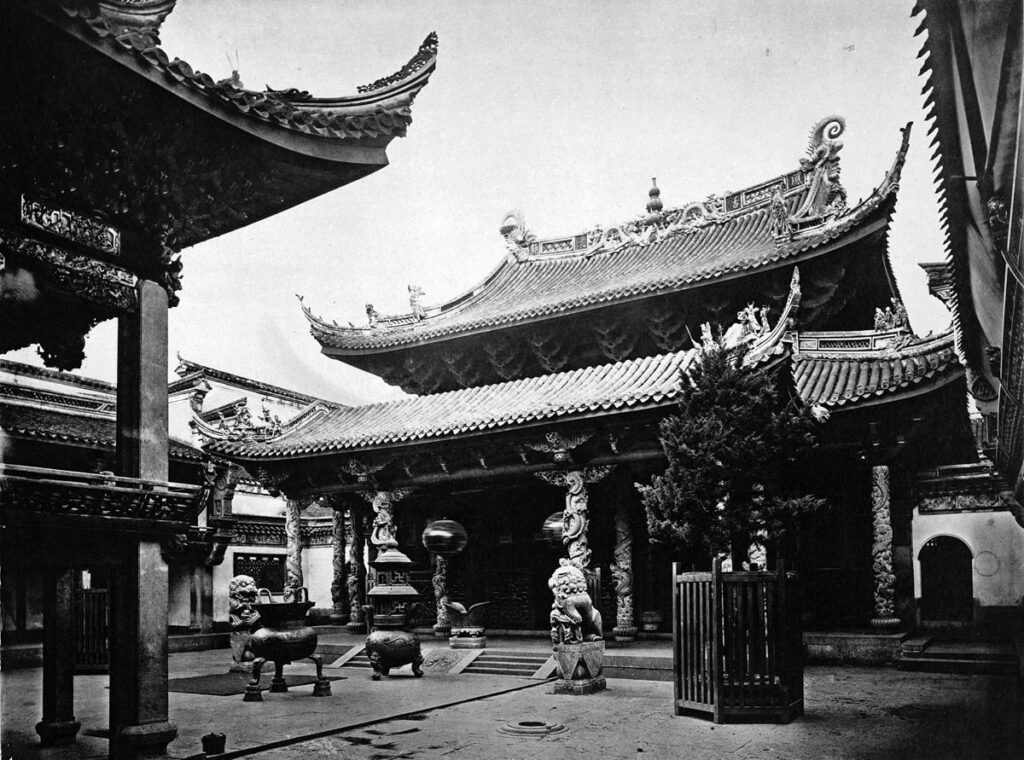
Seven days after his death, it was reported to us one evening, a peddler possessed by a spirit had seen a vision of my father sitting in the city temple of Ningpo. So there was a widespread rumor of his becoming a city god.
I often recall the words of St. James: “Religion clean and undefiled is this: To visit the fatherless and widows in their tribulation and to keep one’s self unspotted from this world.” In this sense, my father is a Catholic, a citizen of the spiritual Jerusalem.
Chapter 3. My Little Mother
The spirit of my mother helps me to understand Taoism; the spirit of my father helps me to appreciate Confucianism. The Taoist in me looks at the vicissitudes of fortune as the succession of day and night, spring and autumn, in the natural order of things. The Confucian in me urges me on in the cultivation of Love, which alone lasts. Thus, I am prepared for the worst but hope for the best.
On the eve of my birth my little mother saw in α dream an old man with a white beard leading a young man on horseback as far as the threshold of her chamber. The old man stopped and said to her, “Madam, this is your son.” Then he left. The horse entered and went directly towards my mother; and at the same time the young man was continually somersaulting on the back of the horse, until finally he entered the womb of my mother. This awakened her from her sleep, and early in the morning I was born.
Μy own interpretation was that I was destined to be a circus actor, for the Chinese word for circus was “horse-play.” Once at a circus I was deeply impressed by a woman walking a tightrope with a pole for balance. She did it so well that it appeared as though she were walking on the plain ground. When I returned home, I tried to emulate her. I tied a rope between a pillar and a millstone about the height of my body. I took a pole in my hands for balance. I set my feet on the rope. Everything was bidding fair; but suddenly the rope snapped, and I fell headlong to the ground, remaining unconscious for a few moments. That was my first fall, and, physically speaking, my greatest fall.
The womb of my mother symbolizes the Catholic Church. The boy is myself. The constant jumping and somersaulting symbolize all the changes, commotions, and upsettings which I had to experience during the long, restless night before I embraced the true Faith.
Chapter 4. My Big Mother
If I am asked who of all human beings is dearest to me, I would answer without the slightest hesitation that it is my big mother. I have dreamed of her more often than of any other person. I have wept more tears in memory of her than of anyone else.
Nobody is perfect, and my big mother had her faults, the chief of which was her intense jealousy of my little mother.
When I was fifteen years old, I had typhoid fever. She nursed me for twenty days. Finally, she collapsed. Upon my waking one morning, I was surprised to find that she had not yet got up. It was not usual, for she was an early riser. When I looked at her, I saw her eyes wide open, but she could not speak. One of her blood vessels had burst on account of her excessive worry and labor during my sickness. She could still recognize me, and shed tears silently. She remained in that state for ten days before she died.
One day as I was looking at myself in a mirror, a thought suddenly shot through my mind and I was cured of sorrow at once. “After a few decades at the most, I too shall die, and then I shall be reunited with my mother.” But who could have foreseen that even before my death, God would give me a Mother who does not die?
Chapter 5. The Philosophy of the Nursery
It was G.K. Chesterton who said, “My first and last philosophy, that which I believe with unbroken certainty, I learnt in the nursery.” At about the age of five I remember seeing Amah Lin, a fat maid servant, weeping piteously because her lower jaw was disjointed. I was told that this because because she had laughed too much. My sense of humour had been awakened and I burst into laughter with my hands carefully holding my lower jaw.
At six I read The Twenty Four models of Filial Piety, in which the young emperor Shun had a stupid father a perverse mother and an insolent brother. He was ordered by his father to cultivate the fields. Elephants came and helped him and birds to weed the grain. .One day his father told him to go down into a well and his brother can stones on him, but he came out miraculously through another opening. His virtuous life got the ears of the Emperor who gave him two of his daughters marriage. He loved his parents and his brother in spite of their treatment of him. From this I learnt the Chinese proverb: Heaven has eyes.
From nine to twelve I was at primary school, where I had to learn many of the Analects of Confucius by heart, for example: The master said is ‘it not a true pleasure to learn and constantly to practice what we have learned? Is it not a real joy to have friends come to us from afar? Is it not the mark of a gentleman not to feel sad even when his merits are not recognized by others?”
I was bent upon learning. In fact we had to memorize and recite the whole book. The meanings were only half digested, but like the ox we often found ourselves ruminating over them, chewing the cud so to speak of the classics. Thus the philosophy of the ancient sages was gradually digested and absorbed and turned into the living tissue of our mental make up
From the age of nine I began to learn English, which I loved. I now think in English, but I feel in Chinese. That is why I have produced only Chinese poems.
Chapter 6. Adam and Eve – a Chinese Marriage
Chapter 7. John is my Name
It was fashionable at that time to choose Western names and I liked the ring of the name John. Much later I discovered that my birthday was on the Feast of St. John Capistrano who like myself was also a lawyer. In the Spring of 1917 I enrolled in the Comparative Law School of China in Shanghai. It was the Dean, Charles Rankin of the Methodist Mission, whose example of goodness and learning inspired me to be baptized a Methodist that winter.
Can it be a mere coincidence that the saintly Abbot Dom Pierre Celestine Lou, who gave the Nihil Obstat to my Chinese version of the New Testament, should have taken a special fancy to my translation of the Gospel of St. John? I myself felt most at home in translating the Epistles of St. Paul. But the Abbot thought that the version of St. John’s Gospel was my masterpiece!
Thus did the paths of the two greatest Chinese of the 20th Century meet.
Chapter 8. The Hound of Heaven
The influence of Goethe’s Faust on me was especially strong. I was so completely enchanted by it that I identified myself with Doctor Faust, and became a close friend of Mephistopheles. I desired to experience everything, including Hell itself! At the same time, I had a mysterious confidence that God would finally triumph over me and my dear friend Mephistopheles. When I read in the Prologue what the Lord said to Mephistopheles:
That a good man, by his dim impulse driven,
Of the right way hath ever consciousness.
My heart leaped with joy, but my feet lightly followed the steps of the devil. Imitating Faust, I was playing with my soul. The romantic strain in me readily responded to his heroic words:
And in myself I’ll gratify each yearning,
Assigned in sum to the whole race of mortals.
All heights and depths my mind shall compass single;
All weal and woe within my breast shall mingle;
Till mine own self to mankind’s self expanded,
Like it at last upon Time’s reef be stranded.

As could have been expected, the result was exactly as he described:
Chapter 9. The Story of a Friendship
In 1920 I went to the States to study at Michigan Law School; and thereafter I was awarded a traveling fellowship from the Carnegie Endowment for International Peace and I chose to go to the University of Paris. During this time, in spite of our great age difference, I struck up an epistolatory friendship with Oliver Wendell Holmes, one of the most influential American judges in history. I first met him on my return to the States in 1923.
He was in the most cheerful of moods. He showed me round his library, picking up one book after another, commenting on them casually but most interestingly. He showed me his collection of the woodcuts and engravings of Albrecht Durer. Finally, he said, “My dear boy, I have not yet shown you the best books in this library.” I picked up my ears and asked, “Where are they?” He pointed at an upper corner; and I saw that it was an empty shelf ! I understood immediately and burst out laughing. I said, “How characteristic of you! You are always looking ahead !” He smiled sweetly.
Later I wrote to him, “You seem to represent a perfect harmony of the most contradictory qualities. You are old, yet you remain in merry childhood; you are a jurist, yet no poet has a sweeter nature; you are tough minded, going by solid facts, yet there is in you a lightness of heart.” Another time, I added, “Ever since I saw you, I have got, as by contagion, a peculiar sense of humour I did not possess before.”
Chapter 10. “Law Is My Idol”.
Holmes and I were two old babies. I was a baby who was an old man. He was an old man who was a baby. And the two old babies corresponded with each other for fourteen years on questions belonging more to eternity than to time.
He used to advise me, “To tackle the unromantic with resolution make it romantic.” Taken on face value, this moves entirely in the natural sphere. But this does not prevent me from applying it to the spiritual sphere, so as to transmute, with the indispensable help of grace, the most ordinary things of life into eternal values. Thus uplifted, the attitude of Holmes is clearly akin to the spirit of Saint Therese. As her sister Marie used to tell her as a child, “Look at those who want to become rich, and see how they toil for gold. Now, little Therese, with far less trouble and at any hour of the day, we can lay up treasures in the Kingdom of God. Heavenly diamonds are so plentiful that we can gather them, so to speak, with a golden rake, and we do this by performing all actions for the love of God.”
In one of his last letters to me Holmes observed that I alternated violently between exaltation and despair. An article I wrote later in 1940 on Blaise Pascal indicates what changes had been wrought in my soul by then.
No lay philiosopher has understood better the spirit of the Christian religion more profoundly than he has. He has taken his time to live into it, and therefore knows what he is talking about. tells us, for instance, that the Christian religion makes those tremble whom it justifies, and consoles those whom it condemns; that “it humbles infinitely more than reason alone can do, but without despair,” and, “exalts infinitely more than natural pride, but without inflating.” No one could have read these words, unless he had felt in his very bones this mysterious compound of humble exaltation. Left alone to himself, a man swings back and forth ceaselessly, like a pendulum between depression and exhilaration. But with the help of Jesus, the swinging becomes so powerful that it describes a complete circle, in which each point is at once exaltation and humility.
Chapter 11. De Profundis
In 1938 I was to be 40, but the all merciful Father, just a few days before 1938, snatched me from the grip of the devil and saved me from myself. I was received into the Holy Catholic Church on December 18 1937 and the nightmare which lasted for more than seven years came to an end.
Now as a family we usually go to Mass together. Every time I find myself kneeling before the communion rail by the side of my wife, I feel a thrill of joy and wonder. It is as though the ceremony of drinking the love-wine were renewed in a transfigured form from day to day.
God has opened my eyes gradually to the interior qualities of my wife to such a degree that, whereas I formally thought she was not worthy of me, now I realize that I am not worthy of her. Christ has become the living bond between us. We have become two hands folded in eternal adoration. Many times, of course, the old Adam and Eve have come back again, the old Adam especially. They die pretty hard and whenever they are alive and kicking they bring discord with them; but the Divine Composer is always waiting for us at the confessional and every time we bring our little discords to Him, he resolves them into a sweeter harmony than ever.