French Bishop and Doctor c. 310 – c. 367

He was sometimes referred to as the “Hammer of the Arians”  and the “Athanasius of the West”.[3] His name comes from the Latin word for happy or cheerful. In addition to his important work as bishop, Hilary was married and the father of Abra of Poitiers, a nun and saint who became known for her charity.

His parents were pagans of distinction. He received a good pagan education, which included a high level of Greek. He studied, later on, the Old and New Testament writings, with the result that he abandoned his Neo-Platonism for Christianity, and with his wife and his daughter (traditionally named Saint Abra), was baptized and received into the Church.

 He tells us of a quest for the truth which led him little by little to recognize God the Creator and the incarnate God who died to give us eternal life. Baptized in about 345, he was elected Bishop of Poitiers around 353-354. In the years that followed, Hilary wrote his first work, Commentary on Saint Matthew’s Gospel. It is the oldest extant commentary in Latin on this Gospel.

In 356, he took part as a Bishop in the Synod of Béziers in the South of France, the “synod of false apostles”, as he himself called it, since the assembly was in the control of philo-Arian Bishops who denied the divinity of Jesus Christ. “These false apostles” asked the Emperor Constantius to have the Bishop of Poitiers sentenced to exile. Thus, in the summer of 356, Hilary was forced to leave Gaul.

Banished to Phrygia in present-day Turkey, Hilary found himself in contact with a religious context totally dominated by Arianism.

Here too, his concern as a Pastor impelled him to work strenuously to re-establish the unity of the Church on the basis of right faith as formulated by the Council of Nicaea. To this end he began to draft his own best-known and most important dogmatic work: De Trinitate (On the Trinity).

Hilary explained in it his personal journey toward knowledge of God and took pains to show that not only in the New Testament but also in many Old Testament passages, in which Christ’s mystery already appears, Scripture clearly testifies to the divinity of the Son and his equality with the Father.

To the Arians he insisted on the truth of the names of Father and Son and developed his entire Trinitarian theology based on the formula of Baptism given to us by the Lord himself: “In the name of the Father and of the Son and of the Holy Spirit”.
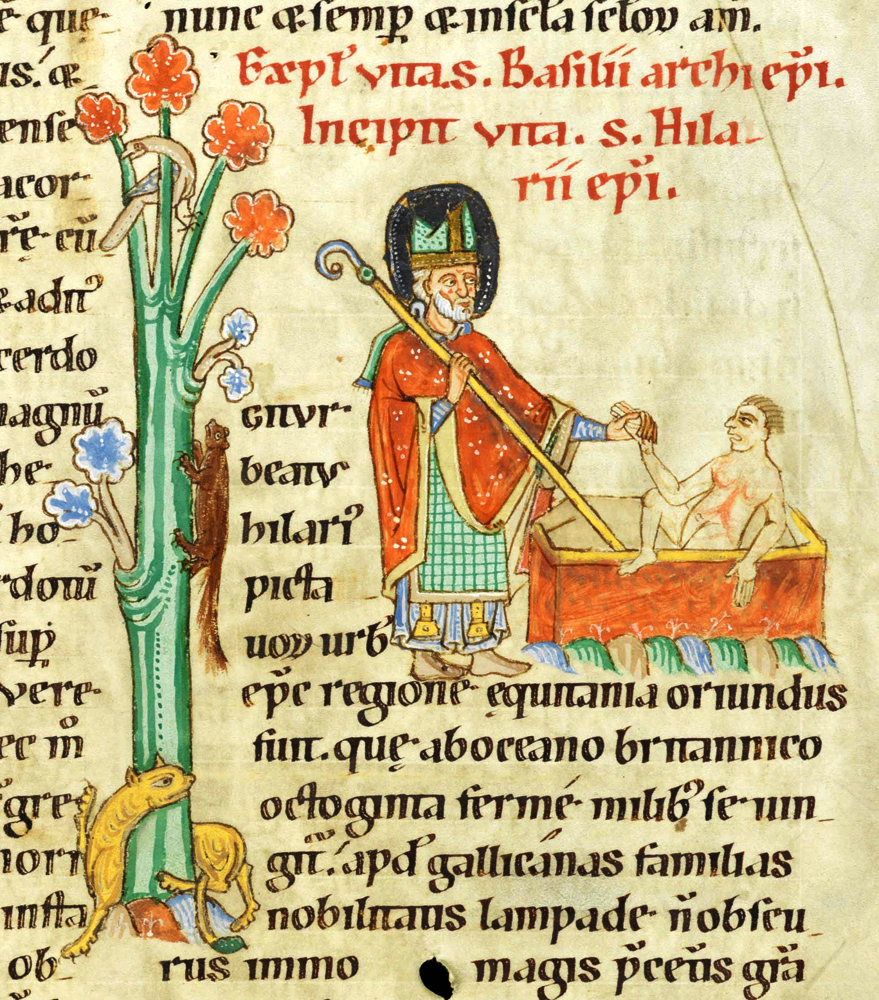
St. Hilary Revives the Dead Infant. The Golden Legend's account of this miracle has Hilary lying down in the dust and praying beside the dead body until the two of them rise together.
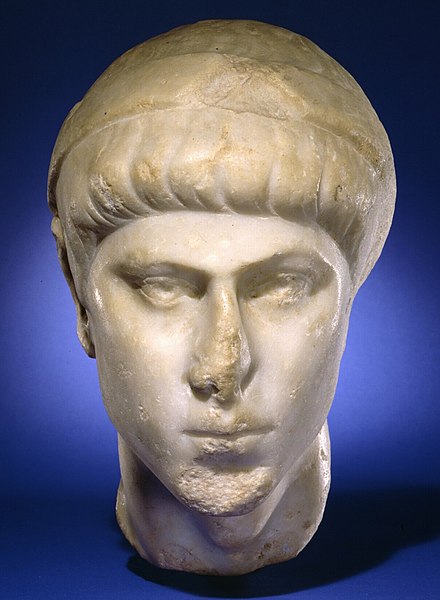
Head portrait of Constantius II found in modern al-Bab, Syria
Hilary attended several synods during his time in exile, including the council at Seleucia (359) which saw the triumph of the homoion party and the forbidding of all discussion of the divine substance.

In 360, he tried unsuccessfully to secure a personal audience with Constantius, as well as to address the council which met at Constantinople in 360. When this council ratified the decisions of Ariminum and Seleucia, Hilary responded with the bitter In Constantium, which attacked the Emperor Constantius as Antichrist and persecutor of orthodox Christians: “a tyrant whose sole object had been to make a gift to the devil of that world for which Christ had suffered.”

Hilary’s urgent and repeated requests for public debates with his opponents proved at last so inconvenient that he was sent back to his diocese, which he appears to have reached about 361, within a very short time of the accession of Emperor Julian.

On returning to his diocese in 361, Hilary spent most of the first two or three years trying to persuade the local clergy that the homoion confession was merely a cover for traditional Arian subordinationism.

In about 361, with Hilary’s encouragement, Martin, the future bishop of Tours, founded a monastery at Ligugé in his diocese.

In 364, Hilary extended his efforts once more beyond Gaul. He impeached Auxentius, bishop of Milan, a man high in the imperial favour, as heterodox. Emperor Valentinian I accordingly summoned Hilary to Milan to there maintain his charges. However, the supposed heretic gave satisfactory answers to all the questions proposed. Hilary denounced Auxentius as a hypocrite as he himself was ignominiously expelled from Milan. Upon returning home, Hilary in 365, published the Contra Arianos vel Auxentium Mediolanensem liber, describing his unsuccessful efforts against Auxentius.

According to Jerome, Hilary died in Poitiers in 367.

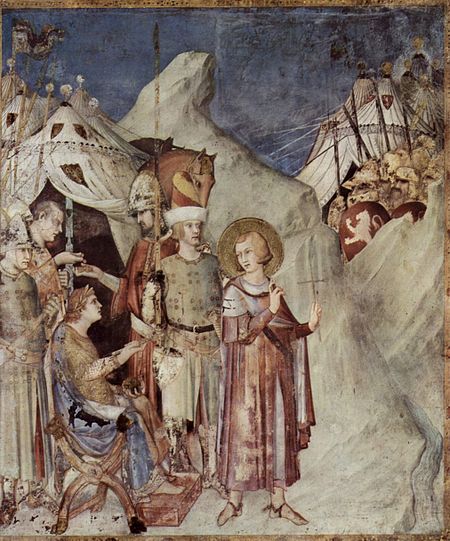
St Martin leaves the life of chivalry and renounces the army. Fresco by Simone Martini.
Oxford

To this day one of the terms of the English courts and the Spring semester of the Universities of Oxford and Durham are called Hillary term, because they traditionally commence on or about January 13, the day of Saint Hilary.

Durham