
Early years
Anthony was born in Koma in Lower Egypt to wealthy landowner parents. When he was about 20 years old, his parents died and left him with the care of his unmarried sister. Shortly thereafter, he decided to follow the gospel exhortation in Matthew 19: 21, “If you want to be perfect, go, sell what you have and give to the poor, and you will have treasures in heaven.” Anthony gave away some of his family’s lands to his neighbors, sold the remaining property, and donated the funds to the poor. He then left to live an ascetic life, placing his sister with a group of Christian virgins.

Hermit
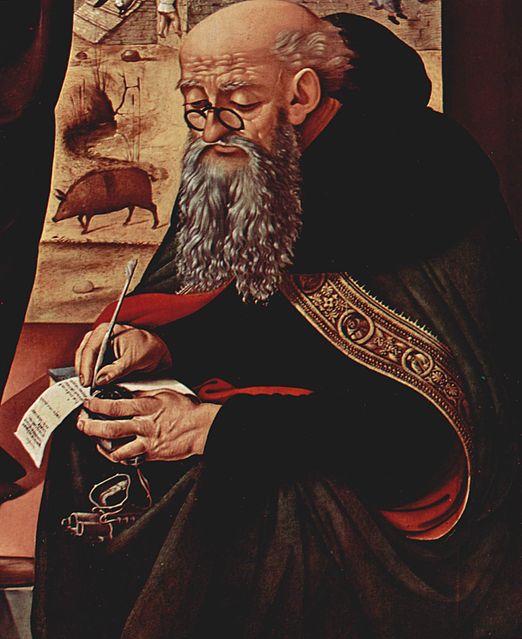
For the next fifteen years, Anthony remained in the area, spending the first years as the disciple of another local hermit. There are various legends that he worked as a swineherd during this period.
He is sometimes considered the first monk, and the first to initiate solitary desertification, but there were others before him. There were already ascetic hermits (the Therapeutae), and loosely organized cenobitic communities were described by the Jewish philosopher Philo of Alexandria in the 1st century AD as long established in the harsh environment of Lake Mareotis and in other less accessible regions. Philo opined that “this class of persons may be met with in many places, for both Greece and barbarian countries want to enjoy whatever is perfectly good.” Christian ascetics such as Thecla had likewise retreated to isolated locations at the outskirts of cities. Anthony is notable for having decided to surpass this tradition and headed out into the desert proper. He left for the alkaline Nitrian Desert (later the location of the noted monasteries of Nitria, Kellia, and Scetis) on the edge of the Western Desert about 95 km (59 mi) west of Alexandria. He remained there for 13 years.
Anthony maintained a very strict ascetic diet. He ate only bread, salt and water and never meat or wine. He ate at most only once a day and sometimes fasted through two or four days.
According to Athanasius, the devil fought Anthony by afflicting him with boredom, laziness, and the phantoms of women, which he overcame by the power of prayer, providing a theme for Christian art. After that, he moved to one of the tombs near his native village. There it was that the Life records those strange conflicts with demons in the shape of wild beasts, who inflicted blows upon him, and sometimes left him nearly dead.
Satan lamented that the demons had to retreat from the towns because of the growth of Christianity and now they were even driven from their final piece of refuge the desert because of the anchorites.
After fifteen years of this life, at the age of thirty-five, Anthony determined to withdraw from the habitations of men and retire in absolute solitude. He went into the desert to a mountain by the Nile called Pispir (now Der-el-Memun), opposite Arsinoë. There he lived strictly enclosed in an old abandoned Roman fort for some 20 years. Food was thrown to him over the wall. He was at times visited by pilgrims, whom he refused to see; but gradually a number of would-be disciples established themselves in caves and in huts around the mountain.
Thus, a colony of ascetics was formed, who begged Anthony to come forth and be their guide in the spiritual life. Eventually, he yielded to their importunities and, about the year 305, emerged from his retreat. To the surprise of all, he appeared to be not emaciated, but healthy in mind and body.
For five or six years he devoted himself to the instruction and organization of the great body of monks that had grown up around him; but then he once again withdrew into the inner desert that lay between the Nile and the Red Sea, near the shore of which he fixed his abode on a mountain (Mount Colzim) where still stands the monastery that bears his name, Der Mar Antonios.

Here he spent the last forty-five years of his life, in a seclusion, not so strict as Pispir, for he freely saw those who came to visit him, and he used to cross the desert to Pispir with considerable frequency. Amid the Diocletian Persecutions, around 311 Anthony went to Alexandria and was conspicuous visiting those who were imprisoned.

Father of Monks
Anthony was not the first ascetic or hermit, but he may properly be called the “Father of Monasticism” in Christianity, as he organized his disciples into a community and later, following the spread of Athanasius’s hagiography, was the inspiration for similar communities throughout Egypt and elsewhere. Macarius the Great was a disciple of Anthony. Visitors traveled great distances to see the celebrated holy man. Anthony is said to have spoken to those of a spiritual disposition, leaving the task of addressing the more worldly visitors to Macarius. Macarius later founded a monastic community in the Scetic desert.
The fame of Anthony spread and reached Emperor Constantine, who wrote to him requesting his prayers. The brethren were pleased with the Emperor’s letter, but Anthony was not overawed and wrote back exhorting the Emperor and his sons not to esteem this world but remember the next.
The stories of the meeting of Anthony and Paul of Thebes, the raven who brought them bread, Anthony being sent to fetch the cloak given him by “Athanasius the bishop” to bury Paul’s body in, and Paul’s death before he returned, are among the familiar legends of the Life. However, belief in the existence of Paul seems to have existed quite independently of the Life.
In 338, he left the desert temporarily to visit Alexandria to help refute the teachings of Arius.
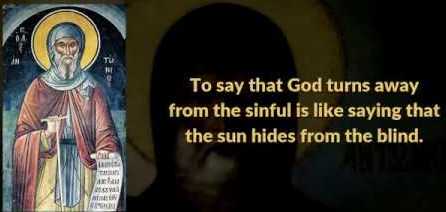

Some Quotes by Saint Anthony
“Without temptation there is no spiritual progress”
“The creator of the heavens obeys a carpenter; the God of eternal glory listens to a poor virgin. Has anyone ever witnessed anything comparable to this? Let the philosopher no longer disdain from listening to the common laborer; the wise, to the simple; the educated, to the illiterate; a child of a prince, to a peasant.”