

Trudging across the burning plains of Castile in the dazzling sun of August is a small figure under the brown hood of a Franciscan. He is Fray Pedro de Alcantara. He is not afraid of being blinded by the dazzling light – the brilliance of his interior vision is more intense than any sunlight.
Having arrived in Avila he treated Teresa with marked kindness. He found joy in her presence. His greatest consolation was to meet those on whom God lavishes great graces…..
The tribe of loud voiced critics lowered its tones, when he declared publicly that he was very sorry for her, because she had suffered the most severe trial possible: the opposition from good people. He added that no one in Avila was capable of understanding her.
With all his sanctity he was very courteous and easy of approach; a man of few words, except to answer the questions put to him. but what he said was very much to the point and showed that he had a sense of humour. Teresa breathed again and came to life, now she had every joy, even that of intelligent and delightful conversation. “God preserve us from gloomy saints !”
The Troubles of the Kingdom of France
Dona Teresa was to prove to the world that contemplation is the most powerful lever for action. In her joy was uppermost; for love is joy and Teresa was wholly possessed by love. What one does through love, with love, never hurts.
Theresa now experienced a new feeling: that of compassion for mankind and in particular for the Kingdom of France. At that time France was Spain’s most formidable enemy, but Teresa’s Love goes beyond the concept of patriotism.
“I understood the calamities and miseries of France and the harm the Lutherans had done there. Knowing that this was the only way I could do something to help, I wept before our Lord, begging him to remedy the condition of affairs. I would’ve given my life a thousand times over to save a single one of the souls that was being lost there.


Teresa’s neice, seventeen year old Maria de Ocampo, a lay boarder at the Convent of the Incarnacion, had been very worldly, but now was inspired by Teresa. She said: “Let’s go away, all of us! And let’s organize a solitary life like the hermits did.” Teresa gave her a searching gaze. “At last”, she thought and thanked God.
Teresa told her friend Dona Guiomar: “These young people were in high spirits yesterday. They amused themselves with working out a plan for us to found a small convent after the style of the Discalced Franciscans.
A great movement for the reform of the religious orders was sweeping over Spain. New orders like the Jesuits were founded, old ones like the Dominicans were reformed.
Teresa was thinking along the same lines as her sovereign, who was then preparing to build the Escorial, the place where Kings would crumble to dust, that he might dwell there amid the continual vision of the hollowness of this world.
We admire Teresa for many things, but we love her for having told us her very feminine reason for a momentary hesitation.
“I like being in the house where I was very much, for I had myself arranged exactly to my taste.”
She gave a quick look round; she felt regret leaving such personal surroundings.
But it was not for her to choose: “We decided quite firmly to leave all that in God’s hands.”

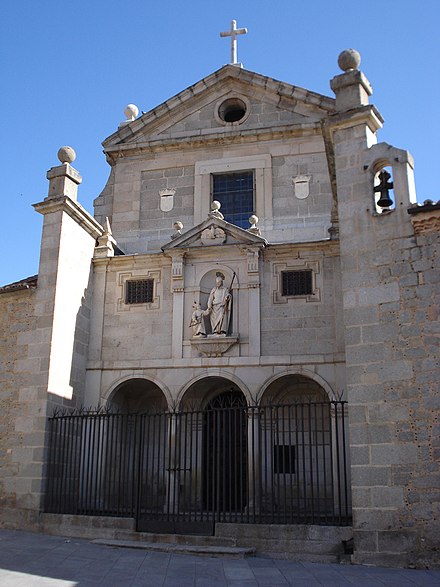
The Plot over Saint Joseph’s
The wealthy widow Dona Guiomar requested the Father Provincial for permission to found a Discalced Carmelite Convent in Avila. The Permission was granted. However there was much opposition, particularly from some of the more worldly nuns in Teresa’s own convent. Teresa’s response was to put matters in the hands of her favourite saint, Saint Joseph; and to silently pray her famous prayer:
Let nothing disturb thee
Nothing affright thee.
All things are passing,
God never changeth.
Patience gains all things.
Who has God wanteth nothing.
Alone God sufficeth.
Father Gaspar de Salazar the head of the Jesuits in Avila authorised Teresa to find a site for the convent, but to keep it secret. Pretending that her in-laws the Ovalles were looking for a new house, she found the ideal building, that was to become the glorious convent of Saint Joseph of Avila. On the ground floor was the future chapel and on the first floor 13 cells and the necessary offices. All this was built around a patio and looked out onto a tiny cloister.
Dona Luisa de la Cerda
Her husband, the Marshall of castile was one of the wealthiest men in Spain. When she was widowed her grief amounted almost to delirium. The Carmelite Provincial decided to take Teresa’s thoughts away from Avila and to send her to Toledo as a companion to Dona Luisa. It was the first time she had seen such a large city. There was a continue click of thousands of looms, on which thousands of weavers wove for the whole of Europe velvet, satin, taffeta, cloth and brocade. Toledo shoes were made, wax candles, the steel of the famous Toledan swords tampered in the waters of the Tagus. There was smelting and engraving and the songs learned from the Moors mingled with men’s voices, with the clang of hammer on anvil, with the rumble of carriages and the neighing of horses. The richest woman in Spain stepped down from her palace to clasp in her arms the nun, for whom God alone sufficed.
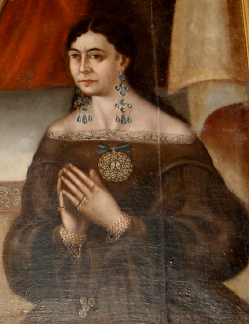

She had prepared a sumptuous apartment for Teresa. Here Teresa had to practice a new form of mortification: that of accepting through politeness the comfortable, wealthy surroundings which to her were irksome. She persuaded Dona Louisa that she had not come to teach or to preach, but that she too had a lot to learn. Their exchange of confidences formed a lasting bond. While Teresa was in Toledo, Maria de Jesus arrived from Rome, barefoot and in rags. There Pius IV had listened paternally to what she said: “Courageous woman! Let all she asks for be done!” He encouraged the reform of the religious orders on the lines laid down by the Counter Reformation.
Teresa and Maria agreed that the nuns in the reformed convents were to live by the work of their hands and to have no revenues. Teresa’s meeting with Maria was for her an immense joy.
The Birth of the Foundations
Over the mighty emperor of all the Spains the sun never set, but it did not dissolve the darkness of violence, of greed, of everlasting death. From Flanders too there came tales of churches pillaged and desecrated, of profanations of the sacred Host..
After returning to St Joseph’s in Avila , Teresa was ordered by the General of the Order of Mount Carmel, Padre Juan Bautista Rubeo of Ravenna, to found more convents. He wrote: “there is no good merchant, labourer, soldier or man of culture, who does not take care of, look after, employ all solicitude over and go to much trouble to enlarge his house, his honour and all his possessions. How much greater should be the efforts made by the servants of God to extend their work to other places, to build churches and religious houses and do all that is necessary to save souls for the glory of the Divine Majesty?”
Another letter marked one of Teresa’s greatest triumphs. Rubeo authorized her to found houses of friars under the primitive rule.
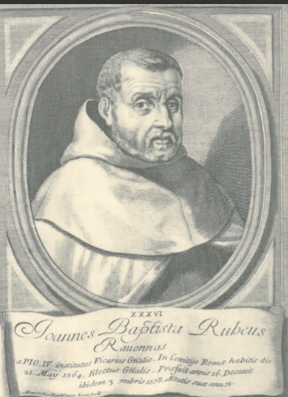
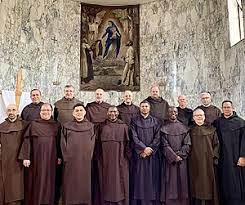
He wrote: “we desire that all religious, who are sons of this Order be transparent mirrors, burning lamps, flaming torches and shining stars to enlighten and help those in the world who go astray.
We grant the petition we have received that we should authorize the foundation of certain houses of friars.
They will celebrate Mass, pray, chant the Divine Office: will devote the requisite number of hours to mental prayer, meditation and other spiritual exercises and will accordingly be known as houses or monasteries of contemplatives Carmelite fathers.
A Friar and a Half
When she began her great foundations Teresa was 52. Religious life had stifled that which made her life in the world such a brilliant success. She was beautiful, gay, lively more eloquent than ever, with a charm which it was useless to resist. In Medina del Campo where she set up a new covent, she first met Padre Antonio de Heredia.
People saw in him a future provincial. He was tall with a handsome face and fine carriage and he never let you forgot he was of gentle birth. His meeting with Teresa made a deep impression on him. When she told him of Padre Rubeo’s letters authorizing her to found two monasteries of men in conformity with the primitive rule and of the difficulty, in which she found herself for want of friars, Antonio de Heredia exclaimed: “I will be the first!”
She thought he was joking. She asked him to try to keep secret, what he was promising for a whole year, during which he would practice the most severe penances.
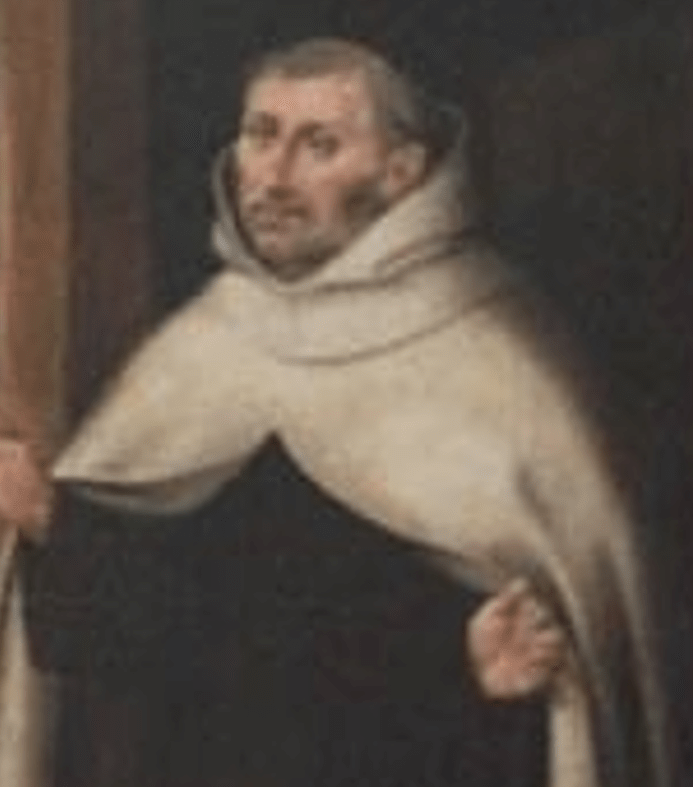

One day there arrived an emaciated young friar, who pleased Teresa very much. Many spoke highly of his learning and piety. Teresa was surprised to find him so small – his height was less than five feet – as she was at the breadth of his forehead and the fire in his dark eyes. She who was such a good talker, also knew how to listen: she let Fray Juan de San Matias talk freely and she praised God for what she heard. The salt of her Castilian wit broke out into a quaint phrase: “Daughters, I have a friar and a half.”
As long as she lived Teresa never forgot the poorest thing she had seen in the world, the little village of Duruelo, scarcely twenty hearths, situated in the depths of the valley of Old Castile. Its ceiling was so low that one had to strip to go into the lean to which served as a choir, so poverty stricken that it reminded one of the stable at Bethlehem. But Our Lord pored fourth His spirit in overflowing abundance and the first two subjects of the Order, Fray John of the Cross and Fray Antonio de Jesus lived there in great joy.
The Princess of Eboli
Ana de Mendoza y la Cerda‘s caprice was to have in her Duchy of Pastrana a convent, which she herself had founded, just as she would have demanded a farthingale overnight from a fashionable dress maker. She was the great grandchild of the Cardinal Archbishop of Toledo and had inherited the turbulence of her distinguished ancestor. She was famous for her beauty, although she had only one eye. She was famous for her quarrelsome, haughty and unscrupulous nature. Our Lord commanded Teresa to obey. And with a great peeling of bells in solemn procession, amid shouts of enthusiasm, with singing and dancing, amid the rhythm of litanies, Teresa of Jesus entered the convent. However she was so tired of courts and courtiers that she refused to found a convent at Madrid.

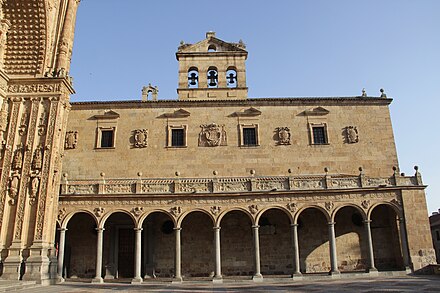
Mother Teresa and Her Daughters
With more pleasure than she had obeyed the orders of the Princess, she answered the appeal of the Rector of the Jesuits at Salamanca and set off to found a convent in the great university city. She arrived there on All Saints Day 1570. It was there that she wrote her Book of Foundations, in which she described the danger of melancholia. It “begins by clouding one’s reason. A single nun with melancholia can upset a whole convent. Teresa hidden away in her convent anticipated the future work of psychiatry. For her gaiety was a great antidote to melancholia.
Years afterwards when the Spanish nuns came to France to found Carmelite convents, the French nuns to their great astonishment saw the venerable Mother ‘more like a seraphim than a mortal executing a sacred dance in the choir, singing and clapping hands in the Spanish way with so much dignity, sweetness and grace’. These dances were in the pure tradition of Teresa.
In Salamanca there was a novice with a voice as clear as crystal and such an inventive genius for music and verse that Teresa often asked her to sing:
May my eyes behold thee
good and sweet Jesus
May my eyes behold thee
and then may I die.

Many Devils
One day when Teresa was begging God’s help for her brother Augustin, the most warlike of the conquistadors, who seemed to forget as he made war against the Auracanians in Chile, that he had to win heaven as well, she ventured to say: “Lord if I saw one of your brothers in such of danger what would I not do to save him?” To this imprudent entreaty our Lord replied : “oh daughter, daughter, those in the Incarnation are my sisters and yet you delay. Take courage!”
Teresa would have preferred to found four convents rather than reform even one; particularly this one. The rule of her convents was made for 21 nuns at most.
How could one make 130 angry nuns live in silence? How could one form them to recollection and obedience? One might as well try to reform hell and it’s legions. Those who stood up for Mother Teresa and those who were shouting for all they were worth, came to blows. Teresa remained calm. The agressive felt guilty. Was it possible that Teresa was a saint after all?
Saint John of the Cross
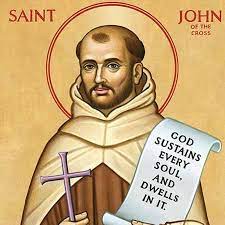
Teresa introduced to the convent of the Incarnation, the little dark man emaciated by penances. Brother John of the Cross although he was 30 seemed a very young man, so clear and pure was the look in his dark eyes. His bearing was calm and extremely modest, his mere presence was an invitation to composure. His countenance reflected something regal that was not of this world and he inspired love and respect at the same time.
The foundries had had a small hut built for him in the immediate vicinity of the convent: he had no time to lose in going to and fro; the work was considerable and urgent: the confessions of 130 nuns to be heard atleast once a fortnight, besides their direction, ranging from the choice of the reading to orientation in the ways of spirituality.
The Great City of Seville
Teresa was commanded to the found a convent in Seville. The journey over the mountains from Castile was precarious. At one point the donkeys and carts carrying the sisters and their provisions took a wrong turning on the narrow track and nearly fell into an abyss.; but a mysterious voice from a distance called, “Sto-o-o-p” and warned them to take another route.
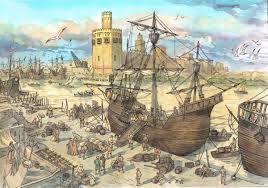
Seville was even less safe than the mountain passes. It was unbearably hot and was known as the ‘Babylon of the Great Sea’.
Its inhabitants were proud, quarrelsome and idle and in spite of their wealth gained from the Americas, they only offered the penniless Teresa a convent that was little more than a hovel. However her brother Lorenzo turned up one day, returned from the Indies. He was immensely wealthy and he funded a very pleasant new convent. Teresa love to describe it:
“the orchard is very delightful”,
“the view extremely fine: a house from which one can see the galleons is not to be despised.”
On her arrival in Andalusia Teresa had been treated as an undesirable person, abused, threatened, dragged before the Inquisition.
Now, thanks to her perseverance and joy in the face of many challenges and difficulties, she was recognised as one of the highest dignitaries of the Catholic, Apostolic and Roman Church, treated as one only treats prelates and saints.

Don Lorenzo de Cepeda, Indian
He was Teresa’s brother and Mayor of Quito in Ecuadaor and son-in-law of Don Francesco de Fuentes, one of the conquerors of Peru who took part in the capture of Atahualpa. “My brother will cease to be charming, when he ceases to live,” said Teresa. He was both serious and devout. He brought back great riches to Spain.
Teresa sent him memorandum on the upbringing of his sons, Lorencito and Francisco: “If someone does not take these children in hand immediately, I’m very much afraid they will soon be just the same as all the other conceited boys of Avila. Your Grace must send them to the Jesuits at once and make schoolboys of them.”
Three miles from Avila Lorenzo bought a fine piece of wheat growing and pasture land. Almost immediately he regretted it and complained it will give him a great deal of work. He would’ve done better to put out his money to interest. Some property invested would’ve given him a good income without any work. He said to his sister “I should have more time for prayer.”
Teresa broke out: “You should be praising God for this transaction. Don’t imagine that if you had more time your prayer would be better. Undeceive yourself. Time well spent in looking after the welfare of your children does not injure prayer. God often gives more in a moment that in long hours. His works are not measured by time.
One day he confided to her that he was having difficulty with mental prayer. She replied: “Go where you can look at the sky. Walk a little, you won’t waste your prayer time for that. Managing our weakness is an art. It doesn’t do to oppress nature. All consists in the search for God and the means by which we draw near him. The soul is led onwards by gentleness.”
The Interior Castle
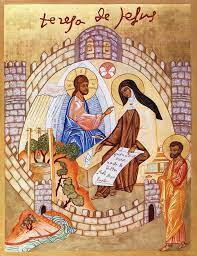
On the night of 3rd December 1577 the Prior of the Calced Friars of Toledo assisted by constables forced the door of John of the Cross’ cell and took him away to prison. Teresa appealed to the King, but for the first time he didn’t answer her. The devil was busy. On Christmas night, Teresa going downstairs to the chapel slipped and broke her leg.
It was then that Padre Gracian imposed on her the task of writing the Interior Castle. Our Lord showed her the plan of the work: a very beautiful globe of crystal in the likeness of a castle with seven mansions.
In The First Mansion the soul is in a state of grace but is still intoxicated with the venomous creatures (symbolic of sin) that dwell outside the castle.
In order to progress, the soul has to stay in this Mansion of Humility for a long time.
In the Second Mansion the soul seeks every opportunity for growth by listening to sermons, partaking in enriching conversations, and in the practice of prayer.
In the Third Mansion the soul realises the danger of relying on its own strength. It attains discipline and charity towards others, but lacks vision and the ability to fully experience the force of love. It endures a spirit of aridity and is given only occasional glimpses of the Mansions beyond.
In the Fourth Mansion the supernatural and natural meet. No longer does the soul depend upon its own efforts, but is totally dependent on God. This is the Mansion of the Prayer of the Quiet. It has no attachments to things of the world and can pass between the ordinary life to one of deep prayer and back again.
In the Fifth Mansion there is a new magnitude of contemplation. The soul prepares for the gift of God’s presence. It is short in duration, but while it lasts, the soul is completely possessed by God.
In the Sixth Mansion, Bride and Groom are able to see each other for a long period of time. As the soul receives increasing favours, it also receives more afflictions, such as bodily sickness, misrepresentation, backbiting and persecution; undeserved praise…and depression…which is comparable only with the tortures of hell.
In the Seventh Mansion the soul reaches Spiritual Marriage. No higher state can be reached. In this Mansion the King dwells

Hope
Elsewhere she writes: “Hope, O my soul, hope. You know neither the day nor the hour. Watch carefully, for everything passes quickly, even though your impatience makes doubtful what is certain, and turns a very short time into a long one. Dream that the more you struggle, the more you prove the love that you bear your God, and the more you will rejoice one day with your Beloved, in a happiness and rapture that can never end.”

The Escape
Teresa endeavoured to make excuses for the imprisonment of St John of the Cross: “they are blinded by rage … they wouldn’t do what they’re doing if they stopped to think.”
St John was imprisoned in a tiny dungeon, his only nourishment bread and water, scourged every day, his tunic stuck to the wounds on his shoulders. He endured it all with love and patience. The only thing that saddened him was the thought of the suffering of Teresa of Jesus.
After nine months he escaped by unscrewing the lock on his door and slipping past the guard. Taking with him the poetry he had written in prison, he got out through a window using a rope made of bed blankets. Having no idea where he was, he let a dog lead him to where there were people. He hid from his pursuers in a convent infirmary, where he read his poetry to the sisters.
From that time onward, his life was devoted to sharing and explaining his experience of God’s love.
Upon a gloomy night
With all my cares to loving ardours flushed,
(Oh venture of delight!)
With nobody in sight
I went abroad when all my house was hushed
In safety, in disguise
In darkness of the secret stair I crept,
(Oh happy enterprise)
Concealed from other eyes
When all my house at length in silence slept.
Upon that lucky night
In secrecy, inscrutable to sight,
I went without discerning
And with no other light
Except for that which in my heart was burning.

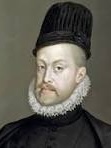
Teresa appealed to Philip II for help against persecution. After some time the King wrote to the Papal Nuncio Bishop Filippo Sega: “I have heard about the war which the Calced are waging against the Discalced Carmelite friars and nuns. I cannot do otherwise than regard such attacks against people, who have always practised the greatest austerity and perfection, without the most misgiving. I have been informed that you are not helping the Discalced in any way. In future range yourself on the side of virtue.”
The nuncio could not do otherwise than obey the Lord of all the Spains. Teresa exclaimed: “When I consider the means our Lord has used to turn the malice and cruelty of the enemies of Carmel solely to our advantage, I am speechless with wonder.”
Teresa did not think it right to take pleasures sadly. To her way of thinking there was a time for trials and a time for rejoicing and when the persecution came to an end, she declared : “As to bodily health, I desire it; but I am satisfied with that of my soul.” This joy and this progress in love were the fruits gathered by Teresa of Jesus from the tree of the cross.
In spite of age and illness Teresa continued to found many convents. She asked Cardinal Gaspar de Quiroga, Archbishop of Toledo and Grand Inquisitor for permission to found a convent in Madrid. He had a long nose and harsh mouth whom El Greco had painted with his long white beard standing out against his scarlet robes and a look expressing weariness more than severity. He said to Teresa: “I am very glad to make your acquaintance, for I have already been greatly wanting to do so. Look up on me as your chaplain. I will help you as much as ever it’s necessary. I want to tell you that the book of yours (her Autobiography) was presented to the Inquisition several years ago. I have read it all through and I maintain its teaching is very safe very true and very profitable. You can take it back again when you like. I give you the permission for which you ask and I beg you to pray to God for me always

Palencia and Burgos
At 65 Teresa still retained her fresh complexion and an astonishing youthfulness, but at Toledo she almost died in an attack of the widespread influenza epidemic. After this she was greatly changed and when she got better, she had become thin and old. She never completely recovered. And in the same year she lost her brother and spiritual son Don Lorenzo de Cepeda. “I am three years older than he and yet I go on living.” She was a perpetual invalid, but endowed with amazing resistance. She was reluctant to go and found new convents at Palencia and Burgos.
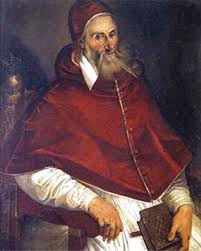
But God had also endowed her with courage and determination; and it was at Palencia that she learned that Discalced and Calced had last been erected into independent provinces by Pope Gregory VIII. Teresa saw the reform not only accomplished and achieved but given perpetuity. “That was one of the greatest joys I could have in this life. Twenty two monasteries and convents, three hundred friars, two hundred nuns will all be subject to one austere, unchanging rule.”
Back in Avila Fray John arrived with all the mules and baggage necessary to take Mother Teresa with him to found a convent at Granada, but she had promised to go to Burgos. Sometimes Teresa was known as Padraza, ‘the great father’ and John of the Cross as Madrecito, ‘the little mother’ .
Teresa introduced him to her nuns: “He is a man really heavenly and divine. I have found nobody like him in Castile. No one guides me so well in the waves of heaven. His absence leaves me in a solitude past believing.
Open your soul to him. You will see how much profit you get from doing so and how much you will advance in spirit and in the way perfection.
John of the cross is truly the father of my soul.

On her freezing winter journey to Burgos her carriage nearly swerved into a river. She jumped into the icy water and hurt herself, so she complained to God: “Lord, amid so many ills that comes on top of all the rest.” God answered: “That is how I treat my friends.” “Ah my God that is why you have so few of them!” In Burgos it took ages to get permission from the Archbishop to found the convent, but finally with God’s help she succeeded.
Great Adventures are of the Spiritual Order
Henceforward Teresa was free from every earthly attachment or anxiety. She no longer loved her family according to the flesh – they no longer had power to separate her from the presence of God, which was infused into her soul – but in the spirit, she loved them so deeply, they were constantly present to her in that light.
Through the close union in her of Martha and Mary she reached the point at which contemplation and action are no longer divided, but inseparable. The union between her and God was so complete now that she has scarcely any of those external manifestations, ecstasies, raptures, which had so often proved mortifying to her humility; at least she had no more of them in public The sudden invasion of divine love did not disturb a body, in which it continually. But wrote her niece, Teresita, she showed a smiling and calm simplicity, which reminded one of a candid child.

Face to Face
The mother Foundress would not admit that she was unwell; in actual fact she was a dying woman. When Christ her beloved said to her in Burgos: “All is finished here. You can go away”, it was because the last adventure of God’s Knight errant, her encounter with death, was to be victorious on condition that she fought one fight more. This was to regularize the convent at Alma de Tormes.
On 2nd October the Foundress told Ana de Bartolome that her death was near. She asked for the holy Eucharist. The Reverent Father Antonio Jesus, Vicar Provincial knelt by her to hear her confession. Then he implored her: “Mother ask our Lord not to take you away. Don’t leave us so quickly.” She was heard to answer; “Father be quiet. Can it be you speaking like that? I am no longer necessary in this world.” Now that it was finished, she allowed her soul to be flooded with the love of God and the desire she had to be united with Him.

She was so ill that it took two nuns to move her in her bed, but when she saw the Blessed Sacrament entering the room she sprang up suddenly and got onto her knees. Her face was on fire with joy and love. The last communion brought from her lips the final expression of love: “My Bridegroom and my Saviour. The longed for hour has come!”
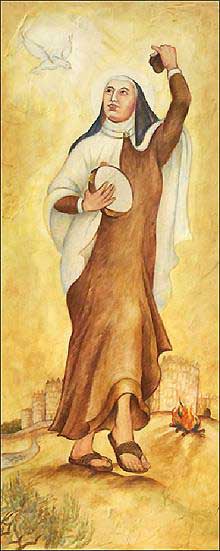
At Dawn on the following day, which was the feast of Saint Francis, she lay on her side in the position usually assigned to Mary Magdalene; her sisters could thus see her wrinkles, caused by age and sickness, disappeared; her face transfigured so calm and radiant that it seemed like the moon at the full.
Those who had seen her in ecstasy, said she was in the presence of God.
It was thus that she waited to be born away beyond the Seventh Mansion by the impetuous eagle of God’s majesty.
Her body gave forth a wonderful fragrance. She expired with three very faint and gentle moans. The countenance of Saint Teresa of Jesus remained so beautiful and resplendent in death that it seemed ‘like a radiant sun.’
As early as 1602 requests for the beatification of Teresa began to pour in at Rome. In 1614 seventy galleons left Genoa under the command of the high Admiral of the fleet Don Carlos Doris. They were bringing the news of the Foundress’ beatification to Spain. In 1622 Blessed Teresa became Saint Teresa of Jesus. During the canonisation ceremony doves and a multitude of other small birds were let loose in Saint Peters’.