

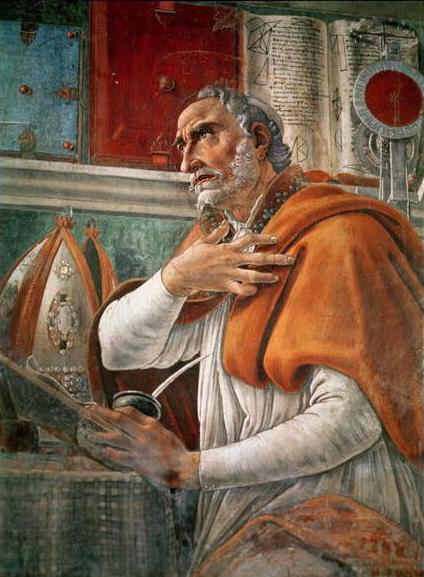
Augustine, this man of passion and faith, of the highest intelligence and tireless in his pastoral care, was born in Thagaste, (today Annaba, on the coast of Algeria), of a Berber family. He was brought up a Christian but left the Church early and spent a great deal of time seriously seeking the truth, first in the Manichaean heresy, which he abandoned on seeing how nonsensical it was and then in Neoplatonism, until at length through the prayers of his mother, Saint Monica, and the teaching of Saint Ambrose of Milan, he was converted back to Christianity and baptized in 387 shortly before his mother’s death.
Augustine had a brilliant legal and academic career, but after his conversion he returned home to Africa and led an ascetic life. He was elected Bishop of Hippo and spent 34 years looking after his flock, teaching them, strengthening them in the faith and protecting them strenuously against the errors of the time. He wrote an enormous amount and left a permanent mark on both philosophy and theology. His Confessions, as dazzling in style as they are deep in content, are a landmark of world literature.

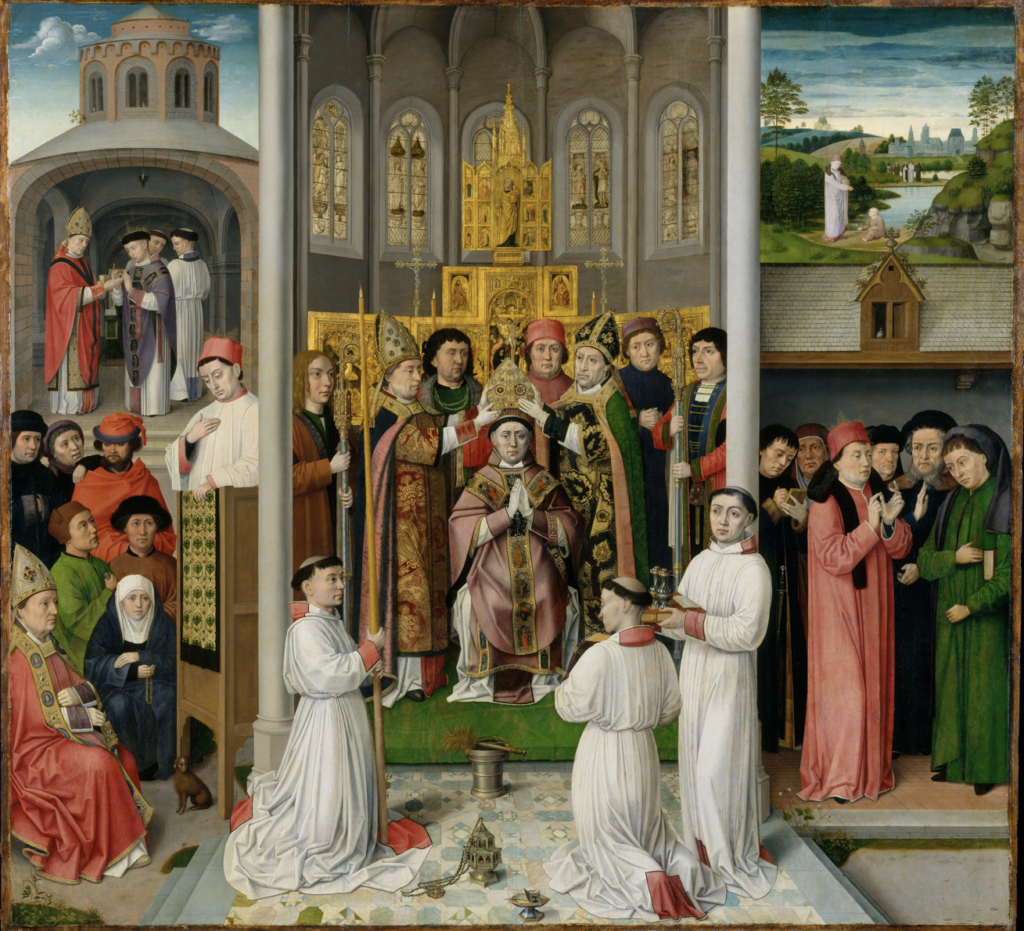
Augustine is the Father of the Church who more than any other has influenced the Church in the West, for better or for worse, and it is important today to reinsert his voice into the patristic symphony, from which his work was isolated by the barbarian invasions.
His seeking, his suffering, the stages of his conversion have been admirably recounted in his Confessions and are astonishingly modern. Augustine was born at Thagaste (the modern Souk-Akhras in Algeria) into a family of small landowners who were oppressed by taxation
His mother, Monica was a passionate woman, venerated as a saint, exercised an enormous influence on her son and raised him in the Christian faith. She and his father, Patricius gave their children a classical education.
Augustine also had a brother, Navigius, and a sister whose name is unknown to us and who, after being widowed, subsequently became the head of a monastery for women. As a boy with a very keen intelligence, Augustine received a good education, although he was not always an exemplary student. However, he learned grammar well, first in his native town and then in Madaura, and from 370, he studied rhetoric in Carthage, the capital of Roman Africa. He mastered Latin perfectly but was not quite as successful with Greek and did not learn Punic, spoken by his contemporaries.


So Augustine studied in the great classical tradition in which he later became a teacher of oratory. His knowledge of philosophy was self-taught, though brilliantly so. His temperament was passionate and sensual and he rejected the Christianity of his mother, Monica, in favour of Manicheism. This presented itself as a gnosis, a science of the invisible, professing a metaphysical (and dietary) distinction between light and dark beings. At Milan he discovered, through a Latin translation, Plotinus and the deep inner experiences in which a human being could be identified with the Absolute.
Of Cicero’s Hortensius Augustine wrote : “The book changed my feelings”, to the extent that “every vain hope became empty to me, and I longed for the immortality of wisdom with an incredible ardor in my heart”. He began to read the Bible. But it disappointed him. In the scriptural narratives of wars and other human vicissitudes, he discovered neither the loftiness of philosophy, nor the splendor of the search for the truth, which is part of it. Yet he did not want to live without God and thus sought a religion which corresponded to his desire for the truth and also with his desire to draw close to Jesus.
Thus, he fell into the net of the Manichaeans, who presented themselves as Christians and promised a totally rational religion. They said that the world was divided into two principles: good and evil. And in this way the whole complexity of human history can be explained. Their dualistic morals also pleased Saint Augustine, because it included a very high morality for the elect: and those like him who adhered to it could live a life better suited to the situation of the time.
Manichaeanism also facilitated the prospects of a career. By belonging to that religion, which included so many influential figures, he was able to continue his relationship with a woman and to advance in his career. By this woman he had a son, Adeodatus, who was very dear to him and very intelligent, who was later to be present during the preparation for Baptism near Lake Como, taking part in those “Dialogues” which Saint Augustine has passed down to us. The boy unfortunately died prematurely.
Having been a grammar teacher since his twenties in the city of his birth, Augustine soon returned to Carthage, where he became a brilliant and famous teacher of rhetoric. However the Manichaeans proved incapable of dispelling his doubts. He moved to Rome and then to Milan, where the imperial court resided at that time and where he obtained a prestigious post through the good offices and recommendations of the Prefect of Rome, Symmacus, a pagan hostile to Saint Ambrose, Bishop of Milan.
In one of the most famous passages of his Confessions: Augustine recounts that, in a garden, he suddenly heard a child’s voice chanting a rhyme never heard before: tolle, lege, tolle, lege, “pick up and read, pick up and read” . He then remembered the conversion of Anthony, the Father of Monasticism, and carefully returned to the Paul’s Epistle to the Romans where the Apostle exhorts to abandon the works of the flesh and to be clothed with Christ. Augustine understood that those words in that moment were addressed personally to him


Augustine acquired the habit of listening to the eloquent preaching of Bishop Ambrose. The African was fascinated not only Ambrose’s rhetoric. His content increasingly touched Augustine’s heart. Augustine realized that the whole of the Old Testament was a journey toward Jesus Christ. Thus, he grasped the whole unity of the mystery of Christ in history as well as the synthesis between philosophy, rationality, and faith in the Logos, in Christ, the Eternal Word who was made flesh.
Thus, Augustine followed his reading of the philosophers’ writings by reading Scripture anew, especially the Pauline Letters. His conversion to Christianity on 15 August 386 therefore came at the end of a long and tormented inner journey and the African moved to the countryside, north of Milan by Lake Como with his mother, Monica, his son, Adeodatus, and a small group of friends to prepare himself for Baptism. So it was that at the age of thirty-two Augustine was baptized by Ambrose in the Cathedral of Milan on 24 April 387, during the Easter Vigil.
Hubertus Drobner in The Fathers of the Church writes: “In early 386 Augustin’s decision-making and his inner conflict between longing for a life of wisdom and his seemingly still undeniable need for sexual fulfillment intensified when he became acquainted with the writings of the Neoplatonist, particularly of Marius Victorinus. the famous rhetor.
After the latter was accorded the extraordinary honour of a statue in the Forum Romanum he converted to Christianity in spectacular fashion. His example was presented to Augustine by the priest Symmachus.
Platonism for the first time convinced Augustus of a purely spiritual concept of God as the one who is good and solved the question of the origin of evil by viewing it as the absence of good and as devoid of substance.

The decisive crisis was finally brought about by the example of Anthony, the Egyptian monastic father. One day as Augustine paced back-and-forth distraught, he heard the voice of a child from the neighbouring house saying: “Tolle legere, tolle legere” (take up and read). Since he was not able to remember a children’s game using these words he understood it as a sign from God, as Anthony had formally, to open the Bible.
He opened the letter of Saint Paul to the Romans 13:13-14: “Not in orgies and drunkenness, not in sexual immorality and debauchery not Ascension and jealousy, rather close yourselves with the Lord Jesus Christ and do not think about how to gratify the desires of the sinful nature.” “Instantly at the end of this sentence as if before a peaceful light streaming into my heart all the dark shadows of doubt flooded away.” The Confessions
After his Baptism, Augustine decided to return to Africa with his friends, with the idea of living a community life of the monastic kind. However, while awaiting their departure in Ostia, his mother died, breaking her son’s heart. The convert settled in Hippo for the very purpose of founding a monastery. In this city on the African coast he was ordained a priest in 391. Despite his reticence, and with a few companions he began the monastic life, dividing his time between prayer, study, and preaching. He did not feel he had a vocation to pastoral life, but realized later that God was calling him.
He was ordained Bishop in Hippo four years later, in 395. He preached several times a week, supported the poor and orphans, supervised the formation of the clergy and the organization of men’s and women’s monasteries. He was very active in the government of his Diocese in the more than thirty-five years of his Episcopate, and exercised a vast influence in his guidance of the Catholic Church in Roman Africa and, more generally, in the Christianity of his time. He coped with disruptive heresies such as Manichaeism, Donatism, and Pelagianism.


His work is enormous, often written in response to the demand of polemics. He asserts the fundamental goodness of all that exists, against the Manicheans (for whom ‘good’ and ‘evil’, ‘light’ and ‘darkness’, are two separate opposed principles). In the face of the Donatists he maintains that the Church is the whole Christ. (The Donatists began by taking up an intransigent attitude towards those Christians who during the persecutions had renounced the faith and later repented. They then founded a Counter-Church in North Africa, administering a second baptism.) Against the Pelagians Augustine proclaims the sovereignty of grace. For them the human being is the cause of his own salvation through ascesis and moral discipline.
Augustine shaped the Western approach to the mystery of God, seeing images of the Trinity everywhere, but chiefly in human nature with its facilities of memory, knowledge-intellect and love-will. He declares that the Spirit is the joint gift of the Father and the Son, though proceeding (primarily) from the Father, and identifies him – for nothing in God can be impersonal – with the love that unites the Father and the Son. His experience – a song of love – is that of the overwhelming irruption of the grace that alone can set freedom free.
He wrote in De Moribus Ecclessia: “To live well is nothing other than to love God with all one’s heart, with all one’s soul and with all one’s efforts; from this it comes about that love is kept whole and uncorrupted (through temperance). No misfortune can disturb it (and this is fortitude). It obeys only God, and is careful in discerning things, so as not to be surprised by deceit or trickery (and this is prudence)”
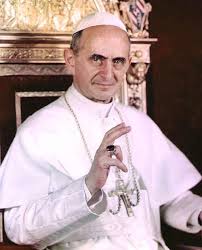
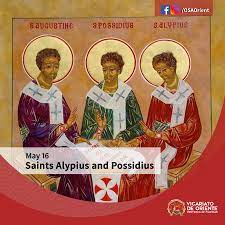
Paul VI stressed: “It may be said that all the thought-currents of the past meet in his works and form the source which provides the whole doctrinal tradition of succeeding ages”. Possidius, his first biographer, said that it seemed impossible that one man could have written so many things in his lifetime.
The Confessions is his extraordinary spiritual autobiography written in praise of God. With their focus on interiority and psychology, they constitute a unique model in Western literature, and not only Western, even non-religious literature, up to modern times. This attention to the spiritual life, to the mystery of the “I”, to the mystery of God who is concealed in the “I”, is something quite extraordinary, without precedent, and remains for ever, as it were, a spiritual “peak”.

“Late have I loved you, beauty so old and so new: late have I loved you. And see, you were within and I was in the external world and sought you there, and in my unlovely state I plunged into those lovely created things which you made. You were with me, and I was not with you. The lovely things kept me far from you, though if they did not have their existence in you, they had no existence at all. You called and cried aloud and shattered my deafness. You were radiant and resplendent, you put to flight my blindness. You were fragrant, and I drew in my breath and now pant after you. I tasted you, and I feel but hunger and thirst for you. You touched me, and I am set on fire to attain the peace which is yours.”
Augustine reviewed his writings in the Retractationum several years before he died, and shortly after his death they were correctly recorded in the Indiculus (“list”) added by his faithful friend Possidius to keep their memory alive while the Vandal invasion was sweeping through all of Roman Africa. The list included at least 1,030 writings. Today, more than three hundred letters of the Bishop of Hippo and almost six hundred homilies are extant, but originally there were far more, perhaps even as many as between three and four thousand.
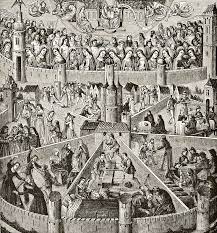
The City of God — an impressive work crucial to the development of Western political thought and the Christian theology of history — was written between 413 and 426 in twenty-two books. The occasion was the sack of Rome by the Goths in 410. Numerous pagans still alive and also many Christians said: “Rome has fallen; the Christian God and the Apostles can now no longer protect the city.” Saint Augustine answered this objection with this impressive work, De Civitate Dei, explaining what the relationship is between the political sphere and the sphere of faith, of the Church.
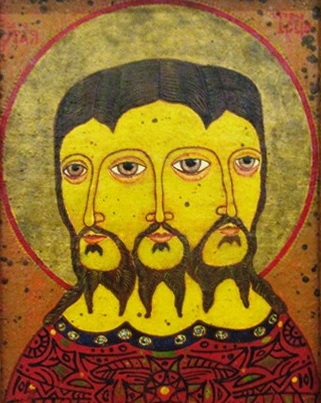
Equally important is the De Trinitate, a work in fifteen books on the central core of the Christian faith. It was written in two phases: the first twelve books between 399 and 412, published without the knowledge of Augustine, who in about 420 completed and revised the entire work. Here he reflects on the Face of God and seeks to understand this mystery of God who is unique, the one Creator of the world, of us all, and yet this one God is precisely Trinitarian, a circle of love. He seeks to understand the unfathomable mystery: the actual Trinitarian being, in three Persons, is the most real and profound unity of the one God.
De Doctrina Christiana is instead a true and proper cultural introduction to the interpretation of the Bible and ultimately of Christianity itself, which had a crucial importance in the formation of Western culture.
However it was far more important to Augustine to take the Christian message to the simple than to write lofty theological works. In a letter written to his colleague Evodius, in which he informs him of his decision to suspend the dictation of the books of De Trinitate for the time being, “because they are too demanding and I think that few can understand them; it is therefore urgent to have more texts which we hope will be useful to many”.
This led to De Catechizandis Rudibus, a method of catechesis, or the Psalmus contra Partem Donati. The Donatists were the great problem of Saint Augustine’s Africa, a deliberately African schism. They said: true Christianity is African Christianity. They opposed Church unity. The great Bishop fought against this schism all his life, seeking to convince the Donatists that only in unity could “Africanness” also be true. And to make himself understood by the simple, who could not understand the difficult Latin of the rhetorician, he said: I must even write with grammatical errors, in a very simplified Latin.

The mass of homilies that he would often deliver “off the cuff”, transcribed by tachygraphers during his preaching and immediately circulated, had a special importance in this production destined for a wider public. The practice of publishing Augustine’s thousands of homilies — often without the author’s control — explains their dissemination and later dispersion, but also their vitality. Because of the author’s fame, the Bishop of Hippo’s sermons served as models for other Bishops and priests.
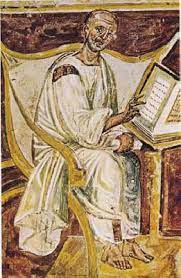
A fresco in the Lateran that dates back to the fourth century shows that the iconographical tradition depicted Saint Augustine with a book in his hand, suggesting, of course, his literary opus, which had such a strong influence on the Christian mentality and Christian thought, but it also suggests his love for books and reading as well as his knowledge of the great culture of the past. At his death he left nothing, Possidius recounts, but “recommended that the library of the church with all the codes be kept carefully for future generations”.
In his Commentary on Psalm 41 Augustine talks of the mysterious dialectic of faith, hope and charity, God never ceasing to ‘empty out souls’ in order to fill them up better.
Hasten to the springs, draw from the wells.
In God is the wellspring of life,
A spring that can never fail.
In his light is found a light
That nothing can darken.
Desire that light which your eyes know not!
Your inward eye is preparing to see the light.
Your inward thirst burns to be quenched at the spring.
Brethren, do our years last? They slip away day by day. Today exists only in the moment in which we speak. Its first hours have passed, the remainder do not yet exist; they will come, but only to fall into nothingness … Nothing contains constancy in itself. The body does not possess being: it has no permanence. It changes with age, it changes with time and place, it changes with illness and accident. The stars have as little constancy; they change in hidden ways, they go whirling through space … they are not steady, they do not possess being. Nor is the human heart any more constant. How many thoughts disturb it, how many ambitions! How many pleasures draw it this way and that, tearing it apart! The human spirit itself, although endowed with reason, changes; it does not possess being. It wills and does not will; it knows and does not know; it remembers and forgets.
No one has in himself the unity of being … After so many sufferings, diseases, troubles and pains, let us return humbly to that One Being. Let us enter into that city whose inhabitants share in Being itself.
Augustine appointed his successor four years before he died. On 26 September 426, he gathered the people in the Basilica of Peace at Hippo to present to the faithful the presbyter Heraclius. He said:
“The day which shall be our last on earth is all times uncertain; but in infancy there is hope of entering boyhood… looking forward from boyhood to youth, from youth to manhood, and from manhood to old age; whether these hopes may be realized or not is uncertain. But how long old age may be prolonged is uncertain. …I came to this town when I was in the prime of life. Now I am old.”
The assembly shouted twenty-three times, “To God be thanks! To Christ be praise!” There followed four years of extraordinary intellectual activity: he brought important works to conclusion; he intervened to foster peace in the African provinces, threatened by barbarian southern tribes. He wrote about this to Count Darius, who had come to Africa to settle the disagreement between Boniface and the imperial court which the tribes of Mauritania were exploiting for their incursions: “It is a higher glory still”, he said in his letter, “to stay war itself with a word than to slay men with the sword and to procure peace by peace, not by war. Your mission, however, is to prevent the shedding of blood” (Ep. 229, 2). Unfortunately, the hope of peace in the African territories was disappointed; in May 429, the Vandals, passed the straits of Gibraltar and streamed into Mauritania. In May or June 430, “the destroyers of the Roman Empire”, as Possidius described these barbarians (Vita 30, 1), were surrounding and besieging Hippo.


In the meantime, the city of Hippo resisted. Augustine’s monastery-home had opened its doors to welcome episcopal colleagues who were asking for hospitality. Possidius left us his direct testimony of those last dramatic days. “In the third month of that siege, Augustine took to his bed with a fever: it was his last illness” The holy old man made the most of that period when he was at last free to dedicate himself with greater intensity to prayer. He was in the habit of saying that no one, Bishop, Religious, or layman, however irreprehensible his conduct might seem, can face death without adequate repentance. For this reason he ceaselessly repeated between his tears the penitential psalms he had so often recited with his people.
The worse his illness became, the more the dying Bishop felt the need for solitude and prayer: “In order that no one might disturb him in his recollection, about ten days before leaving his body, he asked those of us present not to let anyone into his room outside the hours in which the doctors came to visit him or when his meals were brought. His desire was minutely complied with, and in all that time he devoted himself to prayer” He breathed his last on 28 August 430: his great heart rested at last in God.
His body was translated to Sardinia, and from here, in about 725, to the Basilica of San Pietro in Cield’Oro in Pavia, where it still rests today. We “find him alive” in his writings. When I read Saint Augustine’s writings, says Pope Benedict XVI, I do not get the impression that he is aman who died more or less 1,600 years ago; I feel he is like a man of today: a friend, a contemporary who speaks to me, who speaks to us with his fresh and timely faith. In Saint Augustine, who talks to us, talks to me in his writings, we see the everlasting timeliness of his faith; of the faith that comes from Christ, the Eternal Incarnate Word, Son of God and Son of Man. And we can see that this faith is still timely today.
Thus, Saint Augustine encourages us to entrust ourselves to this ever-living Christ and in this way find the path of life.
John Paul II dedicated to him the Apostolic Letter Augustinum Hipponensem, as “a thanksgiving to God for the gift that he has made to the Church, and through her to the whole human race”. His conversion is also a theme for our lives.

Quotes
Love is itself the fulfillment of all our works. There is the goal; that is why we run: we run toward it, and once we reach it, in it we shall find rest.
God created us without us: but he did not will to save us without us.
While he is in the flesh, man cannot help but have at least some light sins. But do not despise these sins which we call “light”: if you take them for light when you weigh them, tremble when you count them. A number of light objects makes a great mass; a number of drops fills a river; a number of grains makes a heap. What then is our hope? Above all, confession.
The justification of the wicked is a greater work than the creation of heaven and earth,” because “heaven and earth will pass away but the salvation and justification of the elect . . . will not pass away.