
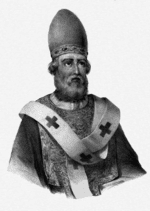
He wrote: “We must begin by purifying ourselves before purifying others; we must be instructed to be able to instruct, become light to illuminate, draw close to God to bring him close to others, be sanctified to sanctify, lead by the hand and counsel prudently. I know whose ministers we are, where we find ourselves and to where we strive. I know God’s greatness and man’s weakness, but also his potential. Who then is the priest? He is the defender of truth, who stands with angels, gives glory with archangels, causes sacrifices to rise to the altar on high, shares Christ’s priesthood, refashions creation, restores it in God’s image, recreates it for the world on high and, even greater, is divinized and divinizes.
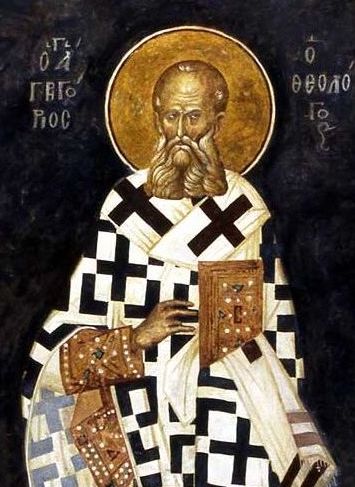
Olivier Clement in his excellent book, The Roots of Christian Mysticism, writes: “He was cultured, too cultured; and probably the most profound among the Greek Fathers; known as the ‘Christian Demosthenes’ for his mastery of the art of rhetoric, and ‘The Theologian’, that is, the celebrant of the Trinity, whose own life and human words to describe it are ‘theology’ par excellence. Like all the great Cappadocians, Gregory belonged to a circle of great landowners ,who might also with a touch of humour be called ‘gentlemen farmers’, men of a broad cultured humanity, fervent Christians in that time of transition between martyrdom and monasticism.
“His mother had converted his father who later became bishop of Nazianzus. Gregory, a child of their old age, ‘offered to the Lord’ from his birth, received a sound religious education, but absorbed the cultural heritage of Hellenism in the best schools: at Caesarea in Palestine, at Alexandria, and especially at Athens where he formed a friendship with Basil of Caesarea. On his return to Cappadocia he became an orator destined for the highest civil appointments. But his soul was divided, somewhat romantic, with a nostalgia for solitude, speculation and contemplation, though eager also for admiration and affection, a melancholy and unreliable temperament, at once desirous of responsibilities and quickly dismayed by them.”
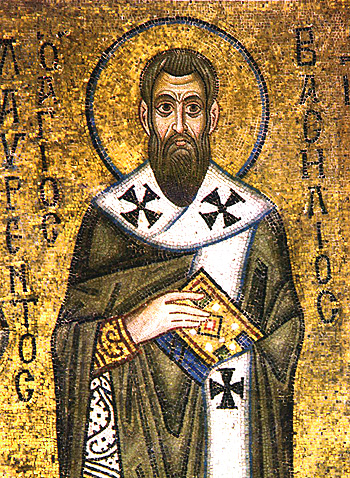
Gregory wrote: “Not only did I feel full of veneration for my great Basil because of the seriousness of his morals and the maturity and wisdom of his speeches, but he induced others who did not yet know him to be like him…. The same eagerness for knowledge motivated us…. This was our competition: not who was first, but who allowed the other to be first. It seemed as if we had one soul in two bodies”
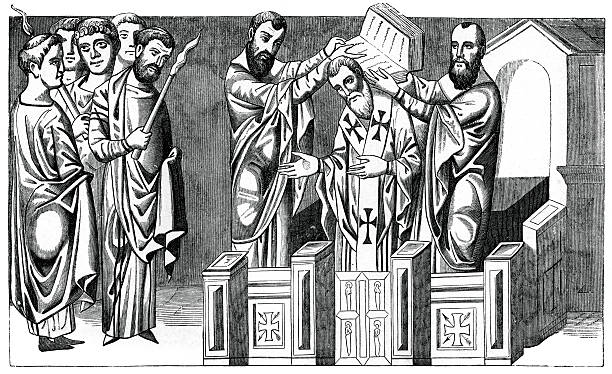
Clement continued: “Involved against his inclination in the service of the Church he let himself be saddled with commitments which he soon afterwards refused to honour. His father ordained him priest, and he disappeared for several months into a ‘desert’ peopled with intellectuals, in order later to take up his ministry and ardently to defend the poor. About 371, to counter the imperial power, Basil increased the number of dioceses and put his own supporters in them. He consecrated Gregory bishop of Sasimus but Gregory refused to occupy his see which was a dusty and noisy stopping place for caravans. At the death of his father, the faithful of Nazianzus demanded him as their bishop. He ran away into solitude and study for four years.
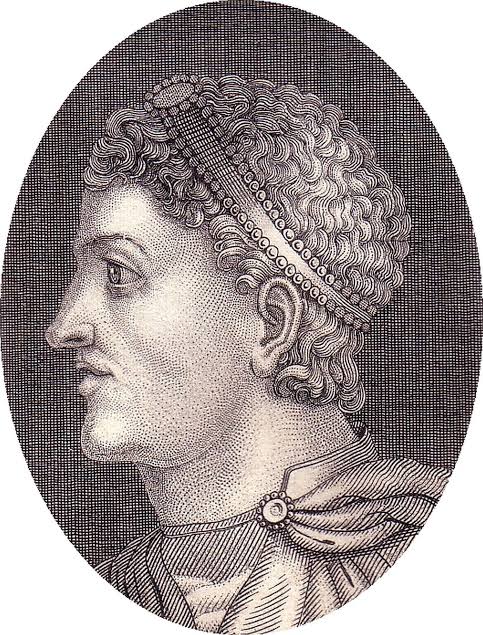
“However in 379 this delicate, complex, awkward intellectual outdid himself: he agreed to leave for Constantinople where the Arians were in possession of all the churches and were turning the inhabitants into fanatics. In a private house, under the sign of the resurrection (Anastasis) he opened a chapel. His preaching, and in particular his five Theological Sermons on the Trinity attracted the people. It was in vain that trouble-makers were sent to insult and stone him. In 381 the Emperor Theodosius, a Spaniard faithful to the Nicene dogma, came into the city. A Council, later to be designated the Second Ecumenical Council, was able to assemble, and in it the teaching worked out by Basil and Gregory triumphed.
“Gregory was proclaimed Archbishop of Constantinople. But the intrigues and tensions of the Council quickly discouraged him. He resigned, and passed the last years of his life on his estate at Arianzus, writing poems, one of which is an autobiographical Song, the first specimen in Christian literature of the ‘secret colloquy’, artistically represented, ‘of the soul with itself and God’.
“In his sermons, which are half way between rhetoric and liturgy, Gregory celebrates above all the mystery of the Trinity which he opposes to the closed monotheism of the Jews and the vague divinities of paganism. The ‘hypostases’ which, each in its own way, contain and present the divine ‘essence’ are distinguished from one another by relations of diversity, simple tokens for recognition: the Father by his character of unoriginated origin; the Son by generation; the Spirit by procession. Thus is worked out at a level of Trinitarian theology the metaphysics of the Person who is not a fragment of the whole but contains it in communion. The Absolute is thus permeated with an infinitely personal love.
“The controversy with Apollinaris (for whom, in Christ, the Logos takes the place of the human soul) led Gregory to develop a spirituality of deification as Christification: like our body and our soul, our spirit (nous) can only be deified by sharing in Jesus’ deified human spirit or soul. Many of Gregory’s texts that celebrate our death and resurrection in Christ entered into the Byzantine liturgy. ‘The cross is the only theologian’, the cross alone, death and life, could transform anguish into faith in Gregory’s heart.
In his homily On Love of the Poor Gregory wrote: “Brethren, let us not be bad managers of the goods that have been entrusted to us, unless we want to hear Peter’s sharp condemnation: ‘Shame on you who hold back the possessions of others. Imitate God’s liberality and there will be no more poor’. Let us not kill ourselves heaping up money when our brothers are dying of hunger … Let us imitate God’s law of creation. He makes the rain fall on the righteous and the wicked and makes his sun rise upon all human beings without distinction. He gives to all the creatures living on earth vast spaces, springs, rivers, forests … and his gifts ought not to be appropriated by the mighty nor by governments. Everything is common, everything is in abundance … He honours natural equality by the equal distribution of his gifts … ‘
“Human beings have accumulated in their coffers gold and silver, clothes more sumptuous than useful, diamonds and other such objects that are evidence of war and tyranny; then a foolish arrogance hardens their hearts; for their brothers in distress, no pity. What utter blindness! They do not realize that poverty and riches, social contrasts and other such distinctions were late arrivals among human beings. They spread like epidemics. They were inventions of sin. But in the beginning ‘it was not so’ (Matthew 19.8) … . Be like gods for the poor, imitating God’s mercy. “
Nazianzen was a mild man and always sought to bring peace to the Church of his time, torn apart by discord and heresy. He strove to overcome his own timidity in order to proclaim the truth of the faith. He felt deeply the yearning to draw close to God. He expressed this in one of his poems:
“Among the great billows of the sea of life,
here and there whipped up by wild winds…
one thing alone is dear to me, my only treasure,
comfort and oblivion in my struggle,
the light of the Blessed Trinity”

He wrote an extensive poetic of of 17,000 verses, unmatched in Greek patristics. His Carmina, most of which he wrote after his return from Constantinople, in the secluded leisure that he enjoyed at Arianzus until his death, are composed of didactic poems, hymns. elegies and epigrams in their traditional metres, namely the hexameter, distich and iambic.
He deals with dogmatic, moral, autobiographical and lyrical themes with the explicit intent of using the poetic form to proclaim the Christian message more pleasantly and more attractively to provide a comparable Christian expression alongside Hellenistic poetry.
With the quality of his poems Gregory decisively refutes the former polemic charge that Christians lacked education and comparable literature.
In another poem he wrote:
You have a task, my soul, a great task if you so desire.
Scrutinize yourself seriously, your being, your destiny;
where you come from and where you must rest;
seek to know whether it is life that you are living
or if it is something more.
You have a task, my soul, so purify your life:
Please consider God and his mysteries,
investigate what existed before this universe and what it is for you,
where you come from and what your destiny will be.
This is your task, my soul; therefore, purify your life.
Scrutinize yourself seriously, your being, your destiny;
where you come from and where you must rest;
seek to know whether it is life that you are living or if it is something more.
You have a task, my soul, so purify your life:
Please consider God and his mysteries,
investigate what existed before this universe
and what it is for you, where you come from and what your destiny will be.
This is your task, my soul; therefore, purify your life.
Gregory teaches us first and foremost the importance and necessity of prayer. He says: “It is necessary to remember God more often than one breathes, because prayer is the encounter of God’s thirst with our thirst. God is thirsting for us to thirst for him. In prayer, we must turn our hearts to God, to consign ourselves to him as an offering to be purified and transformed. In prayer we see all things in the light of Christ; we let our masks fall and immerse ourselves in the truth and in listening to God, feeding the fire of love.”
“Nothing seems to me greater than this: to silence one’s senses, to emerge from the flesh of the world, to withdraw into oneself, no longer to be concerned with human things other than what is strictly necessary; to converse with oneself and with God, to lead a life that transcends the visible; to bear in one’s soul divine images, ever pure, not mingled with earthly or erroneous forms; truly to be a perfect mirror of God and of divine things, and to become so more and more, taking light from light. . .; to enjoy, in the present hope, the future good, and to converse with angels to have already left the earth even while continuing to dwell on it, borne aloft by the spirit.”