Lou Tseng Tsiang

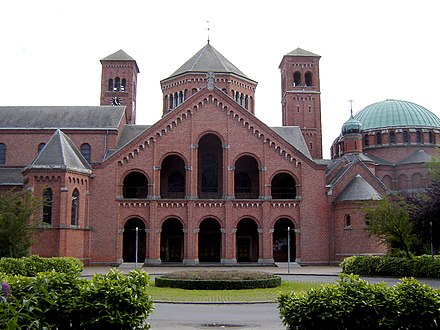
The Monastery of St. Peter, Ghent, Belgium

Premier and Minister of Foreign Affairs of China

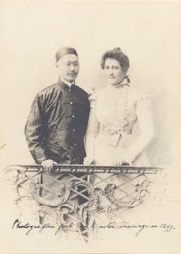
Lou was born on 12 June 1871 in Shanghai, and was raised a Protestant in religion and a Confucianist in philosophy. His father, Lou Yong Fong, was lay catechist for a Protestant mission in Shanghai. He studied at home until the age of thirteen, when he entered the School of Foreign Language in Shanghai, specializing in French. He continued his education at the school for interpreters attached to the Foreign Ministry, and in 1893 he was posted to St Petersburg as interpreter  to the Chinese embassy.  The ambassador, the reform-minded Xu Jingcheng, took an interest in his career. Lou married a Belgian citizen, Berthe Bovy (1855 – 1926), in St Petersburg on 12 February 1899, and eventually converted to Roman Catholicism. The couple had no children.

Lou and his wife Berthe

Diplomatic Career

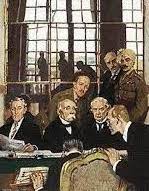
His early years were marked by the Boxer Rebellion, during which his mentor, Xu Jingcheng, was beheaded in Beijing. Lou served the Qing regime as Chinese delegate at the first and second Peace Conferences in The Hague (1899 and 1907), as Minister to Belgium, and as Ambassador to Russia, but he never forgot the imperial government’s betrayal of his “second father”.

When the 1911 Revolution broke out he was Ambassador in St Petersburg, and he took it upon himself, against the advice of his colleagues at other European capitals, to cable Beijing that there could be no hope of assistance from the Great Powers.
The First Hague Conference in 1899: A meeting in the Orange Hall of Huis ten Bosch palace
Sun Yat Sen

Premier and Minister of Foreign Affairs of China

At the proclamation of the Chinese Republic in 1912, he joined the Party of Dr. Sun Yat-Sen, and served as Foreign Minister. He also served as Prime Minister, but his lack of political leverage forced his resignation, ostensibly for health reasons.

 He reformed the Foreign Ministry: abolishing the complicated bureaucracy of the imperial commissions, requiring knowledge of foreign languages at all levels, and instituting modern civil service examinations for recruits.

Versailles Treaty

Paris Peace Conference

Lou personally headed the Chinese delegation to the Paris Peace Conference of 1919. Article 156 of the envisioned Versailles Treaty transferred the German treaty territory in Shandong to Japan rather than recognise the sovereign authority of China. On 6 May, with the Japanese delegation insisting that they would only continue to support the conference’s aims if Germany’s colonial rights in China were transferred to Japan, Lou read the following declaration to the assembled delegates:

The Chinese delegation beg to express their deep disappointment at the settlement proposed by the Council of the Prime Ministers. It appears to have been made without considering the right, justice and the national security of China – consideration which the Chinese delegation emphasized again and again in their hearings  against the proposed settlement, in the hope of having it revised. If such revision cannot be had, they deem it their duty to make a reservation on the said clauses now.

Lou ultimately refused to sign at all. This made China the only participating country not to sign the Versailles Treaty. There is good movie in Chinese, French and English

Benedictine monk and priest in Belgium

From 1922 to 1927 Lou was China’s envoy to the League of Nations in Geneva.

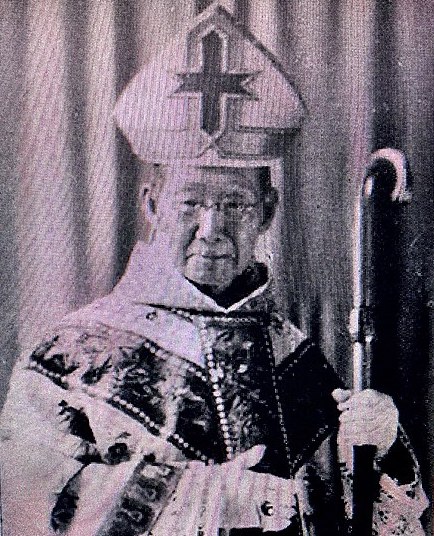
At the death of his wife he retired from an active life, and in 1927 became a postulant, under the name Dom Pierre-Célestin, in the Benedictine monastery of Sint-Andries in Bruges, Belgium.

He was ordained priest in 1935. During the Second World War he gave lectures about the Far East in which he propagandized for the Chinese war effort against Japan.

German security agents noted the names of those attending but took no further action.


Dom Pierre Celestin
John Wu

He commended the work of John Wu the other great Chinese of the 20th Century

John Wu wrote:

“Can it be a mere coincidence that the saintly Abbot Dom Pierre Celestine Lou, who gave the Nihil Obstat to my Chinese version of the New Testament, should have taken a special fancy to my translation of the Gospel of St. John? I myself felt most at home in translating the Epistles of St. Paul. But the Abbot thought that the version of St. John’s Gospel was my masterpiece!”

John Wu recounts a visit he made to the Abbey of St. Andrew in 1947:

“I found the old Abbot burning with apostolic zeal. He desired to go to China to establish a Benedictine monastery in Beijing. On account of the travel conditions of the country I had to put a damper on his project. “Beloved Abbot”  I said, “Do you remember what our Lord said: unless the grain of wheat falls into the ground and dies ,it remains alone, but if it dies it brings for much fruit.”  Somehow I had an idea that the mission of Dom Lou would begin only after his going to heaven. Instead of being saddened by my words he smiled mostly affably and understandingly.

I stayed in the Abbey two days, but I enjoyed the privilege of serving him at Mass.  The way he celebrated revealed his profound spirituality. He read every word slowly, tenderly and distinctly. It made you feel every Mass for him was just as fresh, as if it were his maiden Mass. When he recited Introibo ad altare Deo and I responded Ad Deum qui laetificat juventutem meam, I felt such an ecstasy of joy that I will never forget it.”

Saint Andrew's Abbey, Bruges
Lou Berthe

After his wife, Berthe’s death, Lou wrote these words about her:

‘She has carried my religious life into her grave, and I have carried her eternal life into my retreat. What is there remaining for us to say to one another? We have given to each other all that God has given us to exchange between us: body against body, heart against heart, soul against soul, the religious life against eternal life. Yes; death has separated us, but the religious life has united us a second time, and forever. She watches over me; I pray with and for her. She looks at me from above; I admire her from below. Between us, no distance has ever existed. Today, one more bond unites us more closely than ever; our communion. Oh, my dear life’s friend, for me thou art not dead; thou livest. But I, I am dead, and have well died, for thee!’.

In August 1946 Pope Pius XII appointed Lou titular abbot of the Abbey of St Peter in Ghent. In his final years he hoped to return to China as a missionary, to fulfill the instructions Xu Jingcheng had given him at the beginning of his career:

Europe’s strength is found not in her armaments, nor in her knowledge — it is found in her religion. Observe the Christian faith. When you have grasped its heart and its strength, take them and give them to China.

His planned departure was postponed during the Chinese Civil War, and Dom Lou died in Bruges, Belgium on 15 January 1949

He ended his autobiography:

‘What has my life been worth? Heaven will judge it. But you would please me if, at the end of my story, you would join with me in praying to God that my poor qualities may bear witness to His goodness and to His majesty.’


‘At the end of our stories, may we all be able to ask the same.’