.
It is a good idea to have a regular routine for meditation and to repeat the form of meditation you have already introduced so that it becomes a habit.
However, it might be helpful to introduce the occasional new idea. Try asking your children in both their own language and in English: “Just for 30 seconds close your eyes and try not to move, try not to move, and try not to think. 30 seconds.” Then: “what was that like?”. It was easy to keep the body still but not so easy to keep the mind still. It can help to have a word that you say silently together. Maybe a word that does not have an image. For example, listen to the sound inside yourself of ‘Ma – ra – na – tha’. Say it slowly with the children as if it is four separate words. “Repeat after me ‘Ma – ra – na – tha’. And one more time so we get used to it ‘Ma – ra – na – tha’. That’s very good.”
Of course, you can use another word of your choosing. Now meditate with the children for 3 minutes.
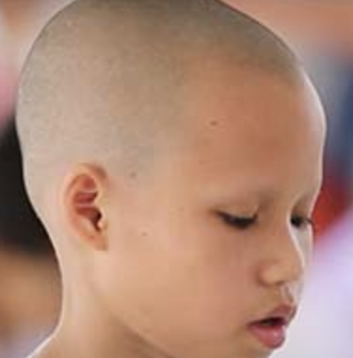
A little girl from Thailand says, “I like to meditate. I sit and meditate every day. It makes me feel good and I think it makes me do better at school too.”
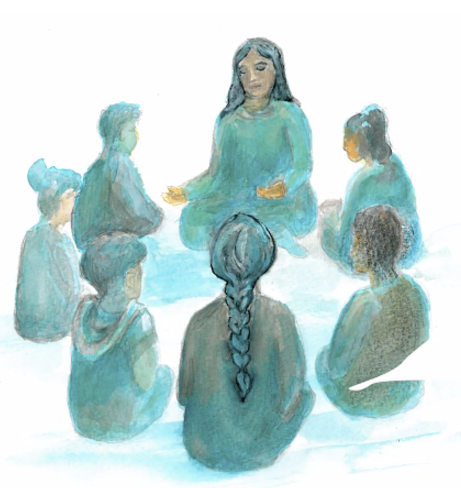
Tell your children to imagine they have a bubble around them, so they are in their own special space. Take a moment to let them get settled.. Give them a little moment to fidget or wriggle a little bit, so that they feel happy to stay still and relaxed.
Now repeat the meditation exercise from courses 1 and 2. Today they can meditate for one extra minute bringing the total to 4 minutes. Then your children will be ready to concentrate.
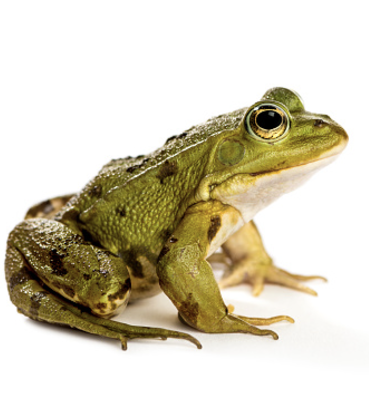
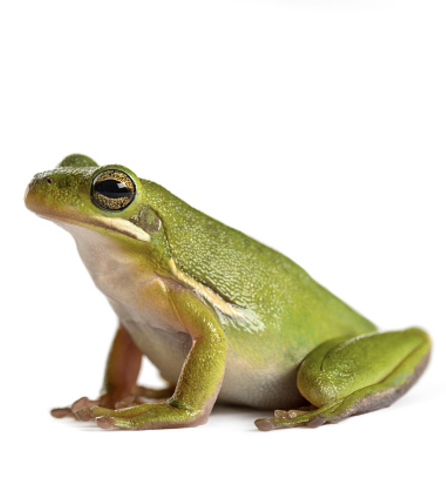
Sitting Still Like a Frog
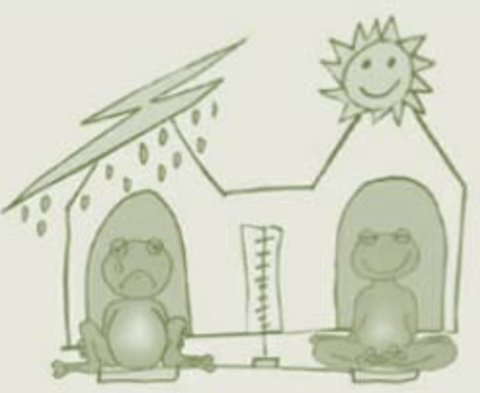
This exercise can be fun and it can lead into your normal meditation. It teaches your children to sit with the attention of a frog. Tell them how a frog can jumps but it also sits really still while observing everything that’s going on around it. Sometimes it moves just a single eye; because a rain drop has dropped on it; or a single leg to shift its position.
Tell them: “ imagine you are a frog on the edge of a large pond. Notice how your arms and legs are still. Your bottom and your belly are still. Your back, your neck and your head are still. When you are sitting here all still and calm you’ll notice all kinds of things. Notice your breath. It moves all by itself. Focus your intention on the tip of your nose, where the air comes in and out again. Maybe you also feel the breath in your throat, in your chest, or perhaps even further down in your belly. You can put your hands on your belly and find it moves a little, every time you breathe. You may also notice the brief pauses just after you breathe in and breathe out. Breathing brings calm, so breathe in and breathe out. Your breathing doesn’t require any special effort. Your body breathes all by itself. You can learn a lot from a frog. Sitting still with the attention of a frog you’ll get better at remembering things. You’ll notice a lot more.”
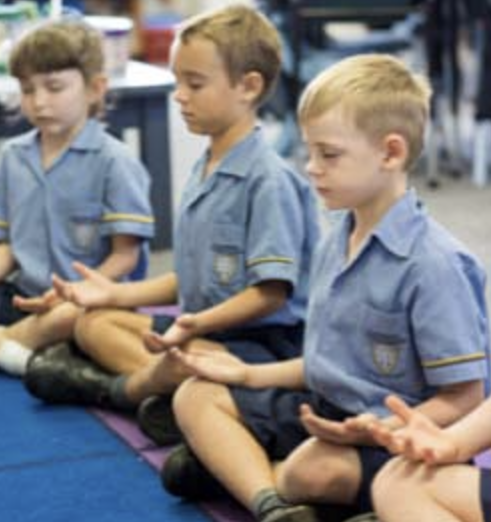
Now have them mediate for five minutes.
Eline Snel from Holland in her book Sitting Still Like a Frog advises:
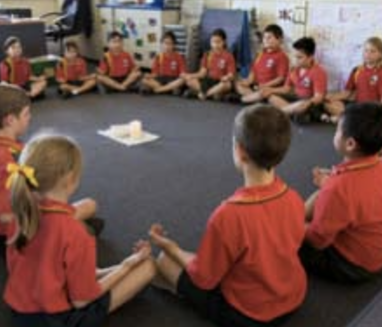
Meditation builds community wherever it is practiced. Sitting together in silence, stillness and simplicity promotes connection and wholeness in all human beings regardless of faith and other forms of diversity.
Meditation comes naturally to children, who experience it as both enjoyable and beneficial. Just as they are happy with their grandparents, parents or teachers paying attention to a story, so they are happy to be quiet and still in meditation. Teaching children to meditate is giving them a spiritual practice and life skill for the modern world that will remain with the for life.
It’s less a question of teaching them to meditate and more about us learning from their simplicity and helping them to stay in touch with their contemplative gift.
Children today are exposed to adult pressures and the addictions of digital entertainment at very early ages. Meditation simply and immediately helps them to cope and survive these forces. Teachers notice the benefits very quickly in classes and schools where meditation becomes part of the regular experience.
The above is taken from the website of the World Community of Christian Meditation
As much as possible give the following instructions in English – or first in the children’s language and then in English. In this way meditation will benefit the learning of English and English will begin to enter the children’s unconscious.
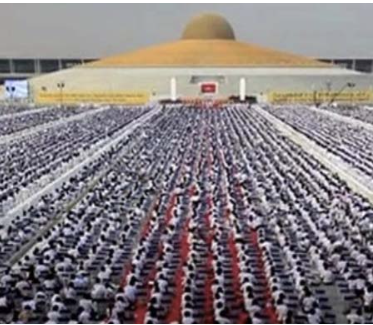
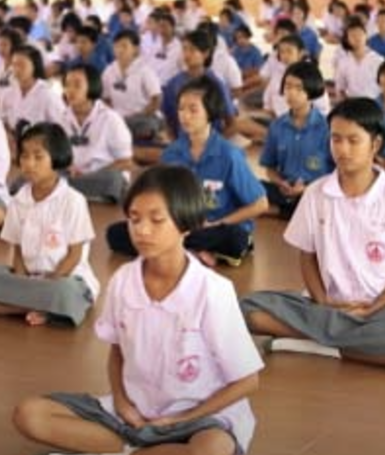
A million Thai children meditate
Before meditation do The Weather Report exercise by Eline Snel. Ask your children: “What weather best describes what feelings are inside you at the moment? Is it sunny? Is it cloudy? Is it foggy? Is it windy? Is it freezing? Is it calm and snowing? How do you feel? Once you know how you are right now, just let it be . . . just as it is . . . ; there is no need to feel or do anything differently. You cannot change the weather outside either, can you? Stay close to your feeling for a while. Direct your friendly and curious attention to the clouds, the clear sky, or the storm that is brewing . . . this is how it is right now . . . ; like the weather, you simply cannot change a mood. Later today the weather will be completely different again . . . , but right now this is how things are. And that is absolutely fine. Moods change. They blow over. There is no need to take any action. What a relief.”
Most children enjoy this weather exercise. It makes them aware of the rain, the sun, and the storm inside them and teaches them to identify less with their moods: I am not the downpour, but I notice that it is raining; I am not a scaredy-cat, but I realize that sometimes I have this big scared feeling somewhere near my throat. What is most important is that they allow themselves to feel the way they feel. Now let them meditate for five minutes.
The benefits of meditation for children include the improved ability to manage stress, control anger, improved attention/concentration and improved interaction/empathy, improved academic outcomes. Most teachers interviewed were positive about the meditation for children programme used in schools in Townsville, Australia.
Most parents reported calming and relaxing effects in their children. Many children reported that they meditated outside of school times especially when they felt under stress. They reported better pro-social behaviour. Many students also said they thought their teachers would benefit from meditation too. Children often experience stress and anxiety quite severely today. External pressures to perform and compete contribute to this in and out of academic areas.
Highly increased levels of mental stimulation operate on them through the media, internet and many addictively violent styles of music and entertainment. One woman, the wife of a University president began to teach her over-active 6 year old son to meditate when he said to her one night as he was unable to sleep, ‘Mum, I wish I had an off-switch.’
I highly recommend the books: Coming Home: A Guide to Teaching Christian Meditation to Children by Ernie Christie and Born Contemplative by Madeleine Simon, as well as the website wccm.org/content/meditatio-meditation-children which has greatly helped me to write these sections on meditation. They are mostly Christian orientated, but they are applicable to those of all religions and also of no religion.
Encourage your children to meditate for six minutes.
It is good to have started meditating young. It will provide a firm foundation to continue through primary, secondary and tertiary education – and into adulthood.
However it is never too late to start – I started in my seventies !
You can belong to any religion – or none.
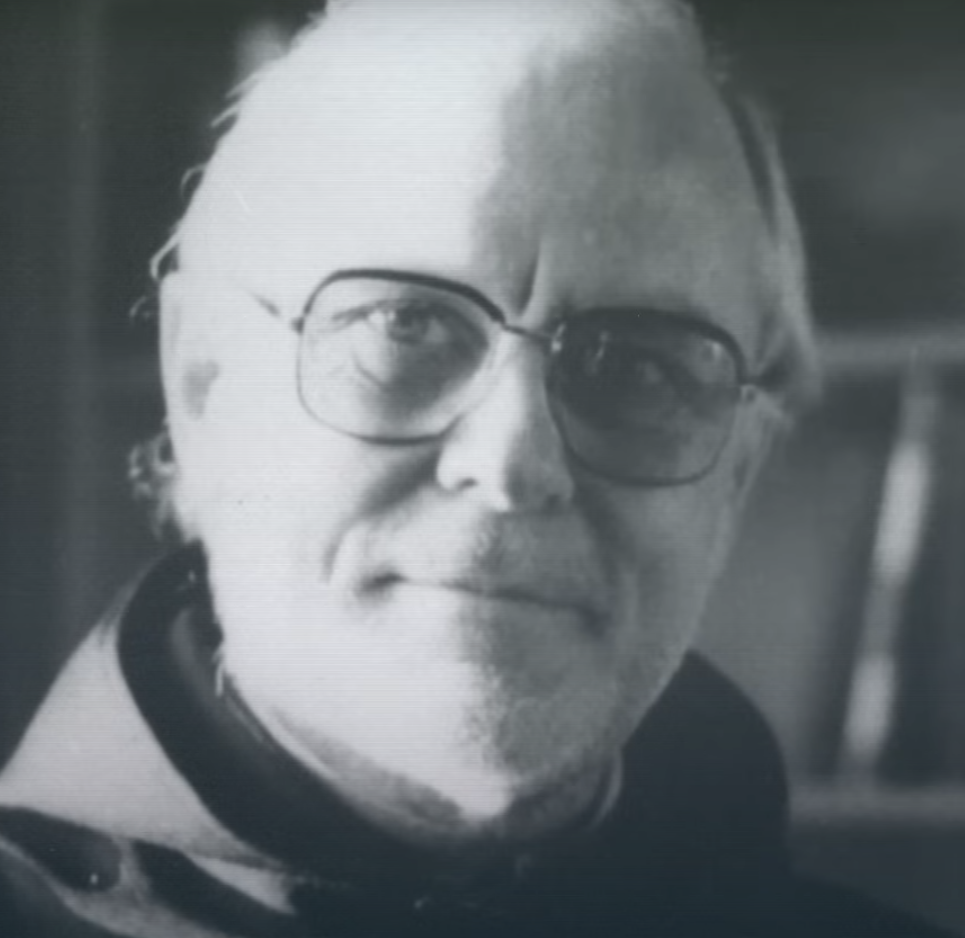
I have found John Main immensely helpful. He was taught to meditate by a Hindu Guru in Malaysia, and later when he became a Benedictine monk in England and then in Canada, he discovered that the Church Father, John Cassian, had taught meditation.
I highly recommend John Main’s Guided Meditation and his many books.
You should also find How to Meditate of practical value.
Note: some give the name contemplation to what we have here termed meditation.
The Catholic Catechism asks: What is contemplative prayer? St. Teresa of Avila answers: “Contemplative prayer [oracion mental] in my opinion is nothing else than a close sharing between friends; it means taking time frequently to be alone with him who we know loves us.” Contemplative prayer seeks him “whom my soul loves.” It is Jesus, and in him, the Father. We seek him, because to desire him is always the beginning of love, and we seek him in that pure faith which causes us to be born of him and to live in him. In this inner prayer we can still meditate (on the Scripture), but our attention is fixed on the Lord himself.
We meditate with our mind and contemplate with our heart.
If you would like to know more about meditation we recommend the following books. Should you consider buying any of them, we would be grateful if you would do so here, please. The commission will help us to maintain and develop the website.