

Wet and Dry Game
You may improvise this game.

Form the class in a large circle. Draw the happy, sad, angry, crying, laughing, surprised, hungry, sleepy faces on the board – or show flash cards. Also do the facial impressions of the emotions.


Musical Magic Box



The Tent game
The teacher improvises on the following example. Having arranged some chairs the teacher produces a sheet, saying, “What do you think we could use this for, huh?” “Maybe we can build a tent.” “Do you want to build a tent with it?” “Does that sound like a good idea to you?” (If she has enough hands she can also use her hand puppet, but this may be too much to cope with!).(You can make an entry with cardboard boxes.)
She starts to lay the sheet over two chairs. “It sounds like a good idea to me.” “We need some more chairs.” “Bring a chair. “Michael (any name of boy and girl) go and get a chair.” “And don’t sit on it.” She and maybe her classroom assistant or buddy or older child finish laying the sheet over the chairs. “Go inside.” “Go inside the tent.” “Come on guys, go inside the tent” “Go! Go! Go! ….. Very good Maria!” “We’re going camping….. Yes, we’re going camping” Show camping flashcard. “Do you like the tent?” She pops her head inside. “Oh it’s nice and warm in here.” “And what do I do if it rains?” “Oooh what happens if it rains?” Then she starts to sing. “Another day (child’s name) want to play, rain, rain go away. Come back another day” Then “Aah, we can stay inside and not get wet”
And what else do we need? If we’re going camping, what else do we need?” She takes a basket with red and yellow coloured paper and a lighted torch inside it. “Look, you guys. We’re going to build a fire. Come on. Who wants to go? Come on.(Name), what colour is this? Yellow. This one’s yellow, that’s right. And what about this one? Red.” So we did get warm in it. Ah, this is so nice! We can tell stories and we can carry it. We can tell stories around the fire. Yeah, that’s right. And what else can we do around the fire? No, don’t take the fire! Don’t take the fire! Don’t take the fire. You leave the fire here. No! Don’t touch it! It’s going to burn! It’s going to burn! Ow! Ow! Ow! [LAUGHING]Yes. And what is this? What is this? A torch. Oh, no! Yes, I know. The fire! The fire! The fire! I know. Gentle. Don’t touch. We can share. We can all share the fire and torch. No, no, no. So we can just get warm with the fire. Yes, I know. It’s a torch. No, no, gentle. Yes, I know. Oh, we don’t fight over this, OK? We can share. Yes, we can share the torch. We can share, yes? I know, I know, but it’s OK. OK, guys. Yes. Yes. Very good! Shall we take a little break now? Yeah?”


Instructions
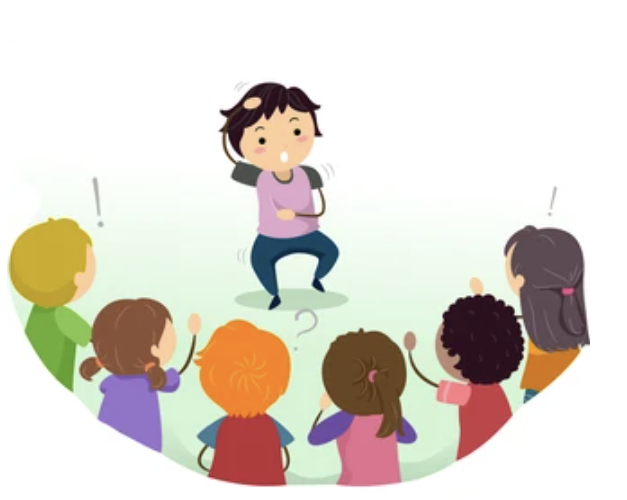
1. Form the class into teams in lines facing forward. The teacher demonstrates what to do.
2. The teacher then demonstrates with the students, so the first student in the line turns to the one behind and asks “What are you?” The next student replies, “I’m a boy/girl.” and then turns to the next student and asks “What do you play?” and the next student replies, “I play ball.” and so on. The teams take it in turn to play the game. Depending on their age, the teacher may have to guide them. The team with the most correct questions and answers wins.
Additional dialogues:
“What do you carry?” “I carry a basket.”
“What do you eat?” “I eat “a bun”/”bread”/ “breakfast”/”beans”/”birthday cake.”
“What do you love?” “I love a baby.”
“What do you sing?” “I sing Happy Birthday.”
“What do you see?” “I see a beautiful girl.” or “I see a bird.”
“What do you ride?” “I ride a bus.”

Taking an Action
The teacher shows a picture of a child waking up. Say “wake up”. Students repeat. Teacher shows flashcards and mimes the words brushing teeth, combing hair, eating, picking up bags and going to school with appropriate movements, gestures and facial expressions. Prompt the students to repeat the activity. Now you will be ready for the warm up song. If doing all the actions and showing the flashcards is too much to combine alone get a buddy or older child to help.

Let the Children Play with Blocks
When children are playing with blocks, they are learning about colour, shape, and patterns, as well as the concepts of weight, size, height, length, vertical and horizontal. Help them to:


Animal Game
A simple drama game to learn animal vocabulary and get everyone moving around and having fun.
This game was invented by Miranda Flynn Legge of www.kidsenglishtheatre.com. She runs wonderful workshops for teachers in beautiful Florence.
Chain Drill
This is similar to the chain drill in kindergarten 2.

Pooh Bear Game
Have a toy bear that two children have to find. Send two children out of the room and have the other children hide the bear. Then invite the two children back and have them search for the bear. If they are far away the other children can shout “freezing”, a bit closer they can shout “cold”, then as they get still closer they can shout, “warm”, “hot” and “very hot” until the two children find the bear. Then you can do the same with more pairs of children.
Of course, you can have any doll or toy to hide that you like. Miranda Legge of www.kidsenglishtheatre.com who invented this game had ‘Bob the Elf’ in a Santa Claus costume because it was nearly Christmas.
Incidentally did you know that the first Santa Claus was Saint Nicholas, who loved giving presents to poor people.

Listening Game
This can be applied to almost any subject!
The Teacher calls out a word or action and the students act it out.
Examples:
The teacher says: “let’s all “clap/jump/run/walk/swim” (to teach verbs to the students);
Or “let’s all be: trains/ cars/ taxi/airplanes” (to teach vehicles or any other nouns)”.
Or “let’s all be: happy/sad/ tired/ shy/ confused (to teach adjectives…).
Variations and Extensions
A student can be the one to call out the words. This is a listening game so you can say a word with the wrong action to check that they are not just copying your actions but are really listening to your voice. You can also get the whole group to make the object or shape as a team, e.g. everyone makes an ‘airplane’ or a ‘triangle’. This game will get everyone involved.
Say and Repeat
Challenging ability for Confidence, Cooperation and Fun.


Building on the last course, using the materials above to improvise on the following dialogue; “Do you want the green tent? No! No? Or do you want the yellow tent? Yes! Oh you want the yellow tent? Yes. Very good. OK, so you’re getting the yellow tent. Again, with one finger. Very good, Dani. Good job. OK, now turn it over.” (so it can be pasted). “There you go. Now take the moon. Green or yellow? Here, on the sky. Green or yellow? Do you want me to help you? You can do it. I know that you can do it. Come on. Turn it over. Green? Green! Yes. Green. Oh, you want a green tent. Very good.”
“Good job, Dani. Very good. Now, do you want the yellow tent? Or would you like the green tent? The green tent. Very good. Now– hold on, let’s do the tent first. What do you need now?” (taking the sprinkler of glitter) “We need the rain drops. Yes. Right here. Hold it right there. There you go. There you go. Like this? Yes? Now turn it over. I’m just going to put this over here. Put this over here. . Put some rain. Turn it over. This one, turn it over and paste it. This one. Like this. And put it– stick it– yes, very good. Very good. Now what do we need Dani? We need drops of rain.”
“(SINGING) Rain, rain, go away. Sprinkle. That’s right. OK, but we need more drops, more drops of rain. (SINGING) Rain, rain, go away. Dani, with one finger, remember? Very good. Yes. (SINGING) One little finger, one little finger, one little finger… drop. And the glue! Yes! And we can make drops. Very good, Dani. Yes, keep going. More drops. More drops. It’s raining a lot! A lot! (SINGING) It’s raining, it’s pouring, the old man is snoring.” (Perhaps make snoring sound). “Where are you going? Ah, you want one of these. Of course you do. Very good. There you go. Put it right here. Put a sprinkle there. Sprinkle it right here, on the glue. Very good. There you go. Right here. Right here. Right here. Sprinkle, sprinkle.”
“Over here. Sprinkle, sprinkle. And your moon and your drops of rain. Very good. Oh, do we have a different white…? One? One? One? One? For their names. Thanks. Look at this. This is going to look beautiful. Good job, everyone. Look, everyone. Look at Dani’s. Look how beautiful it is. Michael, look at Dani’s. It’s so beautiful. Good job, Dani. Alex, do you like Dani’s? It’s very nice. I really like it. Your parents are going to love it. Do you like it? Yes. Yes, yes you do! Very good! Good.”


This is a game to use with movement, gestures and facial expression.
If you take real photos, maybe you can print them and stick them on the class room wall.
Action Game – “Simon Says”
The teacher gets the class to stand and face them.
They will then give them an order such as “Simon says, touch your toes”.
The students must act out the teachers order correctly. If the students do
the wrong action then they are out of the game.
Variations and extensions: Teacher can give orders depending on the
category or topic that they are teaching. She can speed up the orders they give to make them think faster. She can also get the students to come up and become ‘Simon’.
This game gets the students moving around and is competitive.the class in a large circle. Draw the happy, sad, angry, crying, laughing, surprised, hungry, thirsty faces on the board – or show flash cards. Also do the facial impressions of the emotions.

What’s My Job?

Mark a coloured river across the floor of the classroom. One child is the crocodile the others are fish with the river between them.
They ask: ‘Hello Mr. Crocodile, can we cross your golden river?’ He answers: ‘Yes, only if your are wearing blue.” And if someone in wearing blue she/he can cross the river.
The others have to run through. The crocodile catches someone to be the next crocodile and choose then another colour to wear.


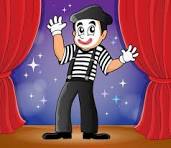
Draw a picture on the board and see who can guess what it is first. You may turn this game into a fun competition.


Here are some suggestions for mimes:



What’s in the Magic Box?
The teacher places a flashcard in the ”magic box.” The teacher or a puppet asks ”What’s in the magic box?” Students/teams ask questions about colour, category (animal? food? etc) and so on. Students/teams must ask at least 3 questions before guessing what it is. Correct guesses mean scoring points, and maybe the opportunity to be ”teacher” with the next item. This game can be used to practice answering closed questions and open questions. Closed-ended questions are those which can be answered by a simple “yes” or “no,” while open-ended questions are those which require more thought and more than a simple one-word answer. The game can also be used to review previous vocabulary, and teach new words. It is also great for listening practice and critical thinking skills. This is my go-to game for beginners due to it’s adaptability.
Students stand in a circle, one is in the middle. Students ask “What’s the Time Mr. Wolf?” The one in the middle can say any time. But when he/she says “It’s 12 o’clock, it’s lunchtime”, all the children have to run and Mr Wolf has to catch someone. That child will be the next Mr Wolf. Small children love it and it’s a good game to practice the question “What’s the Time” and the time expressions.


Arrange the students in a circle. Choose a category, for example, ‘things you would find in a bedroom’. A ball is needed. The person starting with the ball must say aloud an object from the chosen category and then immediately throw the ball to another player around the circle. That player must then do the same but cannot repeat the same word. If a player cannot think of a word, or repeats a word that has already been said; they are out and must sit down!
Variations and extensions: each individual player can come up with their category and pass it onto the next player. For example, the category to start with could be ‘something green’. The first person with the ball could say ‘grass’ then choose another category and pass the ball onto the next person.


Great for practicing question formation!
It’s great because it’s open-ended, so fast finishers can just repeat.the lesson.
The teacher gives a flashcard to the first child, without the others seeing it. She/He then says to the student:
The other students have to guess. Let each student take it in turn to use: speech (in English of course), movement, gesture and sound to act out being a passenger or a rider.
| Transport | Ideas for Sounds to Make and What to Say and Actions. |
| Car | Noise of car. “Drive straight”. “Turn left”. “Park here.” |
| Helicopter | Noise of helicopter. “Take off now. “ “Hover over the city.” |
| Airplane | Noise of plane taking off. “We are taking off.” “Fasten your seat belts.” |
| Parachute | “Jump!” Noise of Whooshing. “Get ready to land.” “Roll over onto ground.” |
| Fire Engine | Fire alarm noise. “Put on your helmets.” “Get the water hose.” |
| Steam train | Noise of steam train. “Which platform?” Whistle. “Close the doors please.” |
| Rowing boat | “Get your oars ready.” Action of rowing. “Don’t fall in.” |
| Bicycle | Action of cycling. “Let’s race.” “I’ve got a puncture.” Bicycle bell sound. |
| Skateboard | “Can you ride on two wheels?” “I can spin.” Imitate actions of skate-boarding. |


Have Fun Dressing Up and Making Drama
Fruit and Vegetable Drama Game


Pirate Game
| Command | Actions. |
| Quarterdeck | Run to a wall / line on the left side of the area. |
| Main Deck | Run back and form the original line in front of the teacher. (Children do not have to be in the same order). |
| Man the Lifeboats | Run to a wall / line on the right side of the area. OR call out a number (e.g. 6) and the children have to get into groups of six and “row” their lifeboats. OR find a partner, sit on the floor facing each other holding hands and rocking backwards and forwards (as in “row, row, row your boat”) |
| Scrub the Decks | Children crouch down and pretend to clean the floor with their hands. |
| Climb the Rigging | Children pretend to climb a rope ladder. |
| Captain’s coming | Children salute and shout out “Aye Aye Captain” |
| Admiral’s coming | Children stop and salute (like captain’s coming) but must continue to stand to attention until the instruction ‘Admiral’s gone’ – giving opportunities for catching children out. |
| Man Overboard | Three children pair up, 2 joining hands to make a ship and the 3rd in the middle with his hand above his eyes looking overboard for the fallen sailor. Anyone alone is out. OR children jump as if going over the side and then sink down holding nose with one hand and raising other hand in air as if going under water. OR children pretend to jump into the water, grab a partner and then swim back to the ship. OR children join into groups of three sitting on the floor one behind another making rowing actions. If done as a game the children not in a group are out of the game. OR children jump in the air and land as if jumping over the side of the ship. OR piggy back a partner. OR children have to find a partner and lift them up. Any children on their own are out. OR children have to find a partner and hold on to them. If any child does not have a partner, they are out. OR children pretend to fall over the side of the ship and swim for their lives! OR children shout “Splash!” and put their hands above their eyes to peer into the “sea”. OR children on their backs waving legs and arms in air as they drown. |
| Walk the Plank | Children have to have to walk in a perfect straight line one foot exactly in front of the other with arms outstretched to the sides (children could also walk along benches). |
| Boom coming over | Teacher makes action of boom moving across deck. Children must duck down to avoid. OR the children curl into a ball on the floor. |
| Captain’s wife | Everyone curtsies (boys think this is hilarious). |
| Captain’s daughter | Children pose like a model (one hand on hip. the other outstretched and slightly bent) and say “Oooooooooooh!” or make a wolf whistle (if your ears can stand it!). OR children wiggle hips and blow a kiss. |
| Submarines | Children lie on floor with one leg raised like a periscope. |
| Shark Attack | Crouch with bent arm forming fin of shark. OR lie on back with leg in air. |
| Fire the Cannon | Children run in pairs and pretend to light the cannon, and shout “Boom!” and jump in the air. |
| Hit the Deck | Children lie down on their stomachs as quickly as possible. |
| Crow’s Nest | Children stand on one leg which becomes the mast, the other foot rests on that knee to become the crows nest and their torso is the pirate looking out to sea, hand above eyes!! OR Have students run to the Jump Ball or Face Off circle in the middle of the gym.. the last student into the circle is out. OR Children peer into the distance and shout “land ahoy!” |
| Rats on board | Children sit on the floor, hugging their knees, whilst feet are raised off floor. |
| Bombs overhead | Teacher calls out ‘bombs overhead’ and throws 3 soft sponge balls at the children. Children are required to dodge the ‘bombs.’ If the children unfortunately get hit by a ball they are out of the game. OR the children crouch and cover their head for ‘protection’. They are not able to get up until ‘All clear’ is called. Anyone who gets up or moves before the ‘all clear’ is out. |
| Rowboats | Pair up facing each other, soles of feet touching and join hands then rock backwards and forwards in rowing motion. |
| Peg Leg Jim | Children have to walk with one leg straight and the other normally. |