Part 1: His Early Life 1813 - 1842

Whatever my passions demand of me, I become for the time being – musician, poet, director, author, lecturer or anything else.

NARRATOR:

Friedrich Nietzsche said of Wagner:

NIETZSCHE;

He is the most ill-mannered genius on earth.

NARRATOR:

KELLER:

Perhaps this is true, but he also at times had immense charm and he was often very kind. There is no denying he was a genius. The music critic, Hans Keller, has written.

Wagner’s music like none other before or after him, let what Freud called the dynamic unconscious erupt with a clarity and seductiveness, which will arouse as much resistance as its sheer power creates enthusiasm. 

NARRATOR:

The music and text of Tannhäuser are based on two German legends and upon a song contest. The story centres on the struggle between sacred and profane love. Redemption through love, is a theme running through most of Wagner’s mature work. Wagner wasn’t a Catholic, but Marcello Brownsberger has called Tannhäuser a Catholic masterpiece.

BROWNSBERGER:

Tannhäuser, has given himself over to the pagan goddess Venus, the demon of lust. Realizing he doesn’t want to be damned, he asks Venus to release him. She refuses, until he cries out: “Mein Heil ruht in Maria! (My salvation lies in Mary!) and Venus is forced to release him.

Tanhäuser flees to a lovely valley where he falls in love with  Elisabeth, a pious and beautiful princess.  He goes to Rome to ask the Pope, who says that as surely as his crosier will not sprout flowers, Tanhäuser will not be forgiven. He decides that if he will go to Hell anyway, he might as well live with Venus for the rest of his life. Elisabeth realizes that he has not been forgiven and dies of sadness, praying for Tanhäuser all the while.

Venus is accepting him back, when word comes from Rome: the Pope’s staff has flowered. Tanhäuser, now shown to be fully forgiven by God through the intercession of Elisabeth, is attacked by Venus’ minions and dies on Elisabeth’s funeral pyre. Tanhäuser is able, through the intercession of Our Lady and a holy friend, to break through the bonds of lust and die redeemed, at peace with God and fellow man.

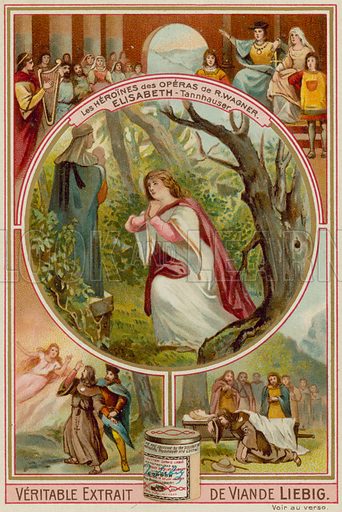
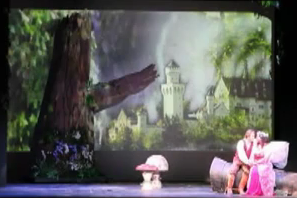
Elizabeth prays for Tannhäuser

NARRATOR:

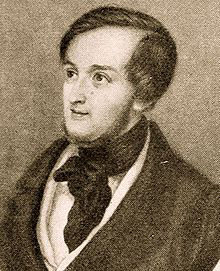
Wilhelm Richard Wagner was born at No. 3 The Brühl, (‘The House of the Red and White Lions’), in the Jewish quarter of Leipzig, on 22 May 1813. He was the ninth child of Carl Friedrich Wagner, a clerk in the Leipzig police service, and of his wife Johanna Rosine, the daughter of a baker. Wagner’s father died of typhus six months after Richard’s birth, following which Wagner’s mother began living with the actor and playwright Ludwig Geyer, who had been a friend of Richard’s father. In August 1814 Johanna married Geyer, and moved with her family to his home in Dresden. Until he was fourteen, Wagner was known as Wilhelm Richard Geyer. He almost certainly suspected that Geyer was his natural father.

NARRATOR:

How deeply the homeless artist, Ludwig Geyer, hard pressed by life and tossed to and fro, longed to feel himself at home in a sympathetic family circle, was proved by the fact that a year after his friend’s death, he married his widow, and from that time forward became a most loving father to the children left behind.

Geyer’s love of the theatre was shared by his stepson, and Wagner took part in his performances. In his autobiography, he recalls playing the part of an angel.

I figured in a tableau vivant, sewn up in tights with wings on my back, in a pose I had laboriously practised.

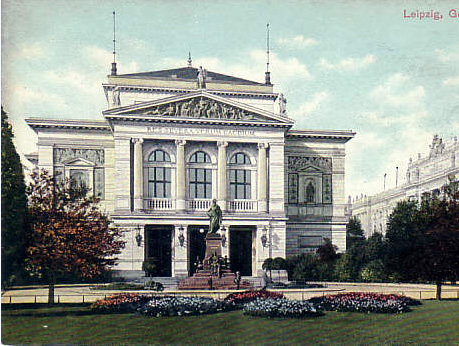
Richard Wagner's birthplace in Leipzig

NARRATOR:

The boy Wagner was also hugely impressed by the Gothic elements of Weber’s Der Freischütz. 

I figured in a tableau vivant, sewn up in tights with wings on my back, in a pose I had laboriously practised.

Moon milk falls on grass,
Spider’s web spun from blood.
Before evening comes again
The bride will be dead.
Before night falls again
The sacrifice will be made.

Der Freischütz appealed very strongly to my imagination, mainly on account of its ghostly theme. From my earliest childhood mysterious and uncanny things exercised an enormous influence over me. If I were left alone in a room for long, when gazing at lifeless objects, such as pieces of furniture, I would suddenly shriek out with fright, because they seemed to me alive

In late 1820, Wagner was enrolled at Pastor Wetzel’s school at Possendorf, near Dresden, where he received some piano instruction from his Latin teacher. He could not manage a proper scale but preferred playing theatre overtures by ear. Geyer died in 1821, when Richard was eight. Subsequently, Wagner was sent to the Kreuz Grammar School in Dresden, paid for by Geyer’s brother. The young Wagner entertained ambitions as a playwright, his first creative effort being Leubald, a tragedy, begun at school in 1826, which was strongly influenced by Shakespeare and Goethe. Wagner was determined to set it to music; he persuaded his family to allow him music lessons.

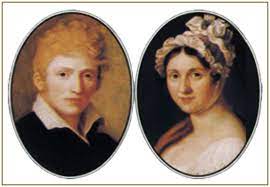
Ludwig Geyer, the acting father
and Johanna Wagner
mother of nine children

By 1827, the family had moved back to Leipzig, wher he began lessons in harmony. In January 1828 he first heard Beethoven’s 7th Symphony and then, in March, Beethoven’s 9th Symphony performed in the Gewandhaus, Leipzig’s premiere concert hall. Beethoven became his inspiration, and Wagner wrote a piano transcription of the 9th Symphony.

I learned that he was deaf, and led a quiet secluded life. I conceived an image of him as a sublime and unique supernatural being, with whom none could compare. This image associated in my brain with Shakespeare; in ecstatic dreams I met both of them, and on awakening found myself bathed in tears.

He was also greatly impressed by a performance of Mozart’s Requiem. 

I was now filled with a desire to compose, as I had been before to write verse.  

From this period date Wagner’s early piano sonatas and his first attempts at orchestral overtures.

At the age of 16 he saw the dramatic soprano Wilhelmine Schroeder Devrient on stage. She became his ideal of the fusion of drama and music in opera. In his autobiography, he wrote

If I look back on my life as a whole, I can find no event that produced so profound an impression upon me. Any one, who can remember that wonderful woman at this period, must to some extent have experienced the almost Satanic ardour, which the intensesly human art of this incomparable actress poured into his veins.

Wilhelmine Schroeder-Devrient

In 1831 he enrolled at the University of Leipzig, where he became a member of the Student Fraternity, entitled to wear a splendid Saxon cap.

He was wild and disreputable, taking part in riots, drinking heavily, and challenging other students to duels.

However he was saved from his worst excesses:

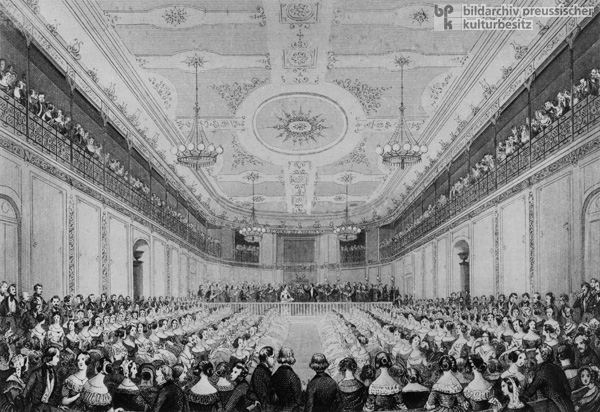
Gewandhaus, Leipzig

The way in which fate preserved me from the consequences of my rashness was truly miraculous. My first opponent had the artery of his right arm severed by another combatant and was therefore unable to fight. Two further opponents ran away to avoid paying debts. A fourth was killed in another duel. A fifth was assaulted in a house of ill fame and ended up in hospital the day we were due to fight.

Student sabre duel

He then became addicted to another obsession.

I was such a victim to the rage for gambling, that no other passion was able to exercise the slightest influence over my mind. Neither the beer house nor the scene of the fights ever saw my face again. In my lamentable position, I racked my brains all day to devise means of getting the money, wherewith to gamble at night. And then I staked my mother’s entire pension, which I lost; and when I was down to my last thaler and sick from lack of food, I staked it and then I began to win and win and win. 

Gambling at Baden Baden

My sensations during this process were of the most sacred nature: I felt as if God and His angels were standing by my side. I confessed to my mother, returned the money to her and from that moment gambling lost all fascination for me. I now devoted myself heart and soul to serious music study.

He took composition lessons with the cantor of Saint Thomas Church, Christian Theodor Weinlig. Weinlig was so impressed with Wagner’s musical ability that he refused any payment for his lessons, and arranged for Wagner’s piano sonata in B flat to be published, as the composer’s opus number 1.

A year later, at the age of 19, Wagner composed his Symphony in C major, a Beethovenesque work, performed in Prague in 1832 and at the Schneider-Herberge in Leipzig.

It was in this dignified old hall that my work was introduced to the Leipzig public for the first time. The place was dirty, narrow, and poorly lighted, and it was here that an orchestra interpreted it simply disgracefully. I can only think of that evening as a gruesome nightmare; and my astonishment was therefore all the greater at reading an excellent notice. Full of hope, I therefore looked forward to a performance of the same work at the Gewandhaus concert, which followed soon after, and which came off brilliantly in every way. It was well received and well spoken of in all the papers; of real malice there was not a trace.

Gewandhaus, Leipzig

In the same year Wagner’s older brother Karl Albert managed to obtain Richard a position as choir master in Würzburg. There at the age of 20, Wagner wrote the libretto and composed the music for his first complete opera, Die Feen (The Fairies).

My prince was called Arindal; he was loved by a fairy called Ada, who held him under her spell and kept him in fairyland, away from his realm. But eventually his faithful friends induced him to return, for his country has fallen into the enemy’s hands.

The loving fairy herself sends him back to his kingdom, for the oracle has decreed that she shall lay upon her lover the severest of tasks. Only in this way can she leave the land of the fairies and marry her earthly lover.

Then the fairy queen appears and destroys his faith in Ada. Arindal imagines he has been dealing with a wicked sorceress. Wild with sorrow, the unhappy fairy sinks down, and reveals their mutual fate to the lover, now lost to her for ever. She tells him that, as a punishment for having disobeyed the decree of Fate, she is doomed to be turned into stone. However Arindal’s madness grows into sublime exaltation. He plays a lyre, expressing his remorse, and his overpowering longing for his enchanted queen. 

Arindal and Ada

The stone is moved by the magic of his love: the beloved one is released.  Fairyland with all its marvels opens its portals, and the mortal learns that, owing to his former inconstancy, Ada has lost the right to become his wife on earth, but that her beloved, through his magic power, has earned the right to live for ever by her side in fairyland.

Michael Tanner, who has written an excellent book on Wagner, says:

It is a work of considerable charm, not much originality, and a pervasive uncertainty about how seriously it wants to be taken.

This opera, which clearly imitated the style of Carl Maria von Weber, would go unproduced until half a century later, when it was premiered in Munich shortly after the composer’s death in 1883.

Meanwhile, Wagner held a brief appointment as musical director at the opera house in Magdeburg during which he wrote Das Liebesverbot (Forbidden Love), based on Shakespeare’s Measure for Measure. This was staged at Magdeburg in 1836, but closed before the second performance, leaving the composer (not for the last time) in serious financial difficulties.

In 1834 Wagner had fallen for the actress Christine Wilhelmine “Minna” Planer.

The ladies of the opera company were not slow to pay court to their youthful conductor. I hit upon the idea of inviting the elite of our opera company to oysters and punch on New Year’s Eve. Would Fraulein Planer consent to take part in such a festivity? Yes. She presented herself in my bachelor apartment, where things soon grew pretty lively. What the champagne failed to accomplish, the punch eventually succeeded in doing; all the restraints of petty conventionality were cast aside, giving place to an unreserved demeanour all round.

And then it was that Minna’s queenly dignity distinguished her from all her companions. Everyone could not fail to see that the link existing between us was not to be compared to any ordinary liaison.
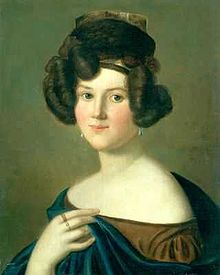
Minna Planer (1835) by Alexander von Otterstedt

I do not believe that Minna ever felt any sort of passion or genuine love for me, or, indeed, that she was capable of such a thing, She obviously had a very favourable opinion of my abilities, though she was surprised at the rapidity of my success. She knew well how to humour my eccentric nature by her gentleness. She never met my impetuous advances with coldness.

At this time Minna and I made friends with Madame Haas, an elderly actress; but she became jealous and began to criticise Minna. One evening I became drunk at a whist party and returning to Minna’s I scoffed at Madame Haas in the coarsest manner. She left the house in high dudgeon. As soon as Minna realised my removal was impossible without the greatest commotion, with the utmost calmness and resolution, she procured me the necessary relief. I sank into a heavy slumber. The next morning’s sunrise marked the starting point of a momentous period in my life. We breakfasted quietly and decorously together. From that day forward we freely and openly gratified our desires, as an acknowledged pair of lovers.

Minna Planer

After the disaster of Das Liebesverbot, in which on the second night there was a fight between members of the cast, behind stage and the performance had to be cancelled, Wagner followed Minna to Königsberg, where she helped him to get an engagement at the theatre. The two married in Königsberg on 24 November 1836. In June 1837 Wagner moved to the city of Riga, then in the Russian Empire, where he became music director of the local opera.

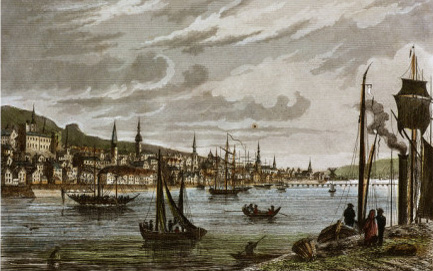
19th Century Riga

Minna had recently left Wagner for another man, but Richard took her back; this was but the first debacle of a troubled marriage that would end in misery three decades later.

By 1839, the couple had amassed such large debts that they fled Riga to escape from creditors.

We did not have passports to enter Prussia. We had to wait until sundown in a smugglers’ drinking den, which gradually became filled to suffocation with Polish Jews of most forbidding aspect. At last we were summoned to follow our guide to the ditch which runs the whole length of the Russian frontier. It is watched continually by Cossacks.

Our chance was to utilise the few moments after the relief of the watch, during which the sentinels were elsewhere engaged. We had, therefore, to run at full speed down the hill, scramble through the ditch, and then hurry along until we were beyond the range of the soldiers’ guns; for the Cossacks were bound in case of discovery to fire upon us even on the other side of the ditch.

We succeeded. Yet the dangers we had overcome were but a prelude to further calamities on our adventurous journey.
A Zaporozhian Cossack.

During their flight, they and their Newfoundland dog, Robber, took a stormy sea passage to London, from which Wagner later drew the inspiration for The Flying Dutchman.

The storm began to rage with unheard-of violence. We thought ourselves in imminent danger of death. It was not the terrible force with which the vessel was hurled up and down, entirely at the mercy of this sea monster, which appeared now as a fathomless abyss, now as a steep mountain peak, that filled me with mortal dread. There raged, beside the tempest on the water, a furious thunderstorm overhead, and Minna expressed the fervent wish to be struck by lightning with me rather than to sink, living, into the fearful flood. She even begged me to bind her to me, so that we might not be parted as we sank. Yet another night was spent amid these incessant terrors, which only our extreme exhaustion helped to mitigate.

The Flying Dutchman by Albert Pinkham Ryder

Michael Tanner describes the opera:

It is characteristic of Wagner’s central figures that they have committed a crime – in Vandecken,  the Dutchman’s case, an oath that he would round the Cape at any cost, for which Satan doomed him to eternal voyaging.

However every seven years he is given a teasing chance of setting foot on land to find a woman who will sacrifice herself for him. So begins the Duet with Senta, which is the heart of the work.

The sombre glow that I feel burning here,
Should I, wretched one, call it love?
Ah no! It is the longing for salvation,
Might it come to me through such an angel..

In his essay “Sorrows and Grandeur of Richard Wagner”, Thomas Mann quotes these lines and comments:

Never before had such complex thoughts, such convoluted emotions been sung or put into singable form. What a penetrating insight into the complex depths of an emotion!

The actor Simon Callow in his book, Being Wagner, has said 

Wagner is both Vanderdecken and Senta; the redeemer and the redeemed. From now on the idea of redemption – through love, through sex, through God, through art – underpinned everything he ever wrote, with himself in it, right at the thick of things. He is both the one who needs redemption and the redeemer. What had he done that was so bad? And what qualified him to redeem, not just himself, but the nation, perhaps the world? 

Whatever it was, it was a destiny he embraced, the destiny, as he saw it, of the artist. The artist is he who suffers on behalf of humanity, and whose work is the cure for its ailments. Art was the only hope for mankind. It should therefore be at the centre of society. And at the centre of art was the artist. That was the logic that kept him going.

WAGNER:

Imagination creates reality.

NARRATOR:

is one of Wagner’s most famous quotes

The Wagners spent 1839 to 1842 in Paris, where Richard made a scant living writing articles for the Revue et Gazette Musicale.

In one piece called ‘Death in Paris’, he writes about a provincial German composer, who starves to death in Montmartre, making a final statement which seems like a parody of the Catholic Creed and which may well have represented Wagner’s own deepest feelings:

WAGNER:

I believe in God, Mozart and Beethoven, likewise in their disciples and apostles; I believe in the Holy Ghost and in the truth of the one and indivisible Art; I believe this Art to be an emanation of God that dwells in the hearts of all enlightened men; I believe that all men are blessed through Art and that it is therefore permissible to die of hunger for its sake; I believe that in death I shall attain the highest bliss – that in my life on earth I was a dissonant chord, which death will resolve in glorious purity … I believe in a Day of Judgement upon which all who dared to exploit this chaste and noble Art for the sake of profit, and all who in the baseness of their hearts dishonoured and disgraced it for the sake of sensual pleasure will be fearfully punished; I believe that they will be condemned to listen to their own music for all eternity. On the other hand I believe that the souls of Art’s true disciples will be transfigured in a shining heavenly fabric of glorious harmony and be united therein forever – may such a lot be mine! Amen!

Wagner drawing by Keitz, Paris 1842

NARRATOR:

Michael Tanner, one of his many biograhers, wrote:

TANNER:

It is a semi-paradox of his life that though he was always complaining of exhaustion, suffered from chronic insomnia, and tirelessly complained about tiredness, he struck everyone as a human volcano, never resting and needing always to be the centre of attention at any gathering – a goal in which he invariably succeeded.

NARRATOR:

Wagner and Minna were often short of food and in winter could not afford to heat their lodgings.

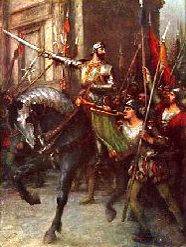
However, he also completed his third and fourth operas Rienzi and The Flying Dutchman during his stay in Paris. Rienzi is a medieval Roman, who succeeds in outwitting and then defeating the nobles and in raising the power of the people.

TANNER:

Magnanimous at first, he is forced by events to crush the nobles’ rebellion against the people’s power, but popular opinion changes and even the Church, which had urged him to assert himself, turns against him. In the end the populace burns the Capitol, in which Rienzi and a few adherents have made a last stand.

Michael Tanner again:

It was attending a performance of Rienzi in Linz which set Hitler, so he often claimed, his goal of absolute power.

Cola di Rienzi (1313-1354

WAGNER:

The distressing poverty of my home in Paris grew more apparent every day and yet I was now to give a last touch to Rienzi, the most voluminous of my operas.
I had decided to offer the first production to the Court Theatre at Dresden.

NARRATOR:

His relief on leaving Paris for Dresden was recorded in his Autobiographic Sketch of 1842:

WAGNER:

For the first time I saw the Rhine – with hot tears in my eyes, I, poor artist, swore eternal fidelity to my German fatherland.

NARRATOR:

The first night of Rienzi at the Hopofer, Dresden in 1842 was Wagner’s first success.

WAGNER:

No subsequent experience of mine can be compared with day of the first production of Rienzi. When I try to recall that evening, I can only picture it with all the paraphernalia of a dream. I was unconscious of the applause, and when I was tempestuously called for, I had to be driven onto the stage.

My opera excited the interest of the princesses of the royal family. They thought the exhausting length of six hours a drawback; so it was proposed two halves of it should be given on successive nights. 

Hopofer, Dresden

However many of the audience considered it a fraud to have to pay for two performances, and the management was obliged to accept some of my cuts and to go back to the old arrangement.

(SOUND OF FLOGGING AS DESCRIBED)