
Joy—deeper yet than woe is she!
Saith woe: Hence, go!
Yet Joy would have Eternity—
Profound, profound Eternity!
(Friedrich Nietzsche, Thus Spake Zarathustra)
One truly lives only when one dances.
(Isadora Duncan)

The World as Work of Art
Dear Unknown Friend,
The above quotations are a musical prelude to the twenty-second Major Arcanum of the Tarot “The World”.
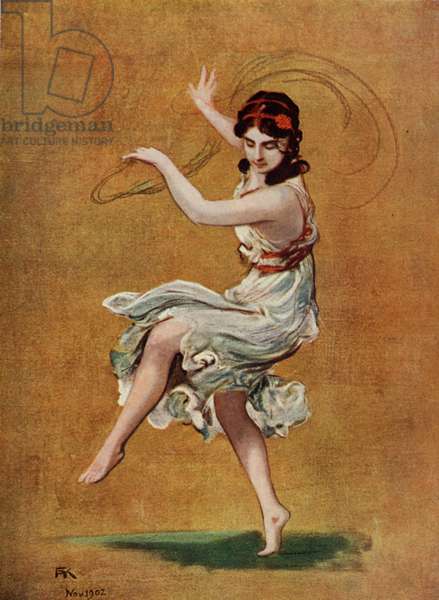
The Card represents a naked woman in a garland dancing and holding a wand in the left hand and a philtre in the right. She is wearing a scarf thrown lightly across her shoulder. In the four corners of the Card one sees the Angel and the Eagle above, and the Bull and the Lion below. The four sacred animals thus enclose the garland in which the naked dancer, with her floating scarf, is dancing.
The first impression of the Card suggests a conception of the world as rhythmic movement or dance of the female psyche, sustained by means of the orchestral accompaniment of the four primordial instincts, which gives the appearance of a rainbow of colours and forms—or, in other words, that the world is a work of art. This idea is portrayed in a most impressive way by Edward Carpenter in his work The World as a Work of Art.
In order to arrive at certainty there is no other way than that of profound meditation. . Let us therefore follow the general suggestion that the context of the Card conveys.
Creation
The idea of the world as a work of art is implicit in all cosmogonies which explain the origin of the world through a creative act, or through a series of creative acts, as is the case in Moses’ Genesis. Creation entails the demiurgic rearranging of pre-existing matter from a chaotic state into a cosmic state, where the transformation from primordial chaos into cosmos is intelligible only by analogy with the magical art or the magic of art. “In the beginning God created the heavens and the earth — so begins the account of the creation of the world in Moses’ Genesis. Can one conceive of another idea here than that of the act transforming the ideal into the real?
And is this transformation into objective reality of that which exists only in divine thought and will analogous to the act of artistic creation as well as to the magical act? Is the divine magic implicit in Moses’ account of the creation of the world one and the same as the divine art that is implicit therein?

Platonic philosophy, also, conceives of the visible world as the realization of the invisible world of archetypes or ideas. Thus, the Neoplatonist Plotinus says that the idea “Man” is pre-existing and realizes itself in each particular man.
“…when Man enters into human form there exists a particular man who, however, is still Man. From the one thing Man—man in the Idea—material man has come to constitute many individual men: the one identical thing is present in multiplicity, in multi-impression, so to speak, from the one seal.” (Plotinus, Ennead VI)
Magic and Art
Here the metaphysics of magic and, at the same time, that of art are portrayed with admirable clarity! By means of the biological knowledge available in the first quarter of the twentieth century, Edgar Dacqué, in Life as Symbol reveals the nature of the “seal” spoken of by Plotinus (“the one identical thing is present in multiplicity from the one seal”):

“Schopenhauer once said that things appear to the child so bathed in splendour and of such a paradisical nature because they experience naively each particular thing. This inner reality is entirely lost for man who has attained the maturity of rational thought, when he comes out of the “childlike state” of animated and living perception and is given over to laws of pure abstraction. Thus, each time we are in the state of experiencing the idea in form, we are—like the child— within Nature. Goethe was such a child. If, therefore, as I have tried to show all along, man is the archetype of the evolutionary history of species and the centre of living Nature…if the animal kingdom, as the ancients already knew, is man disintegrated—which we can now take in a realistic sense—then we have a solid basis for all totemism and animal cults that is well founded from the standpoint of natural science.”
In other words, Edgar Dacqué—just like Pierre Teilhard de Chardin—sees the world with its animal, plant and mineral kingdoms as variations of man, who is the archetype of Nature in evolution.
Man is therefore the “seal” spoken of by Plotinus, and the beings of Nature are partial imprints of him. Is not the world in evolution, following Dacqué, a work of art in creation where the idea—man—becomes reality?
With respect to Goethe, whom Dacqué cites as an example of one who perceived the archetypal world in particular phenomena, he conceived of the creative, artistic act as an integral part of the creative activity which works in Nature. For him, a flower which pushes forth from the soil, and a poem which “pushes forth” from the “soil” of the soul of the poet, are two manifestations of the same creative magical force.
He called this force “metamorphosis”. Goethe observed metamorphosis in scientific and artistic works. His writings Theory of Colours, are a description of the metamorphosis of light; his work The Metamorphosis of Plants is what its title says; his fragment The Metamorphosis of Animals is again what its title says, and his master work Faust is nothing other than the metamorphosis of the human soul since the Renaissance.

Concerning the relationship between art and magic, Joséphin Péladan— himself an artist and magician—said:
“With respect to geniuses, they are intuitive people who bring to expression supernatural laws with images; they attract an influx from beyond and they are in direct relationship with the occult. Neither Dante, nor Shakespeare, nor Goethe carried out evocations, and all three understood the occult; they were wisely content to create eternal images; and in this they were incomparable mages. To create in the abstract, to create in the souls of men, vivifying reflections of the mystery—this is the great work.” (Joséphin Péladan, Introduction aux sciences occultes)
Thus, artistic creation differs from the operation of ceremonial magic in that the latter is more inward than the former. The relationship between sacred art and sacred magic amounts to that between the beautiful and the good, i.e. to the relationship between colours and warmth of the same light. The beautiful is the good which makes itself loved; the good is the beautiful which heals and vivifies.
But the good from which the beautiful is lost becomes pure duty; the beautiful which is detached from the good and loses it from sight becomes softened to pure enjoyment— stripped of responsibility. The hardening of the good into a moral code and the softening of the beautiful to pure pleasure is the result of the separation of the good and the beautiful—be it morally, in religion, or in art. It is thus that a legalistic moralism and a pure aestheticism of little depth has come into existence. This has, at the same time, also engendered corresponding human types: on the one hand the “stiff-as-a-peg” human type, who was at his height during the reign of Puritanism in England—this form of life and religion without joy and without art—as also in the shape of Huguenot ennui in a large part of France and Switzerland, and on the other hand the human type of the bearded “artist”, of shabby appearance with a mop of tufted hair, and with licentious morals, who is in full flower now (1966) all over the place.
The twenty-second Arcanum of the Tarot suggests the idea that the world is to be understood artistically rather than intellectually, since it is movement and rhythm (as the central figure is dancing). Does this Arcanum want to communicate this teaching only or does it, in the manner of the twenty-first Arcanum “The Fool”, also give a warning? In other words, has it also two aspects—a teaching aspect and a warning aspect? For if the Arcanum whose Card represents an itinerant fool brought us to its more profound name, i.e. “Love”, cannot the Arcanum whose Card represents a naked dancer in a garland bring us to its second, hidden name—“Folly”?

We shall see if this is so after having deepened our meditation on the Arcanum “The World” far enough to be able to be in a position to see clearly both the profound beauty of the world and the danger of the beauty of the world. May our meditation therefore be sober, and may it not let either the Arcanum’s teaching or the warning that it entails escape us.
I say sober meditation, but since it is a matter of meditation on the world as a work of art, instead of conceiving of it as a system of laws, do we not—in advance—condemn ourselves to sterility by renouncing the élan of intoxication? Has not Baudelaire, an artist of genius, bequeathed us intoxication as the sole, indispensable key for creation and artistic creativity
Joy
Just as there is human Art and art, so also there is cosmic, divine, creative Art and the cosmic art of mirages. And just as there are ecstasies from the Holy Spirit, so there are intoxications from the spirit of mirage—which is named the “false Holy Spirit”. If you seek for the joy of artistic creation, spiritual illumination and mystical experience, you will inevitably more and more approach the sphere of the spirit of mirage; if you seek for truth through artistic creation, spiritual illumination and mystical experience, you will then approach the sphere of the Holy Spirit, and you will open yourself more and more to the Holy Spirit. The revelations of truth issuing from the Holy Spirit bring with them joy and consolation, but are only followed by the joy which results from the revealed spirit of truth; cf. John xvi, 13), whilst the revelations that we have called “mirages” follow the joy— they are born from the joy.

The sobriety that we propose to maintain in this meditation on the Arcanum “The World” is the necessity of keeping away from the spirit of mirage by means of faithfulness to the vows of chastity, poverty and obedience—these vows being the sole means of avoiding the dangers of the sphere of the spirit of mirage

The joy which results from truth and the belief which results from joy is the key which opens the door to understanding the Arcanum of the world as a work of art: as the world of Wisdom “who was at work beside him…rejoicing before him always” (Proverbs viii, 30), and it is this Arcanum again which reveals the world as a work of art of deceptive mirage, i.e. the world of maya, the great illusion, who plays her game unceasingly—or, in other words, on the one hand the world which reveals God by manifesting him, and on the other hand the world which hides him by covering him.
Whether it is a matter of the world seen in the light of truth or of the spirit of mirage, it is a twofold joy.
What is joy? What is it in its deeper sense ?
Joy is the harmony of rhythms, whilst suffering is their disharmony. The pleasure that one experiences in winter when seated close to a fire is the restoration of an accord between the body’s rhythm and the rhythm of the air. The joy that friendship gives is the harmony between the psychic and mental rhythms of two or more people. The beatitude (Matthew v, 8) promising those who have a pure heart that they will “see God” signifies the accordance of their basic rhythm with the divine rhythm. Joy is therefore the state of harmony , of the rhythm of created being with divine rhythm.
Now, the whole world is the accordance of innumerable rhythms.Thus life is basically joy.
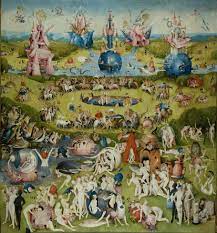
The Septuagint—the Greek version of the Bible —renders Genesis 3.23 as: “…the Lord God sent Adam out of the garden of delight to cultivate the ground out of which he was taken…” . This version is taken over by the Vulgate —“So the Lord God drove him out from that garden of delight, to cultivate the ground from which he came” —whilst the Hebrew Bible says only: “YHVH sent him forth from the garden of Eden, to till the ground from which he was taken”. The translators of the Hebraic by “garden of delight”, were thereby advancing the thesis that the world is the kingdom of joy. It was only after the Fall that suffering became added to joy.
Can one imagine a world deprived of all Joie de vivre? Does not the very idea of movement —biological, psychic or intellectual — presuppose a conscious or unconscious “yes”? A lot is said in biology and psychology about the instinct of self-preservation, but what is this instinct if not the affirmation of existence? If this were not so, universal weariness and disgust would have long ago put an end to all life.
Even the most austere asceticism bears witness to joie de vivre, for it wants to purify the mixture following the Fall. The idea of Buddhism and yoga— deliverance from terrestrial life—in the last analysis only affirms being, by commending the final surpassing of the world of forms to the degree of universality which is that of pure being. And the state of pure being—not of nothingness—is appraised in yoga as beatitude or blessedness by postulating the equation:
sat (being) = chit (consciousness) = ananda (blessedness)

Suicide

Buddhist nirvana is the state of complete absence of the suffering entailed by earthly incarnation. If nirvana signified “void” and not the blessedness of pure being, no one— including the Buddha himself—would be able to find the considerable energy demanded by the moral and intellectual effort which leads to nirvana. In order to make this effort, one has to want—and one cannot want the void, i.e. that where there is nothing to want. Complete suicide? No, since suicide is an act of despair, whilst nirvana is the hope of the blissfulness of peace which one is able to attain after having travelled a long path of discipline, renunciation and meditation. Do we not pray, we Christians, also, for the souls of the departed: “grant them eternal rest, O Lord”?… and “may they rest in peace”? Thus, Buddhists want nothing other than this “eternal rest” that they call nirvana. There remains, lastly, the question of suicide. One says of some such person that he blew his brains out because he did not want to live any longer. Is it true that he did not want to live? Or rather, did he commit suicide because he wanted to live otherwise?…because he did not believe that he could change his life?
At the root of the depression and despair which lead to suicide, the element of dissatisfaction is to be found, i.e. the desire and assertion for another form of life or another way of living. One is not dissatisfied if one does not want anything. One does not despair, if one does not hope for anything. One does not kill oneself if one does not take life seriously. All dissatisfaction presupposes the affirmation of an imagined happiness. All despair presupposes a virtual hope. Thus, all suicide presupposes the passionate affirmation of some value in life: love, glory, honour, health, happiness…


Wisdom and Mirages
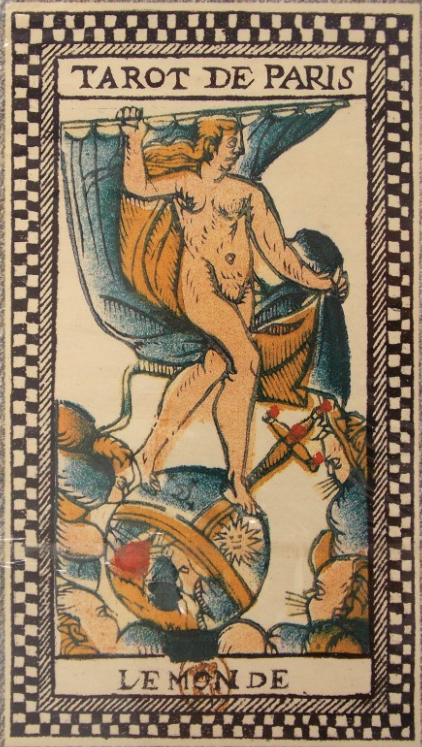
“rejoicing before him always, rejoicing in his inhabited world”—is found represented on the Card of the Arcanum “The World” of a Tarot printed at Paris in 1500, the existence of which was pointed out by Oswald Wirth in Le Tarot des imagiers du moyen age Here “The World” is represented by a globe, analogous to that held in the left hand of the Emperor (fourth Arcanum); above this globe of the world an entirely naked woman is dancing, who is holding up a huge curtain in her right hand, the extremity of which she gathers together in her left hand. Oswald Wirth says: “This is Truth manifesting itself unreservedly, by drawing aside the veil of appearances in order to communicate the secret of the essence of things”.
Joy is the accordance of rhythms. Solomon speaks of the primordial joy which is the accordance of divine creative rhythms and the artistic creations of Wisdom. But he speaks also of another joy—that of accordance with the rhythm of “Folly” (the second name of the Arcanum “The World”):
Folly is a noisy woman,
Wanton and without shame.
She sits at the door of her house,
she takes a seat on the high places of the town,
calling to those who pass by,
who are going straight on their way:
Whoever is simple,
let him turn in here!
And to him who is without sense she says:
Stolen water is sweet,
and bread eaten in secret is pleasant!
But he does not know that those who go in there perish
—that her guests are in the depths of Sheol
(the valley of the dead)
The Septuagint adds to the last verse:
But hasten away, delay not in the place, neither fix thine eye upon her: for thus shalt thou go through strange water; but thou shouldst abstain from strange water and drink not of a strange fountain, that thou mayest live long, and years of life may be added to thee.
“Belt of Lies” or “Sphere of the Holy Spirit”
There is, the joy of Wisdom and the joy of intoxication called “strange water”. The former springs from Wisdom, whilst the latter consists of mirages. For a sphere of mirages exists in the invisible world, which constitutes the principal trap for esotericists, gnostics and mystics. Rudolf Steiner named it the “belt of lies” and in traditional Christian Hermeticism it is called the “sphere of the false Holy Spirit”. This belt is closer to “ego-consciousness” than the “sphere of the Holy Spirit”, where saints sojourn and act on human terrestrial consciousness. To rise to the sphere of the saints and the celestial hierarchies, one has first to “traverse” the “sphere of the false Holy Spirit”. It is to the disciple “without sense” that the above-quoted text of the Septuagint is addressed: “…delay not in the place, neither fix thine eye upon her: for thus shalt thou go through strange water” (Proverbs ix, 18 ). Similarly, it is to the disciple “without sense” that the false Holy Spirit, the spirit of “Folly”, addresses herself by saying:
“Stolen water is sweet, and bread eaten in secret is pleasant!”
Mixture of Truth and Lies

The lure of the sphere of mirages sweeps consciousness away in a delicious current of easily-won illuminations without having to make the moral effort summarized in the three words: cross, prayer and penitence. Here consciousness dispenses with all law, with no responsibility of rendering account to anyone at all about anything at all receiving illuminations gratis, that it has not prayed for…free from all memory of sin, free of all remorse and all responsibility for sins and errors of the past, as if sin and error were trifles hardly worth remembering. Filled with joy, savouring the creative élan, consciousness gives itself unreservedly to visionary and inspired speculation, where every image and every thought which are presented to it appear to be revelations from above, imprints of seals of superhuman wisdom. This “stolen water” is all the more dangerous because it inundates the soul with floods of psychic energy, which is an entirely new experience, which tally with the most intimate inclinations and desires of the soul.
False Prophets and Messiahs
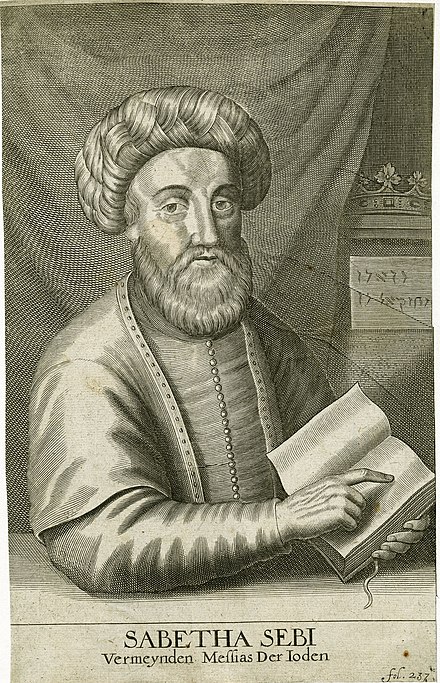
It is thus that false prophets and messiahs arise. This was painted by Epiphanius— himself a witness of (and probably also a participant in) the gatherings of the Barbeliot sect—who recounts what he saw because he reckoned it impossible to keep silence:
They have their wives in common and they have a sign of recognition whereby they determine whether the newcomer belongs to their sect. The sign is given as they are shaking hands: as they touch, they make a kind of tickling on the surface of the palm of the hand. After they have recognized one another, they set about supper right away. They put on the table a sumptuous repast—eating meat and drinking wine even if they are poor. When they have dined together thus and, as it were, are “brimming at the veins” with energy, they then get down to business. Each man separates himself from his wife, saying to her: Stand up and fulfil the love-feast (agape) with thy brother…
.. After they have had intercourse, not satisfied with the depravity of their fornication, they elevate their disgrace towards heaven. Each man and woman takes the man’s ejaculation in their hands. Then, stepping forward and directing themselves towards heaven with this filth in their hands, they pray, as so-called “stratiotics”, offering to the Father of All what they have in their hands, with the words: We bring to thee this offering, the body of Christ…(Hans Leisegang, Die Gnosis)

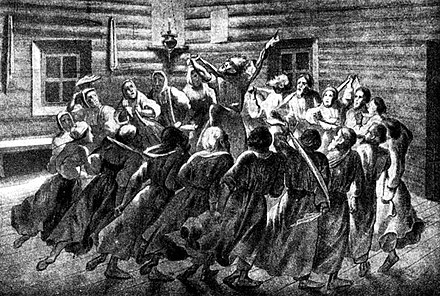
It was thus, also, that meetings of the Russian Khlysty sect (“flagellants”) of the nineteenth century sometimes finished, after the “descent of the Holy Spirit”, through orgies of free love resulting from the freedom communicated by the “Holy Spirit”.
It was also thanks to revelations from the sphere of mirages that, for example, many families of Estonian peasants in the nineteenth century sold off their goods in order to go to a place on the elevated side of the Baltic sea, to Laksberg, so as to wait there for the arrival of a “white boat”—predicted by their prophetically inspired leaders—which was to have taken them to a land of freedom, where there would be neither barons nor taxes.
Lastly, it was thus that the medicine men of a number of tribes of Red Indians in North America, exasperated by the disappearance of herds of bison in the last quarter of the past century, had a revelation of a new magical cult— the “bison dance”—the practice of which would make the herds of bison reappear in the prairies, as it would also make the white man withdraw from the hereditary hunting terrain of the Red Indians. It was only after the bloody intervention of the United States army that the practice of the magical cult came to an end.
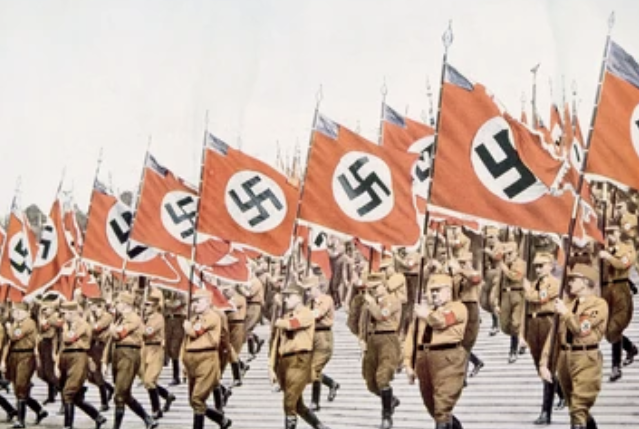
Intellectual hallucinations of still greater significance have, in our century, had their hold on entire peoples. It is not necessary to read The Dawn of Magic by Louis Pauwels and Jacques Bergier to understand that Hitler’s Nazi adventure was due to a dynamism released through an intellectual hallucination of prodigious power.

Marxism


Another example of the semi-magical hold of an intellectual hallucination over whole peoples is given by Marxism-Leninism-Stalinism-Maoism. For the intellectual system and principles underlying this movement are as at variance with world reality as was the “myth of the twentieth century” of Nazi Germany. The Marxist intellectual mirage paints a scene of the world and human history where the spirit is only a kind of “exhalation” — in the guise of ideologies, religions and moral codes—issuing forth from material things and interests. The spirit is only an epiphenomenal superstructure upon biological and economic factors, produced and fashioned by them.
The success of Marxism-Leninism—apart from its appeal to feelings of resentment and indignation of the disinherited classes—is due to the putting to work of a prodigious quantity of psychic energy instilled into the masses of militants as a consequence of contact with the “sphere of the false Holy Spirit”, inspired by some leading inspired prophets. It is the sphere of mirages which explains not only the semi-magical hold of Bolshevism on the masses but also its doctrines. This latter is the offspring of two different experiences: the experience of the sphere of mirages and that of economic material realities.

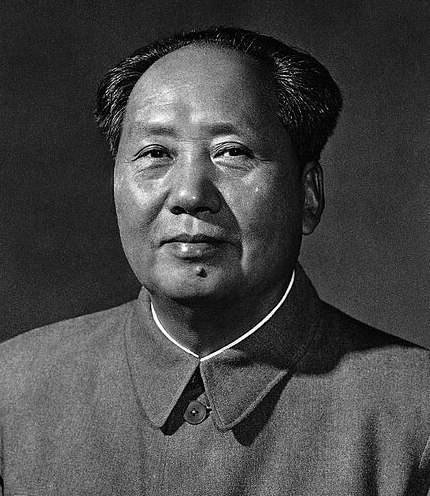
The first experience engenders the fundamental dogma of Marxism-Leninism that the spirit—with ideologies, religions and moral codes as its functions—is only a projection of human interests and ambitions expressing the will to power; which is true if the experience of spiritual life goes no further than the sphere of mirages…if it stops at this sphere…if it does not arrive at the sphere of the Holy Spirit, i.e. that of the saints and Angelic hierarchies. Thus it has happened that the authors of Marxist-Leninist doctrine have discovered the reality of the sphere of mirages as an almost inexhaustible source of psychic energy on the one hand, and as an immense fabric of superstructure, on the other hand, where all earthly interest receives its ideological, religious and moral clothing.

Purely earthly aspirations amount to the will to power, which is the basis of the survival of the fittest presented by Charles Darwin. On the other hand, power in the domain of human terrestrial life amounts to wealth and enjoyment of the fruits of production. Add to these conclusions drawn from experience of the sphere of mirages those drawn from experience of the earthly economic domain and you arrive inevitably at the second fundamental dogma of Marxism-Leninism, namely that the means of production should belong to the whole community or society and not to individuals or groups of individuals.
All other propositions of Marxist-Leninist doctrine—such as the social revolution, the dictatorship of the proletariat, the classless society, the decline of the state, etc.—follow from these two fundamental dogmas, founded on the interweaving of experience of the sphere of mirages and experience of the economic domain seen as the field of the struggle for existence and the survival of the fittest, the struggle between exploiters and the exploited.
National Socialism
The “myth of the twentieth century” of Nazi Germany owed its hold on the masses to the influx of energy from, and to the illuminating effect of, the sphere of mirages. This time it was a matter not of the economic life, but rather of biological life —seen in the light emanated from the sphere of mirages. The factors of heredity and those of “blood” in Nazi doctrine took the place of the economic factors in Marxist-Leninist doctrine and differentiated it from the latter. The two doctrines have in common the will to power—of classes in the one, and of races in the other—which move human history.
Tthe Nazi mirage dissipated suddenly as a consequence of the hard experience of complete military defeat. With respect to the Marxist-Leninist mirage, it is dissipating little by little as a consequence of the hard and sobering experience of economic reality and the reality of human nature. “Revisionism”, after having rejected Stalinism, is at work, and will not allow itself to be halted any more.

The mirages dissipate, but at what a price…
The sphere of mirages is Hermeticism’s trial and danger. Occultists, magicians, gnostics and mystics are the dupes of the “sphere of the false Holy Spirit”, no less often than nations or leaders of social and political movements. We have already cited the case of the moral aberration of the Barbeliot gnostics in Egypt, and we mentioned that of the Khlysty sect in Russia, nearer to our time. These cases could be banished from your thoughts, dear Unknown Friend, since they relate to ancient and more recent sects and not to esotericists of an independent spirit. It is nevertheless a fact that one can observe here and there that independent spirits end up by becoming sectarian esotericists, with their own revelations. As they are lacking the fruits of a disciplined training, and as there is no one of authority to whom they can turn at the times of danger, they easily fall prey to the lures of of mirages.
Mankind is a unity and one person’s experience is meant to help and serve others. One cannot dispense with the experience of others, if one wants to avoid the traps set along the way of spiritual experience. Truth to tell, the principal reason as to why occultism is “occult” and esotericism is “esoteric”, i.e. demanding protection through secrecy, is the concern to protect “free spirits” against the dangers of enslavement through “inflation”, as Carl Gustav Jung called it, which is an aspect of the sphere of mirages.
On the other hand, the general reserve and refusal to accept occultism, esotericism, gnosis and mysticism that is manifested by the public opinion of all times, is due to the same reason. The sphere of mirages has in the past played too much of a role here, and has sown a profound mistrust in the conservative opinion of the public. The sober public does not want illusions—it has had enough of them.
The playing with mirages is the historical cause of the veil of secrecy. This way esotericism protects itself. For the way of esotericism—the way of personal and authentic spiritual experience—necessarily entails confronting the reality of the sphere of mirages or the “sphere of the false Holy Spirit”.
The Three Vows

This is why the mystics of eastern Christianity do not tire of warning beginners of the danger that they call “seductive illumination” and insist upon the nakedness of spiritual experience, i.e. on experience of the spiritual world stripped of all form, all colour, all sound and all intellectuality. The intuition alone of divine love with its effect on moral consciousness is the sole experience to which one should aspire. Ladyzhendsk in his book The Inner Light gave a well documented exposition of the doctrine of orthodox mystics concerning true and false illumination. There he reproaches the mystics of western Christianity for their doctrine of admitting visions and illuminations of an intellectual naturet.
The mystics of eastern Christianity are so impressed by the danger of mirages that they prefer to renounce all spiritual experience of a visionary or intellectual nature. The mystics of western Christianity are also conscious of the reality of its dangers, but they do not reject outright all vision and intellectual illumination. Their experience accumulated under the supervision of the religious orders (there are no religious orders in the East) and that of the hierarchical Church (in the East there is no directing centre able to validate the experience of thousands of years of the spiritual life of Christian mankind allows them to derive criteria needed to distinguish whether or not private revelations stem from the sphere of the Holy Spirit. These criteria amount to the strict observation of the vows of obedience, poverty and chastity, according to their letter and according to their spirit.
The chaste mind seeks the truth and not the joy of revelation, just as chaste love seeks union with the loved one and not carnal pleasure. The chaste mind is sober; it does not let itself be swept away by the “stolen water” which is sweet. The poor mind refuses to drink the “stolen water”, since it seeks only what is essential to the life of the body, the life of the soul, and the life of the spirit. It does not seek the superfluous— even if it is spiritual—and will not accept the invitation to take part in the orgy of spiritual illuminations that the sphere of mirages offers it. The obedient mind has an awake and cultivated sense of obedience, i.e. the spiritual hearing of the will, which renders it capable of recognising the voice of truth and distinguishing it from other voices. It is to this spiritual hearing, developed by obedience, that the Gospel of St. John refers in the following passage:
He who does not enter the sheepfold by the door but climbs in by another way, that man is a thief and a robber; but he who enters by the door is the shepherd of the sheep. To him the gatekeeper opens; the sheep hear his voice, and he calls his own sheep by name and leads them out. When he has brought out all his own, he goes before them, and the sheep follow him, for they know his voice. A stranger they will not follow, but they will flee from him, for they do not know the voice of strangers. (John x, 1-5)
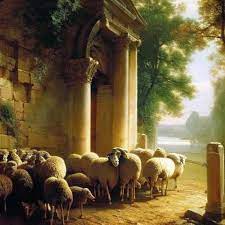
True obedience is not at all the subjugation of the will to another will, but rather the moral clairaudience of the will—the faculty of knowing and recognising the voice of truth. And it is this which renders the soul inaccessible to the lures of the sphere of mirages.
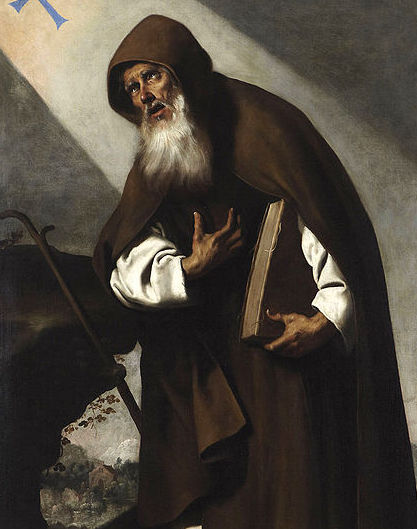
Although no practising esotericist is sheltered from mirages, he who has made the vows of obedience, poverty and chastity an affair of the heart will come out victorious. If St. Anthony said, “No salvation without temptation,” one could add: “No temptation vanquished without the three vows.”
Unfortunately, it is a fact that esotericists, in contrast to monks and nuns, tend as a general rule to make little of the vows of obedience, poverty and chastity. They seem to have made their fundamental attitude scientific, where one relies on intelligence alone. The result of this is very often a game of intellectual fireworks which, in contrast to the light of the sun, does not illumine, does not warm and does not vivify.
It is not sterility alone which is the principal danger of intellectual flight at the expense of moral and spiritual progress. Mirages supply not only visions but also intellectual illuminations. Mirages paints dazzling intellectual scenes for the mind that forgets the necessity of the vows of obedience, poverty and chastity. Dazzled by the artistic breadth of the intellectual edifice, such a mind accepts it, believing himself to have been favoured by revelation from above.
What renders such an intellectual mirage all the more dangerous is that it is a mixture of truth and illusion, mixed in an inextricable way. The true serves to prop up the false and the false seems to lend the true a new splendour. It is therefore a mirage and not pure illusion, which would be easier to perceive. It is a net woven from the true and the false which lays hold of the befuddled soul.
The sphere of mirages is also constantly at work to re-shuffle facts relating to former lives and karmic relationships. For example, it can evoke a series of subjective reminiscences or scenes from a distant past which, being a mixture of the true and the false, can completely disorientate the beneficiary —or rather the victim—of these revelations. Mirages are frequent in the case of relationships between persons of the opposite sex who feel drawn to one another. It then often happens that the qualities, and even the identity, of one soul are projected upon another. Many a Tristan thinks he recognizes his Isolde in a simple maid, just as many an Elsa of Brabant sees her Lohengrin in a gallant.
Practical esotericism demands at least the same prudence as exact science, but the prudence that it demands is of a nature that is not only intellectual but also moral. In fact, it encompasses the whole human being with his faculties of reasoning, imagination and will. It is therefore a matter of being prudent.
For this reason the rule of every serious esotericist should be to be silent —often for a length of years—concerning every new illumination or inspiration that he has, so as to give it the necessary time to mature, i.e. to acquire that certainty which results from its accordance with moral consciousness, moral logic, the totality of spiritual and ordinary personal experience—and that of friends and spiritual guides of the past and present— as also with divine revelation, whose eternal dogmas are guiding constellations in the intellectual and moral heaven. And it will be only after having arrived at such an accordance that a personal illumination or inspiration can be considered communicable and presentable.


This applies not only to esotericists but also to artists. The latter—above all those who hold to the principle of “art for the sake of art”—are, as a general rule, playthings of mirages. Whilst keeping to the dogma of autonomy of truth and morality in the domain of art, they fall easy prey to mirages, so that they even identify this sphere with the very source of their inspiration. For if one hardly concerns oneself with the “what” and seeks only the “how” of artistic creation, one will certainly end up by giving oneself up to illuminations and inspirations from the sphere of mirages—the sphere par excellence of so-called creative imagination, withdrawn from moral control.
This was well understood by Goethe, who wrote Faust over a period of sixty years. He not only wanted to brush aside the sphere of mirages from his work but also to bring to the light of day in Faust the reality and mechanism of the action of this sphere. For him, art was not purely and simply a product of the play of the imagination, but rather a continuation in the subjective domain of the creative work which Nature carries out in the objective domain. He insisted on directed imagination for artistic creation as well as for knowledge.
The category of “literary classicism”, i.e. by making them a question of literary taste instead of seeing and recognizing here an appeal to the conscience of the artist to stop drawing his inspirations from the sphere of mirages…at such a cost that the single work—Faust—could demand sixty years of work! Artists, like esotericists, are obliged to make their works pass the trial of time, so that the poisonous plants from the sphere of mirages can be uprooted, and there remains only the wheat—pure and ripe.
Sacred Art
Sacred art is distinguished from profane art, just as sacred magic is distinguished from profane magic and sorcery:
Every sacred art is therefore founded on the symbolism inherent in forms. A symbol is not merely a conventional sign. It manifests its archetype by virtue of a definite ontological law…a symbol is in a certain sense that to which it gives expression. For this very reason traditional symbolism is never without beauty: according to the spiritual view of the world, the beauty of an object is nothing but the transparency of its existential envelopes; an art worthy of the name is beautiful because it is true. (Titus Burckhardt, Sacred Art in East and West)
Sacred art is therefore founded upon a science of forms and not upon subjective artistic creative elan or upon the subject as such.

When historians of art apply the term “sacred art” to any work that has a religious subject, they forget that art is essentially form. An art cannot properly be called “sacred” solely on the grounds that its subjects originate in a spiritual truth; its formal language also must bear witness to a similar origin. Such is by no means the case with a religious art like that of the Renaissance or of the Baroque period, which is in no way distinct, so far as style is concerned, from the fundamentally profane art of that era; neither the subjects which it borrows, in a wholly exterior and as it were literary manner, from religion, nor the devotional feelings with which it is permeated in appropriate cases, nor even the nobility of soul which sometimes finds expression in it, suffice to confer on it a sacred character. No art merits that epithet unless its forms themselves reflect the spiritual vision characteristic of a particular religion.
What must be copied is the way in which the Divine Spirit works.
Purification must precede illumination and perfection. Sacred art, which imitates the way in which the divine spirit works, requires that the soul of the artist rids itself of its own inclinations and habits, i.e. that it becomes poor, so as to be able to receive the wealth of the divine spirit…that it reduces its own phantasy and its own predilections to silence, i.e. that it is chaste, so as not to disturb the limpid waters flowing from the divine source…and that it is obedient, so as to be able to work in concert with the divine spirit.
Now, the Card of the twenty-second Arcanum of the Tarot—“The World”—represents a dancer holding a magic wand in her hand, and a philtre in the other. The wand symbolises the creative power of realisation below of that which is above; she holds it vertically. This is the gesture of actualising below that which is above—the gesture of sacred art, i.e. the gesture imitating the way in which the divine creative spirit works. And the following is what Paul Marteau says concerning the philtre that the dancer is holding in her other hand:
It is the creative philtre of illusion on all the planes of Nature, for man can have both the illusion of love and that of spirituality. The philtre is opposed to the wand in the sense that the illusion created by man can give him an ephemeral kingly dignity.
In other words, the Arcanum “The World” has a twofold meaning: it teaches that joy, i.e. the accordance of rhythms, is at the root of creation; and it warns, at the same time, of the danger of seeking for creative joy instead of for creative truth. Thus he who seeks first and foremost for creative joy will drink from the philtre the intoxicating potion of illusion of the sphere of the “false Holy Spirit”, i.e. the sphere of mirages, whilst he who seeks first and foremost for creative truth will not only find it through the sober effort of vertical elevation but will also participate actively in the accordance of rhythms, i.e. creative joy. He will learn the way of the wand, i.e. to put himself vertically in contact with the “sphere of the Holy Spirit”—the sphere of saints and the celestial hierarchies—by traversing the sphere of mirages unperturbed.
The Arcanum “The World” thus communicates to us a teaching of immense practical significance: “The world is a work of art. It is animated by creative joy. The wisdom that it reveals is joyous wisdom—that of creative artistic élan, and not that of an engineer-technician or industrial designer. Happy is he who seeks wisdom in the first place, for he will find that wisdom is joyous! Unhappy is the one who seeks the joy of joyous wisdom in the first place, for he will fall prey to illusions! Seek first the creative wisdom of the world—and the joy of creativity will be given to you in addition.

Intensity is no Criterion of the Truth
From this teaching there results an important rule of “spiritual hygiene”, namely: that he who aspires to authentic spiritual experiences never confounds the intensity of the experience undergone with the truth that is revealed. For an illusion stemming from the sphere of mirages can bowl you over, whilst a true revelation from above can take place in the guise of a scarcely perceptible inner whispering. It is often difficult to even notice it, without speaking of being seized or bowled over by it. If this were not so, what good would exercises of profound meditation be? Serious esotericism prescribes attention so intense that it is in a position to perceive within the silent domain of the depth of the soul where spiritual truth reveals itself. This latter has the tendency to work gently and gradually. As a general rule, the spiritual world does not at all resemble the surging of the sea—at work to break down the dams holding it back, so as to inundate the land. No, what characterizes the spiritual world, i.e. the “sphere of the Holy Spirit”, is the consideration that it has for the human condition. The amount and frequency of revelation from above, destined for a human being, is measured with a lot of care, so as to avoid every possible perturbation in the moral and physical equilibrium of this person. What the spiritual world prefers most of all is a gentle flow of inspiration which intensifies to the extent that the moral forces of the recipient grow and mature. Here a succession of elements comprising a great truth are revealed little by little until the day when the great truth in its entirety shines within the human consciousness thus prepared.
Then there will be joy, certainly, but not the perturbation of equilibrium which is intoxication—nor will there be nervous over-excitement or insomnia.
This is the law of the wand that the central personage of the Card of the twenty-second Arcanum is holding in one of her hands. But it is just the opposite which applies to the philtre that she is holding in the other hand. There, first and foremost, it is a matter of the joy and intoxication which result from mirage-revelations. The way of working of the “sphere of the false Holy Spirit” is to make human souls convinced of the truth of intellectual or visionary mirages through the intensity of the impression that they produce. “That which excites the most is true” seems to be the criterion advanced by the sphere of mirages.
The Numinous
The most advanced school of modern depth psychology that of Carl Gustav Jung, considers the numinous in psychic experience as a dynamic reality of the unconscious. By numinous is meant that which the soul experiences as something irresistibly imposed on it. The numinous is a psychic experience, in dream or, phantasy, which subjugates he who experiences it. Consciousness submits to its action rather than calling it forth. The numinous subjugates man independently of his will (cf. C. G. Jung, Psychology and Religion).
According to Jung, the reality of the unconscious is manifested by action of a numinous character upon consciousness. Jung says this about the unconscious:
It must be counted as boundless: infinite or infinitesimal. Whether it may legitimately be called a microscosm depends simply on whether certain portions of the world beyond individual experience can be shown to exist in the unconscious. The theory of instinct and the findings of biology in connection with the symbiotic relationship between plant and insect have long made us familiar with these things…A general proof of the rightness of this expectation lies in the ubiquitous occurrence of parallel mythologies, Bastian’s “folk thoughts” or primordial ideas; and a special proof is the autochthonous reproduction of such ideas in the psyche of individuals where direct transmission is out of the question…
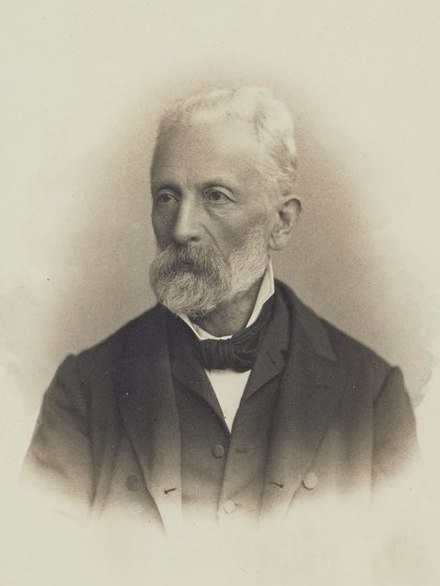
Mythologies are the aforementioned “portions of the world” which belong to the structural elements of the psyche. They are constants whose expression is everywhere and at all times the same (C. G. Jung, Medicine and Psychotherapy)
The unconscious—with its numinous action—is therefore not confined to the individual soul; it surpasses it in every direction. Being “something boundless”, the unconscious is the world seen under its psychic aspect. Which means to say that it consists not only of innate, i.e. prenatal, individual tendencies and inclinations, but that it also includes what we have designated as “spheres”—namely the “sphere of the Holy Spirit” and that of the “false Holy Spirit”. Action of a numinous character from the unconscious, thus conceived, is certainly a criterion sufficient to distinguish the manifestation of the reality of the unconscious from the manifestation of the subjectivity of the individual soul through the latter’s spontaneous fantasy, feeling and intellectuality, but it does not at all suffice to distinguish the truth within this reality, i.e. to distinguish the action of the sphere of the Holy Spirit from that of the sphere of mirages. For the sphere of mirages, also, is real—but reality is one thing and truth is another thing. A mirage is certainly real, but it is not true; it is deceiving.
Dangers of the Unconscious
Here is what Jung said concerning the danger which menaces mankind on account of the unconscious:
Psychology constitutes nothing less than the most indispensable knowledge that we have. Indeed, it is apparent with an increasingly blinding clarity that that which constitutes the greatest danger threatening man is not famine or earthquakes or microbes or cancer but man’s well being. The cause of this is quite straightforward: there still does not exist any effective protection against psychic epidemics— and these epidemics are infinitely more devastating than the worst catastrophes of Nature! The supreme danger which menaces both the individual and the populace as a whole is psychic danger. With regard to this, our understanding proves to be quite powerless, which is explained by the fact that rational arguments act on the conscious—but on the conscious alone—without having the least effect on the unconscious. Consequently, a major danger for man emanates from the mass, i.e. the crowd, at whose core the working of the unconscious accumulates—first muzzling, then stifling the pleas for reason on the part of the conscious. Every organisation of a crowd constitutes a latent danger, like that of piling up dynamite. Because it produces effects that no one wanted, and which no one is able to hold in check. For this reason one must ardently hope that knowledge of psychology will spread on such a scale that human beings will finally understand the source of the supreme danger hanging over their heads. It is not by arming themselves to the teeth, every country of itself, that nations will be able, in the long run, to preserve themselves from the terrible catastrophes occasioned by modern war.
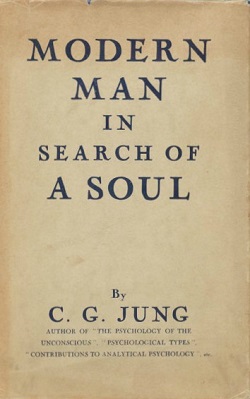
Accumulated arms demand war! On the contrary, would it not be preferable in future to guard against and to avoid the conditions delineated at present—in which the unconscious breaks down the dams of the conscious and dispossesses the latter, making the world run the risk of inestimable devastation? (C. G. Jung, Modern Man in Search of a Soul)
This is a warning from a man who speaks with real knowledge—with more knowledge, in fact, than many an authentic occultist—thanks to his prodigious experience accumulated during a long life directed by the will to heal. And it was this will to heal which made him first of all an explorer and then an expert in the world of depths, the door to which is the human soul.
Four Holy Animals
But let us return to the Arcanum “The World”-the Arcanum of movement, ie. of the “how” of moving that which is moved by that which moves.
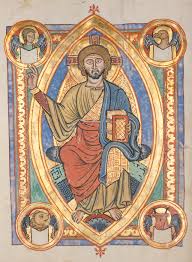
Until now we have been occupied with the central figure of the Card, i.e. with joyous Wisdom with her wand and philtre. The movement emanating from them is outside or above the human soul and the world of action. In order to understand the whole world, it is necessary to consider the movement immanent in beings and things. This latter is represented in the Card by the garland which surrounds the central figure, and by the four figures—the three animals and the Angel— in the four corners of the Card, outside of the garland.
The garland represents the movement immanent in growth and the four figures symbolize the movement immanent in basic instinct, or what the ancients called the “four elements”. For the four elements—“fire”, “air’, “water” and “earth”—are not chemical substances, or even states of matter (namely warmth, gaseous, liquid and solid), but rather modes of movement immanent in all substance…mental, psychic, organic, and also inorganic. They are therefore the four fundamental instincts immanent in the world-in-movement; and this is why they are depicted in the tradition of religious iconography in general as the cosmogonic quaternary of the Bull, the Eagle, the Lion and the Angel.
The Angel and the three sacred animals are represented in the firmament by stars of first magnitude located at the four cardinal points: Aldebaran, or the eye of the Bull; Regulus, or the heart of the Lion; Altair, the light of the Eagle; and Fomalhaut in the stellar Fish, which absorbs the water poured out by the Waterman. These stars mark the extremities of a cross whose centre is the polar star which, because of its immobility in the middle of the celestial rotation, corresponds in the Arcanum (“The World”) to the young girl framed in an oval of greenery depicting the zone of the ecliptic. (Oswald Wirth, Le Tarot des imagiers du moyen age)
The idea underlying this correspondence between the four “sacred animals” of the Evangelists and the stars of the signs of the zodiac is the cosmic or zodiacal significance of the four “cosmic instincts” or “elements”. It attributes a universal and also a stable function to them in the planetary world of movement, just as the fixed stars are attributed with this function in the zodiac.
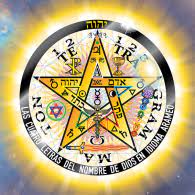
But it is not the constellations of the zodiac which manifest the principle of the quaternary of the “cosmic elements” or “basic instincts”. This principle is found manifested in the ineffable name of God—the Tetragrammaton—the imprint of which on a cosmic scale constitutes the quaternary in question. For what we know as the category (i.e. the structural disposition of our intelligence) of causality—with its quaternary of effective causes, formal causes, material causes and final causes—is only a special case of this imprint. Indeed, we would not know how to perceive order in the universal movement that we call “the world” if we did not apply causality, that is to say, if we did not distinguish what moves from what is moved, what forms from what is formed, the source from the aim, the beginning from the end. Without the application of causality to universal movement, we would be able only to contemplate it “open-mouthed”, instead of being able to derive from it a “universal evolution”, a “universal history”, and a “law of gravitation”—and also to find the causes of illnesses, disasters, and all the dangers which lie in wait for us, so as to foresee them and avert them.
Four Temperaments
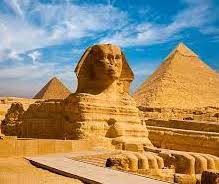
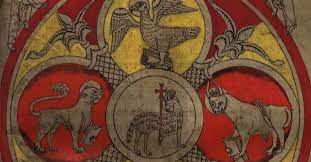
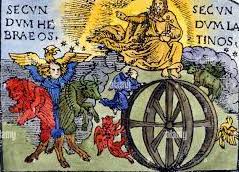
The four temperaments are, again, a special case of the universal quaternary of impulsion, movement, formation and form, of the four elements —fire, air, water and earth. And at the basis of these four elements the quaternary of the motive instinct immanent in the world is found. This instinct in turn reflects the four cosmic entities which bear the the divine chariot—the Angel, the Eagle, the Lion and the Bull from Ezekiel’s vision of the chariot and from the vision of St. John, who describes them as follows:
The first living creature was like a lion, the second living creature like an ox, the third living creature had the face of a man, and the fourth living creature was like a flying eagle. (Revelation iv, 7)
Ezekiel, however, stresses the fundamental unity of the four living creatures by saying:
As for the likeness of the faces of the four living creatures, each had the face of a man in front; all four had the face of a lion on the right side; all four had the face of an ox on the left side; and all four had the face of an eagle at the back. (Ezekiel i, 10)
They are a unity because the divine name, the Tetragrammaton, is a unity (which, however, is made up of four elements) and because they represent this name, which is the divine chariot. Thus, the Zohar says concerning the four Hayoth (living creatures) of Ezekiel’s vision:
It is written concerning them, “And the likeness of their faces is as the face of man” (Ezekiel i, 10). They are all embraced in that likeness, and that likeness embraces them all… These likenesses are engraved on the throne—the supernal chariot which is comprised in the four letters of the Tetragrammaton, which is the name that comprises all…and the throne is decorated with these likenesses, one to the right, one to the left, one in front, and one behind, corresponding to the four corners of the world…( The Zohar)
The Divine Name
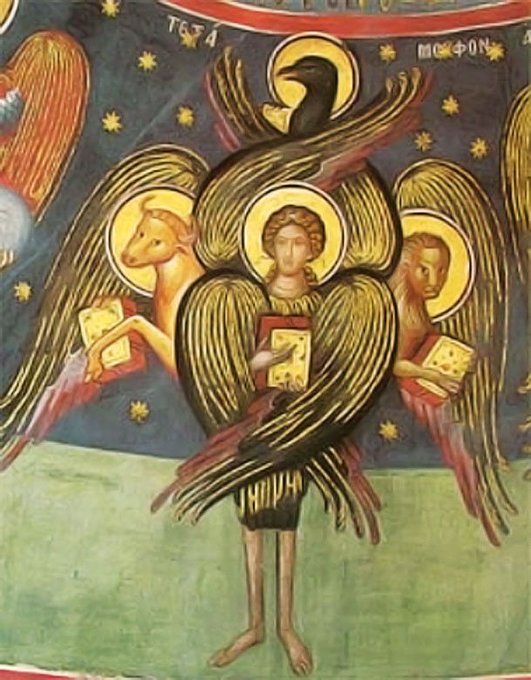

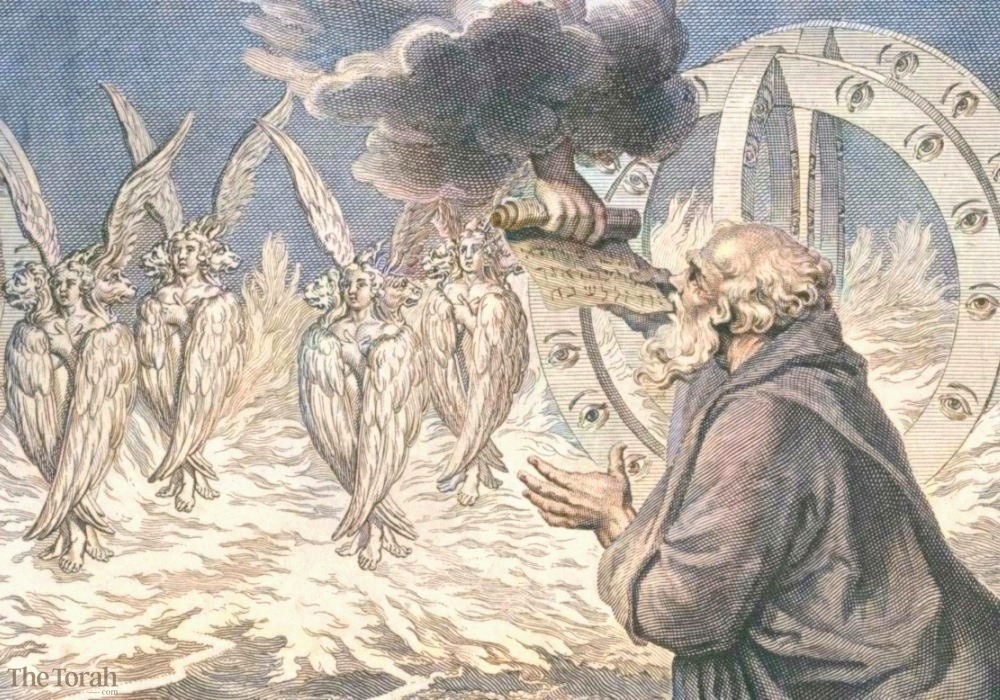
The Zohar not only says that the four letters of the divine name (Tetragrammaton) correspond to the four corners of the world—the four cardinal points: East, West, North and South—but also speaks of Michael (whose likeness is as the face of man) directing himself towards the North with all the faces turned towards him. In the further discourse, it is said:
The ox ascends to seek guidance and gaze in the face of man…the eagle ascends to seek guidance and gaze in the face of man…the lion ascends to seek guidance and to gaze in the face of man…“man” contemplates all of them, and all ascend and contemplate him.
The fourth living creature of Ezekiel’s vision—the Angel —is the synthesis of all of them. The Zohar describes how the Angel embodies the mystery of the four living creatures:
“On the chariot of God are myriads of thousands of SHINAN (Angels)” (Psalm Ixviii, 17): the word SHINAN expresses by means of its initials all the faces, the SHIN standing for SHOR (ox), the NUN for NESHER (eagle), and the ALEPH for ARYEH (lion), and the final NUN representing by its shape man, who walks erect, and who mystically combines male and female.
All these myriads of thousands of Angels—continues the Zohar—issue from the archetypes symbolized by the name SHINAN, and from these types they diverge into groups (characterized by their respective faces). All the Angels with faces other than the face of man have two faces—firstly, that which is their particular one, and secondly, that which they have borrowed from the “man” by contemplation of the face of man (i.e. in beholding Michael): by reflecting the characteristic of strength (EL), for Angels with the face of the bull; by reflecting the characteristic of greatness (GADDOL), for those with the face of the eagle; by reflecting the characteristic of power (GHIBOR), for those with the face of the lion. The “man” contemplates all the other faces, and they “all ascend and contemplate him”. It is thus that they all receive the particular imprint of the “man”, who is characterised by the name “tremendous” (NORAH). For this reason, the names by which the Holy One is called in the scripture are: “the strong, the great, the mighty and the tremendous” (Nehemiah ix, 32).
These names are engraved above on the supernal chariot which is comprised in the four letters of the Tetragrammaton, which is the name that comprises all… These four supernal names bear along the throne, and the throne is comprised in them…It descends with its burden like a tree laden with branches on all sides and full of fruit. As soon as it descends, these four likenesses come forth in their several shapes emitting bright flashes which scatter seed over the world.
This is the moving account from the Zohar—which emanates such fascinating and rejuvenating freshness—concerning the chariot of God and the four spirits of the four elements whose symbols are found represented in the four corners of the Card of the Arcanum “The World”.
Three Modes of Energy
The three-coloured garland surrounding the central figure portrays the idea of the immanence of all passivity (blue colour), all activity (red colour) and all neutrality (yellow colour) in the world-in-movement—the world of impulses emanating from the four spirits of the four elements.
These three colours signify the three essential modes of energy—passivity (latency), activity (deployment), and neutrality (harmony of equilibrium)—described in the Bhagavad-Gita and designated as the three qualities tamas, rajas and sattva, which are the modes of manifestation of the four elements.
Sattva action is that…which is performed in the Shastras, which is performed without attachment, desire or aversion, and without the desire for any fruit by the performer.
Raja action is that which is attended with great trouble and which is performed by one who desires for the fruit of action, and who is filled with egoism.
Tama action is that which is performed from delusion, without regard to consequences, and with one’s own loss and injury as well as of others.
Sattva agent is he who is free from attachment and egoism, who is full of constancy and energy, and who is unmoved both in success and failure.
Raja agent is he who is full of affections, who desires for the fruit of actions, who is covetous, cruel and impure, and feels both joy and sorrow.
Tama agent is he who is void of application, who is without discernment, who is obstinate, deceitful, malicious, idle, desponding and procrastinating.
One can amplify indefinitely the manifestations of the three qualities (gunas) in all domains of existence. Thus the mineral kingdom is in the tamasic state, the animal kingdom is in the rajasic state, and the plant kingdom is in the sattvic state. The sage (brahmin) is in the sattvic state, the warrior (kshattriya) is in the rajasic state, and the servant (shudra) is in the tamasic state. The sun is sattvic, lightning is rajasic, and the moon is tamasic, etc. It is always a matter of equilibrium (sattva), activity (rajas) and passivity (tamas), which are the modes of manifestation of the four elements.


The Four Planes of the Sephiroth Tree
Now, the three-coloured garland is the field of manifestation of the four elements acting at the heart of life’s phenomena in the guise of vital élan, inherent in the current of life. It is “the river flowing out of Eden to water the garden, which divided and became four rivers” (Genesis ii, 10). The ancient Greeks named the river which divides itself into four branches the “ether”,Now, the three-coloured garland is the field of manifestation of the four elements acting at the heart of life’s phenomena in the guise of vital élan, inherent in the current of life. It is “the river flowing out of Eden to water the garden, which divided and became four rivers” (Genesis ii, 10). The ancient Greeks named the river which divides itself into four branches the “ether”, which is divided into four elements, i.e. fire, air, water and earth. Hindu doctrine names the fifth element, which is the root of the four elements, akasha—generally translated by “ether”. And mediaeval alchemy sets great store on the quintessence (quinta essentia, or “fifth essence”) at the root and basis of the four elements. Thus, we read in Hermetis Trismegisti ...:
Divide your stone into four elements…and rejoin them as one, and you will have the whole magisterium.”
That is, the magisterium or “know-how” of the “great work” is the separation of the four elements from the “primal substance” and then the realisation of their unity in the “ether” of the ancients. (cf. Aristotle, De coelo i, 3).
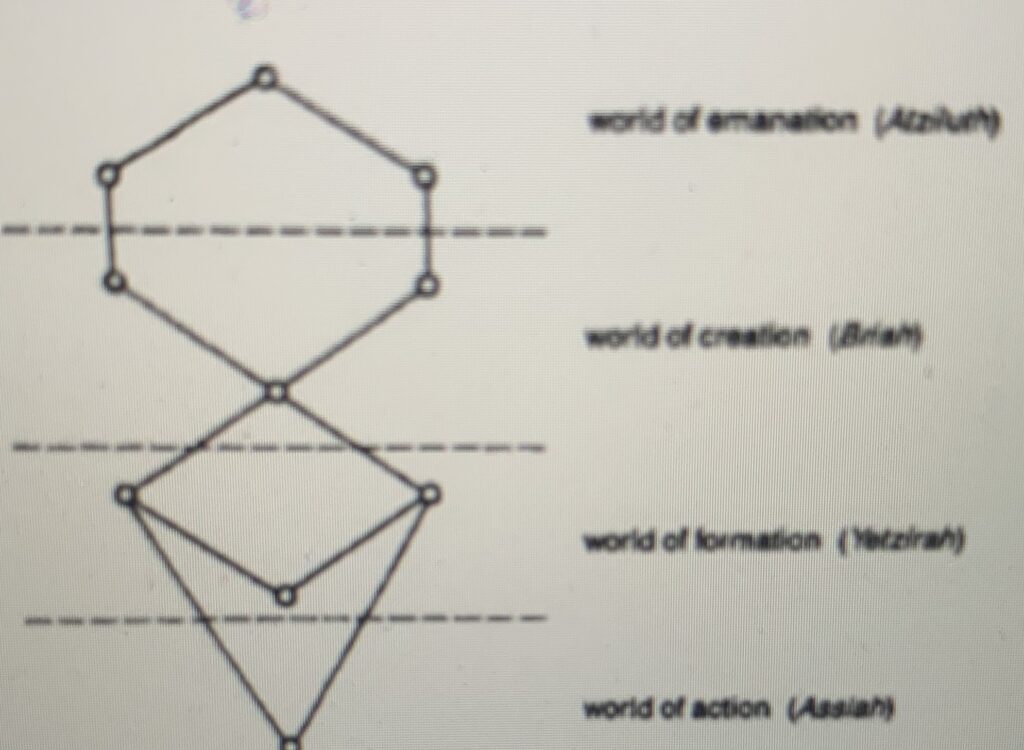
One could, for example, establish the role of the four elements in the four worlds (or planes)—namely, the world of emanation, the world of creation, the world of formation, and the world of action (Atziluth, Briah, Yetzirah, and Assiah)—according to the Sephiroth Tree, by taking the ten Sephiroth for each plane and by summarising for each plane (by means of synthesis) the result obtained.
Minor Arcana of the Tarot

If we were to do this, what would we obtain?
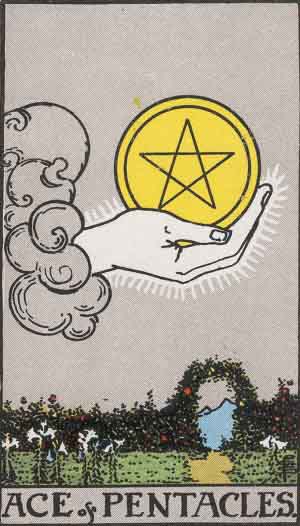
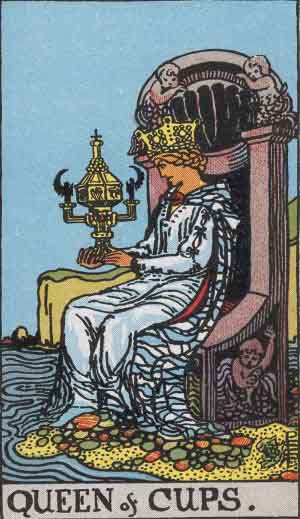
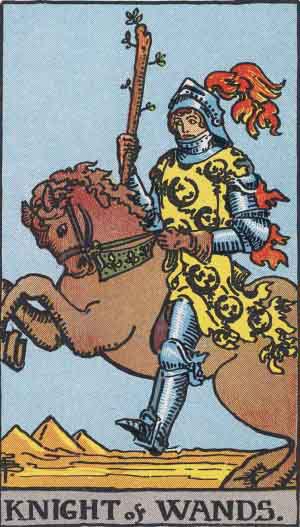
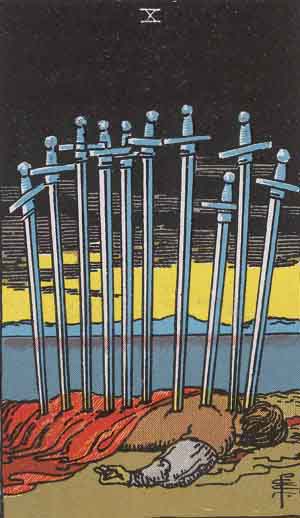
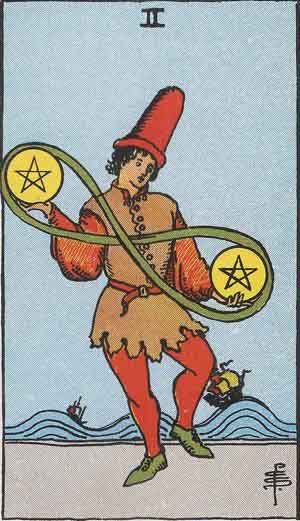
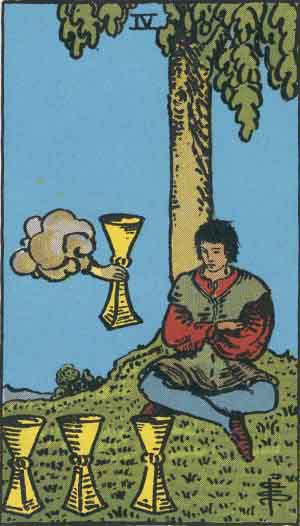
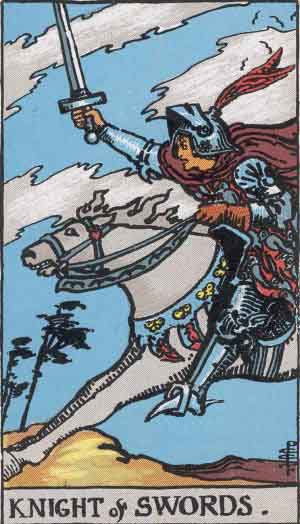
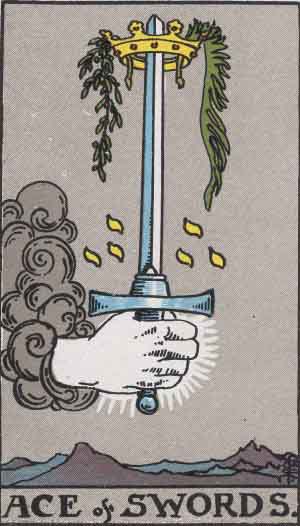
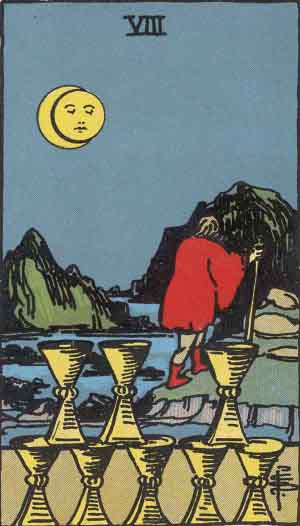
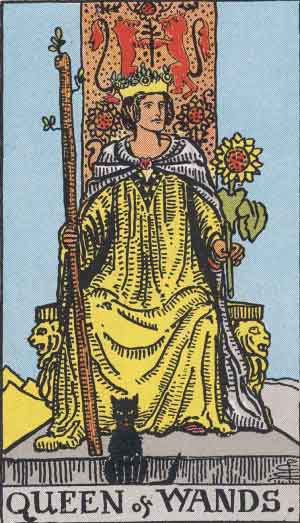
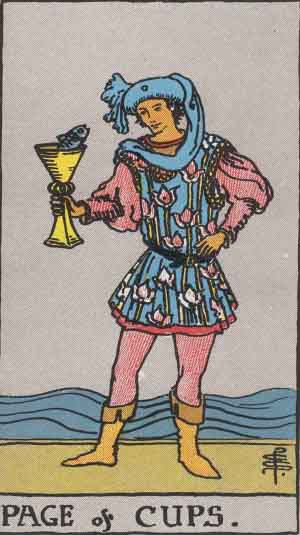
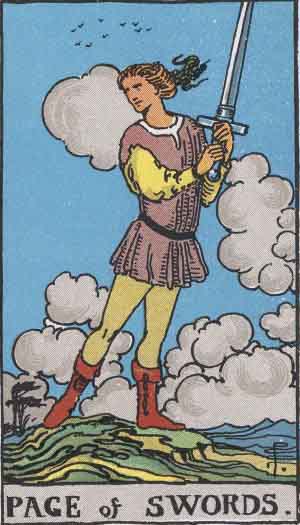
We would obtain the system of the Minor Arcana of the Tarot, i.e. the four times ten Cards numbered 1 to 10 and the four times four figures synthesising the teaching of the four elements in relation to the four worlds. We would thus obtain the forty numerical Cards, and the sixteen Cards of figures, of the system of Minor Arcana of the Tarot, i.e. ten numerical Cards of pentacles, ten numerical Cards of swords, ten numerical Cards of cups, and ten numerical Cards of wands, as well as the four Cards of figures of pentacles, four Cards of figures of swords, four Cards of figures of cups, and four Cards of figures of wands. With regard to the sixteen Cards of figures, the correspondence between the four worlds and figures is: knave—world of action; knight—world of formation; queen—world of creation; king—world of emanation. Concerning the four “suits”—pentacles, swords, cups and wands—they correspond exactly to the structure of the sacred name YHVH and, consequently, to the four elements. Wands represent the emanating principle, the YOD of the divine name; cups represent the conceiving principle, the first HE of the divine name; swords represent the formative principle, the VAU of the divine name; and pentacles symbolise the principle of form, the second HE of the divine name.
The fifty-six Minor Arcana of the Tarot are, therefore, simply a development from the last Major Arcanum of the Tarot, “The World”, developed Cabbalistically—rigorously and mathematically—where systematisation is pushed so far that one asks oneself involuntarily if it is not a matter of a rationalistic performance, pure and simple. Indeed, it is difficult to accept, in the first instance, the Minor Arcana of the Tarot as arcana in the sense of the Major Arcana that we have been meditating upon. For the rational arrangement so jumps out at one that one is tempted to reject it as “playing around” and therefore as something far inferior to the Major Arcana of the Tarot. Nevertheless, there was a school (that of St. Petersburg in the first quarter of this century, mentioned in Letter XXI) where it was taught that the so-called “Minor” Arcana of the Tarot are in reality Major Arcana in the sense that they signify a more elevated degree of knowledge and experience than that corresponding to the so-called “Major” Arcana of the Tarot. The Minor Arcana are to the Major Arcana as the upper school is to the lower school—such was the accepted thesis at the school in question.


Now, after more than forty-five years of effort and study have elapsed, I must tell you, dear Unknown Friend, that the above thesis does not do justice to the Arcana of the Tarot—either to the Major or to the Minor Arcana. For the Major Arcana are reduced in this thesis to the role of a preparatory school for the Minor Arcana—which they are, thanks only to the use that the said school made of them. And the use that was made of the Major Arcana was that of a framework for an encyclopaedic teaching concerning the Cabbala, magic, astrology and alchemy. As the Major Arcana lend themselves marvellously to the task of serving as a framework for such an encyclopaedic teaching, they were therefore made use of for this purpose. Thus, the Major Arcana played the role of a general teaching programme for the traditional occult sciences, aiming at giving general knowledge concerning their nature and methods, whilst the role of psychurgical practice was reserved for the Minor Arcana, i.e. the transformation of consciousness rising from plane to plane, which followed, as it were, as the upper school follows on from the lower school (the “lower school” being that of the Major Arcana). However the Major Arcana are not a teaching programme for the occult sciences, but rather a school of meditation aiming at awakening consciousness to the laws and forces—to the arcana—which are at work beneath the intellectual, moral and phenomenological surface. And the Minor Arcana constitute a systematised summary of experiences gained during meditation on the Major Arcana, in the guise of amplification—analysis and synthesis pushed to the extreme—on the Major Arcanum “The World”. They are, if you like, a detailed elaboration of the Major Arcanum “The World”— or, again, its application in the domain of the various planes of consciousness, rising from the plane of action to the plane of emanation.
As it would ask too much of your forces, dear Unknown Friend, if I were to present you—in addition to the present twenty-two meditations on the Major Arcana of the Tarot—another fifty-six meditations on the Minor Arcana, and as, also, the time necessary for this task is lacking, I invite you, dear Unknown Friend, to do this work yourself, to write—in the manner of these Letter-Meditations—Letter-Meditations on the Minor Arcana of the Tarot. It is so as to facilitate this task that I propose the following considerations, which can serve as a key to the Minor Arcana of the Tarot— these are:

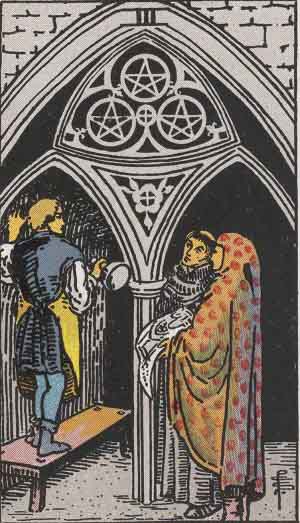
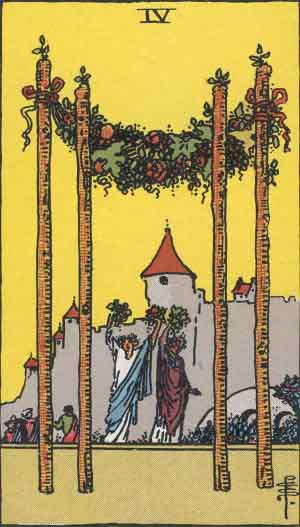
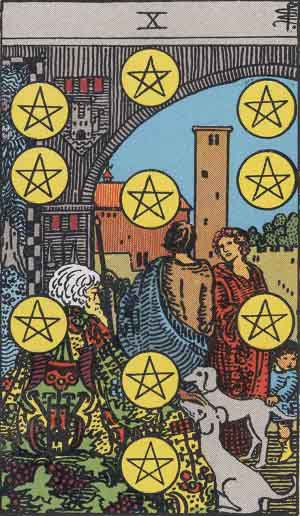
The Minor Arcana of the Tarot represent the way of ascent from consciousness belonging to the world of action (the phenomenal world) through the world of formation and the world of creation to the world of emanation. Thus, it is a matter of four degrees (including the summit) of ascent from the world of sensual and intellectual imagery, which corresponds to pentacles, to the world (or degree) of destruction of this imagery—or the “wilderness”—which corresponds to swords, so as to attain to that degree of spiritual poverty which is necessary to become a receptacle for revelation from above—which degree corresponds to cups. The summit is attained when the cup of consciousness which receives the revelation from above is transformed—by cooperating with revelatory action—into this latter. It then becomes revelatory activity itself, being actively united with the world of emanation. Then the degree of wands or sceptres is attained, i.e. that of pure creative activity.
Therefore the way begins in the world of coins or pentacles. This is the world of the imagery of facts, intellectual constructions and imagined ideals. Here consciousness surrounds itself with a world of images—on the one hand the memories of experiences, and on the other hand the formulae and schemes of the intellect, as well as those of moral imagination, which latter we call “ideals”. This world of images is neither reality nor illusion. It consists of values/images corresponding to reality and which are therefore “convertible” into reality; for this reason coins are its symbol. For just as pieces of money are not themselves board, heating and lodging but can be converted into board, heating and lodging, so do memory images and the formulae and schemes of the intellect and moral imagination represent realities—being “worths” that may be converted into reality.
Now, the world of coins—the world of images—has a twofold significance. It signifies, on the one hand, the wealth acquired by consciousness, and on the other hand it signifies the totality of that which must be renounced if consciousness wants to come to spiritual reality. Because in order to convert money into real things, i.e. in order to buy them, one has to pay. One has to become “poor in spirit” in order to have the kingdom of heaven.

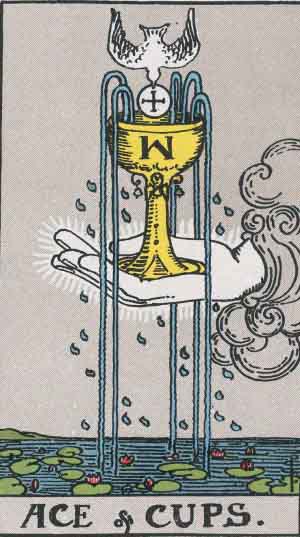

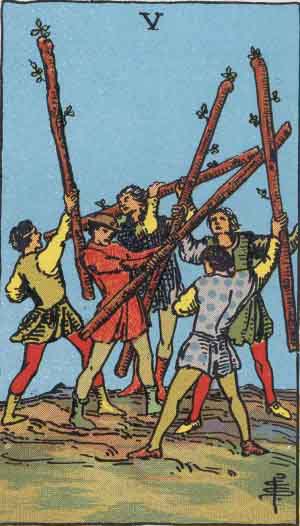
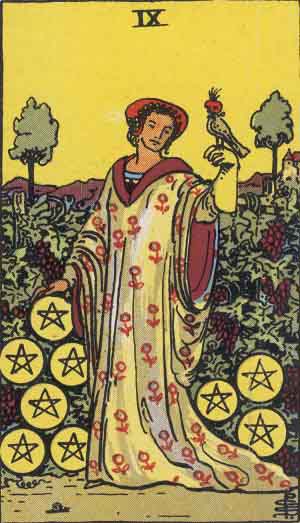
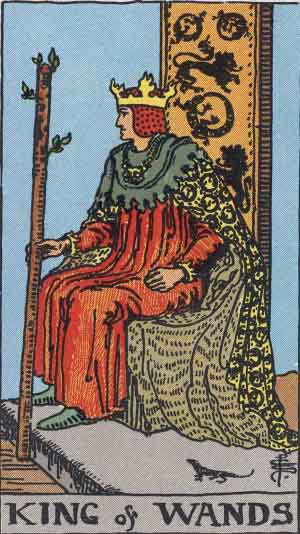
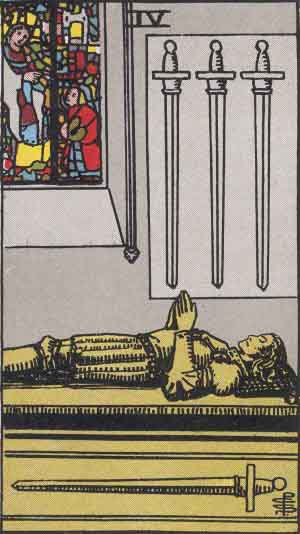
This payment, where one divests oneself of one’s wealth of spirit, is that of swords. Here, the values/images (or coins) that one has struck through intellectual, moral and artistic effort are destroyed, one after the other, in the same (Sephirothic) order in which they were formed. This can last an instant, an hour, or decades. With St. Thomas Aquinas it took the time of a single ecstasy, whilst with Plato it seems that it was a slow process extending over several years. With respect to St. Thomas, it was probably at the end of 1273 that he underwent the decisive ecstasy. It lasted so long that his sister, with whom he was staying at the time, became concerned and thus questioned Brother Reginald.
Who said to her: “The master is often caught up in spiritual rapture when he contemplates anything: but I have never before seen him taken out of his senses for so long.” And so, after about an hour or so, the socius, i.e. Brother Reginald, went to the master, and tugging hard at his cloak, finally woke him out of his sleeping contemplation. He said with a sigh: “Reginald, my son, I reveal to you something in secret, forbidding you to reveal it to anyone as long as I live. I have come to the end of all my writing, because such things have been shown to me, such that all that I have written and taught now seems to me very insignificant, and this leads me to hope in God, that as I have come to the end of my teaching, so very soon will I come to the end of my life.”
The ecstasy that St. Thomas underwent persuaded him that all that he had written and taught was of little significance . This is a case of passing through the sphere of swords. Concerning the other “rich man”—Plato, whose works, in eight volumes, are before me as I write these lines—he made the astonishing statement in his letter to the parents and friends of Dion (Plato’s Seventh Letter, which the ancients designated with the name of the “great letter’—written by Plato at about the age of seventy-five):
I have written no treatise on these matters , nor shall I ever write one. These matters cannot be expressed in words as other subjects can, but after persistent occupation in the study of these matters, after living for some time with them, suddenly a flash of understanding, as it were, is kindled by a spark that leaps across, and once it has come into being within the soul it proceeds to nourish itself.


Purification, Illumination and Perfection
The “worlds” or “spheres” of pentacles (coins), swords, cups and wands correspond to the degrees of the traditional way of preparation, purification, illumination and perfection.
What one acquires through observation, study, reasoning and discipline constitutes the degree of preparation, or the world of coins.
This “world” exposed to the action of the breath of the Real, constitutes the degree of purification, or the world of swords.
That which remains after this trial becomes the virtue or faculty of the soul to receive illumination from above. This is the degree of illumination, or the world of cups.
And, lastly, to the extent that the soul raises itself from receptivity to active cooperation with the Divine, it is admitted to the degree of perfection, or to the world of sceptres or wands.
These are the things which can serve as a key to the Minor Arcana of the Tarot, for your work, dear Unknown Friend, on these Arcana.
Adieu, dear Unknown Friend,
Festival of the Holy Trinity 21 May 1967