This is where you can be researcher, writer, presenter, sound recordist, producer and editor together yourself – with the help of a few other voices.
Let me share one of my favourite productions that was broadcast four times on BBC Radio 4.
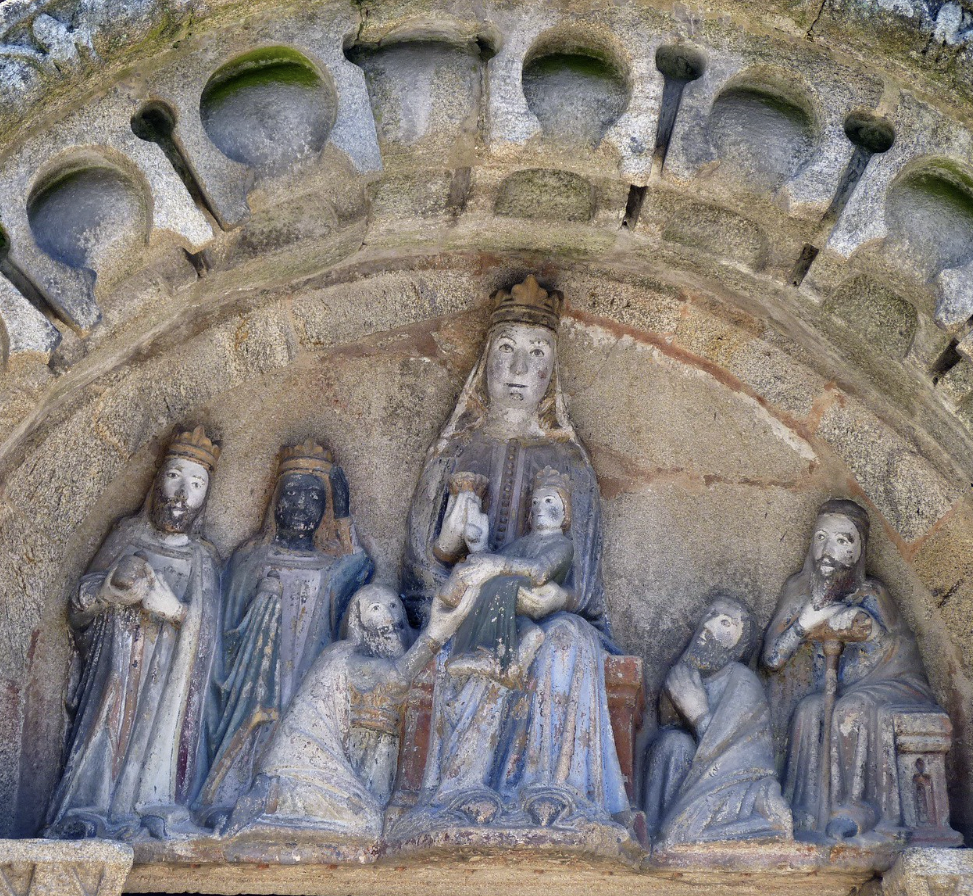
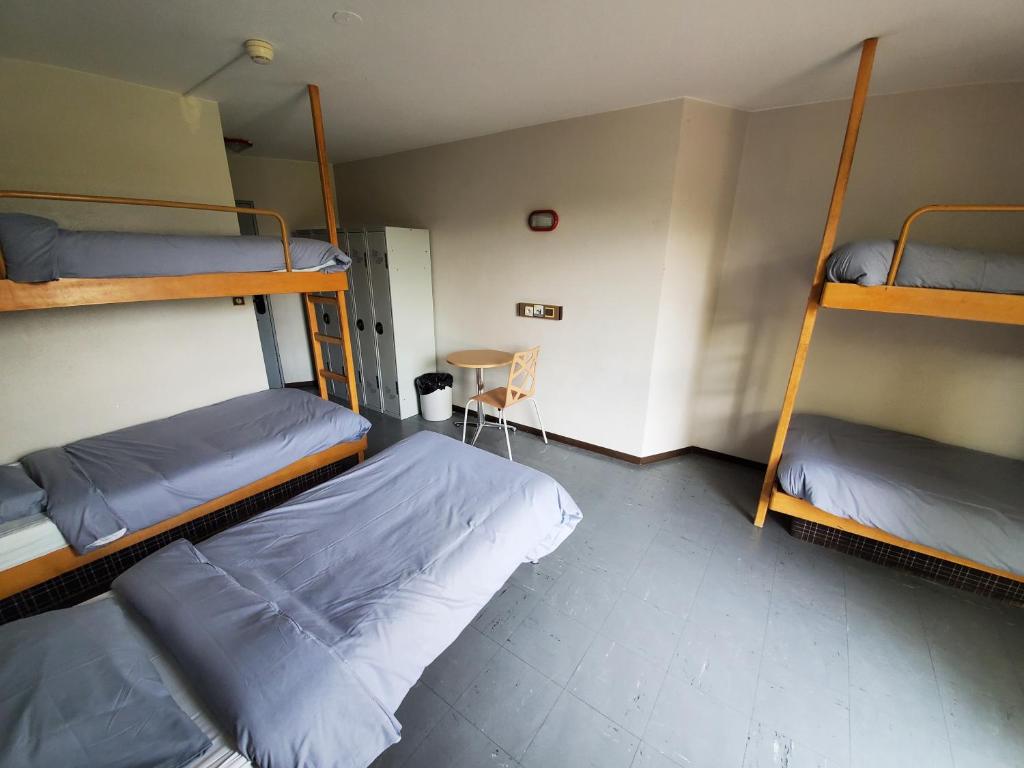
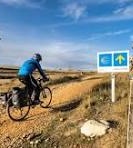
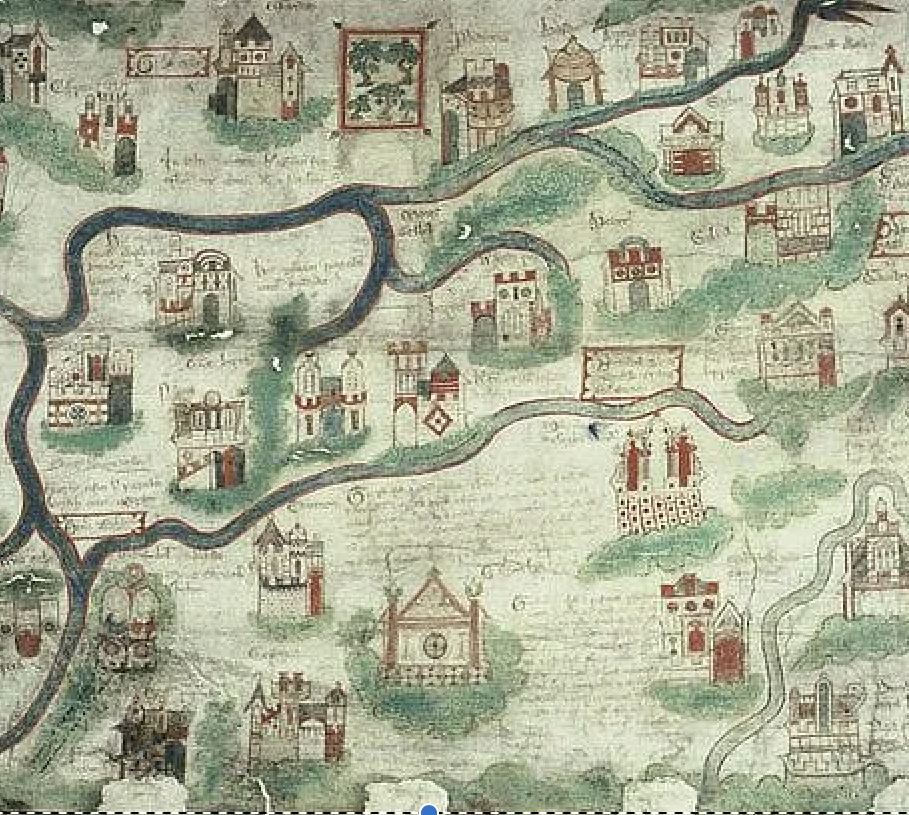
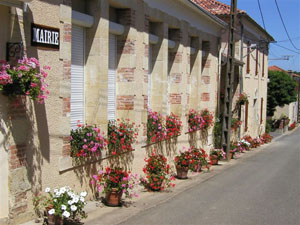
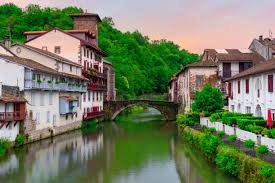
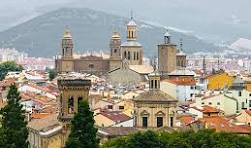
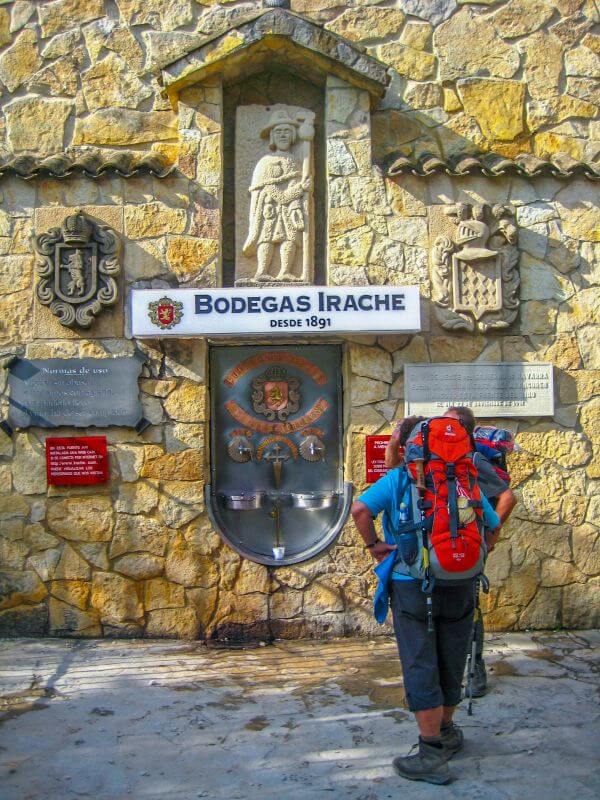
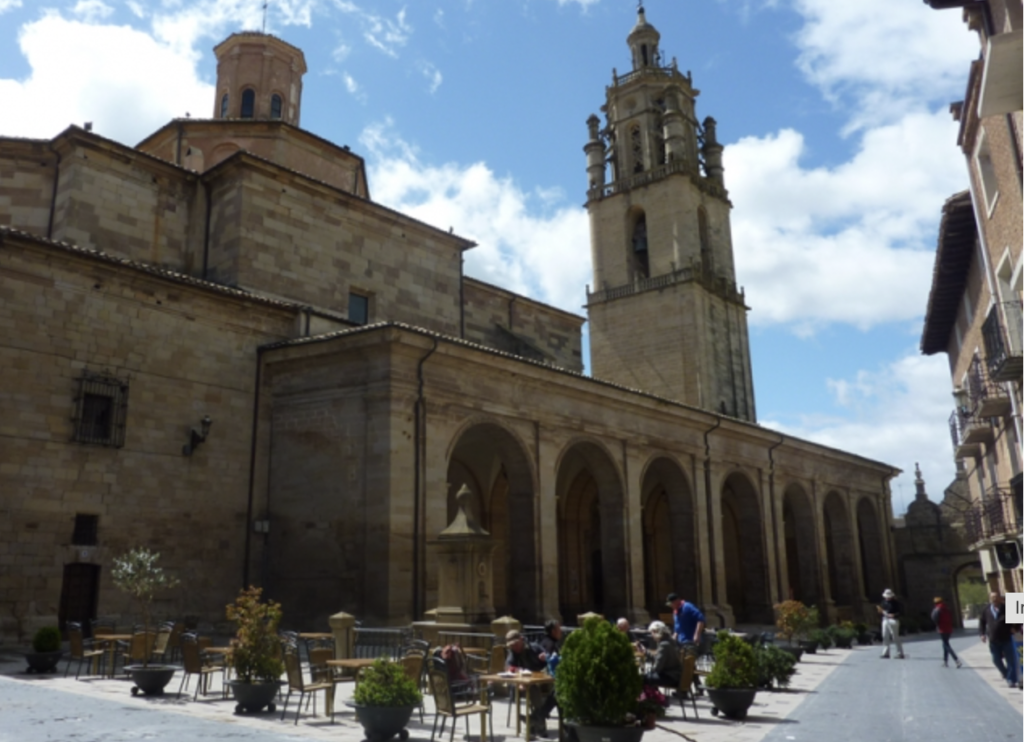
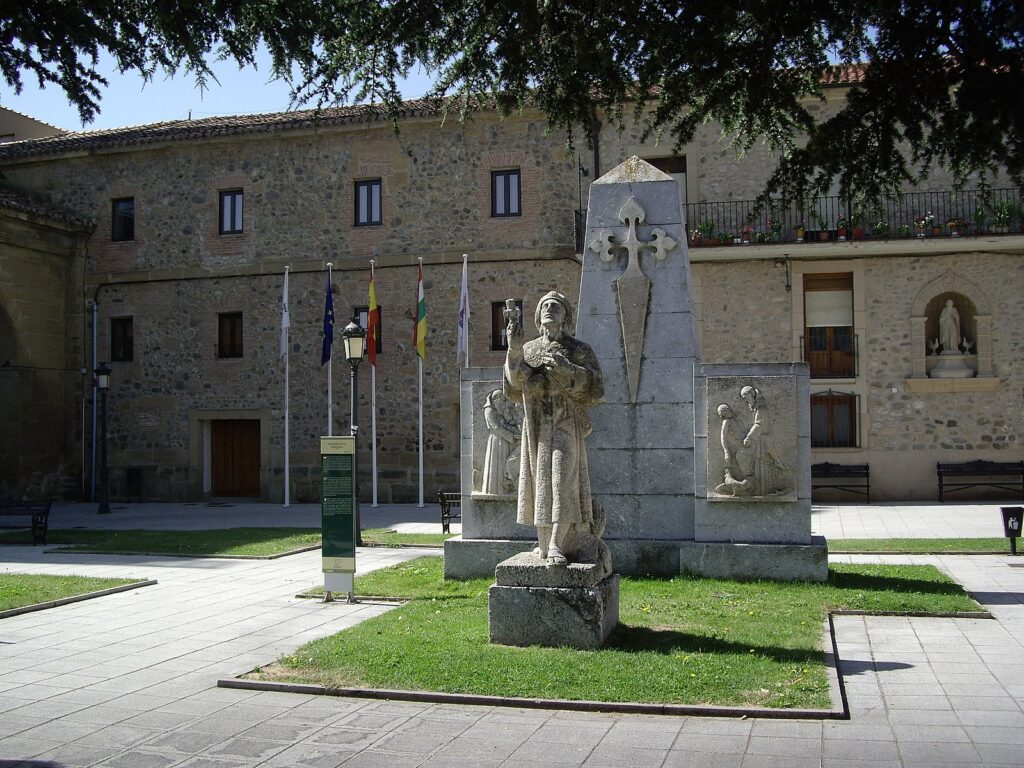
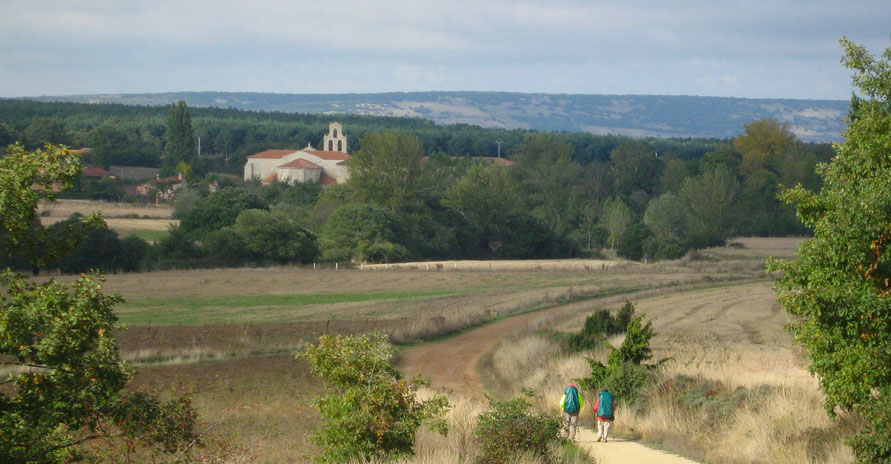
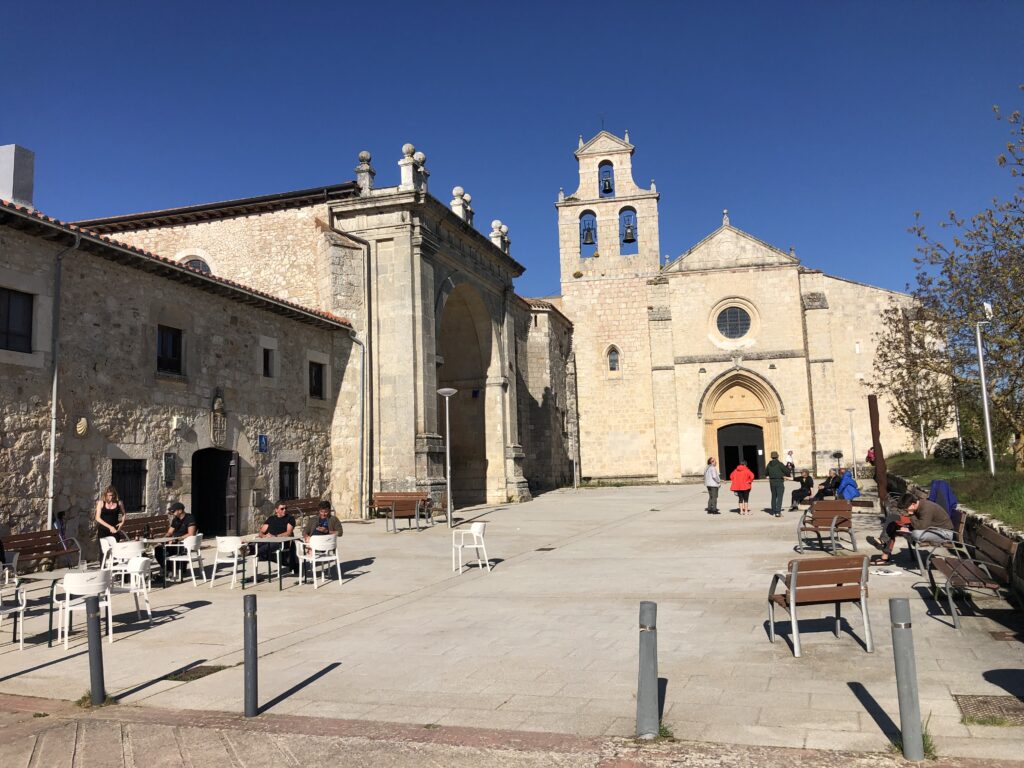
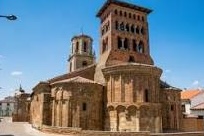
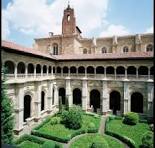
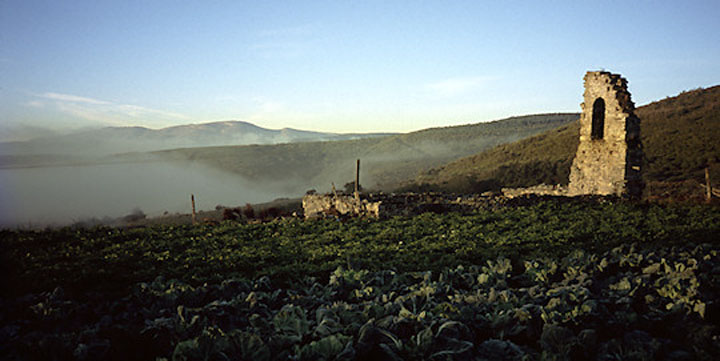
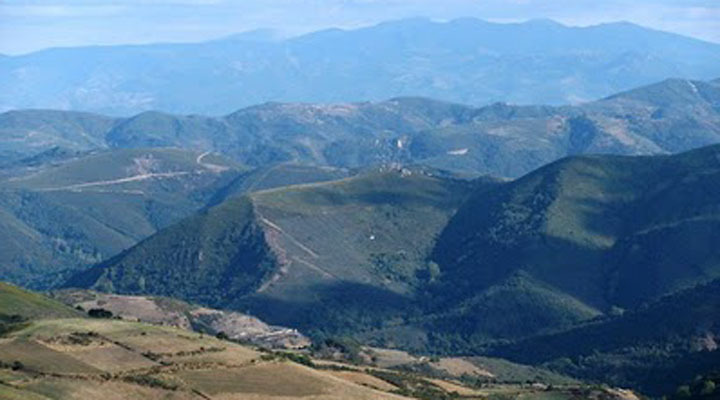
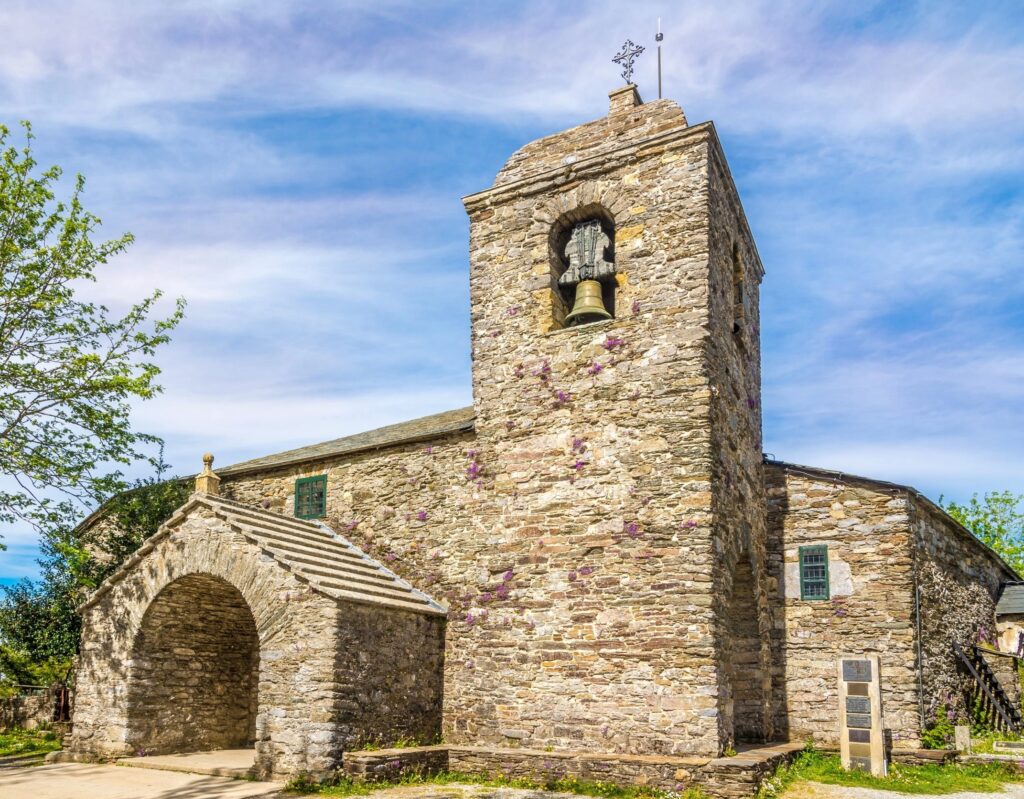
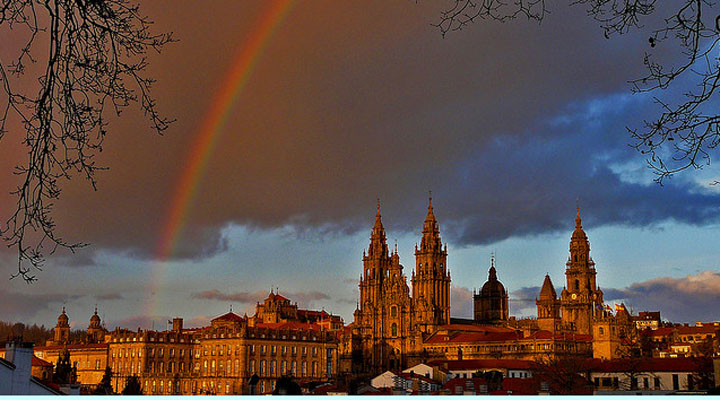
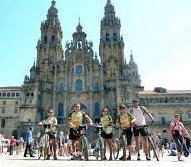
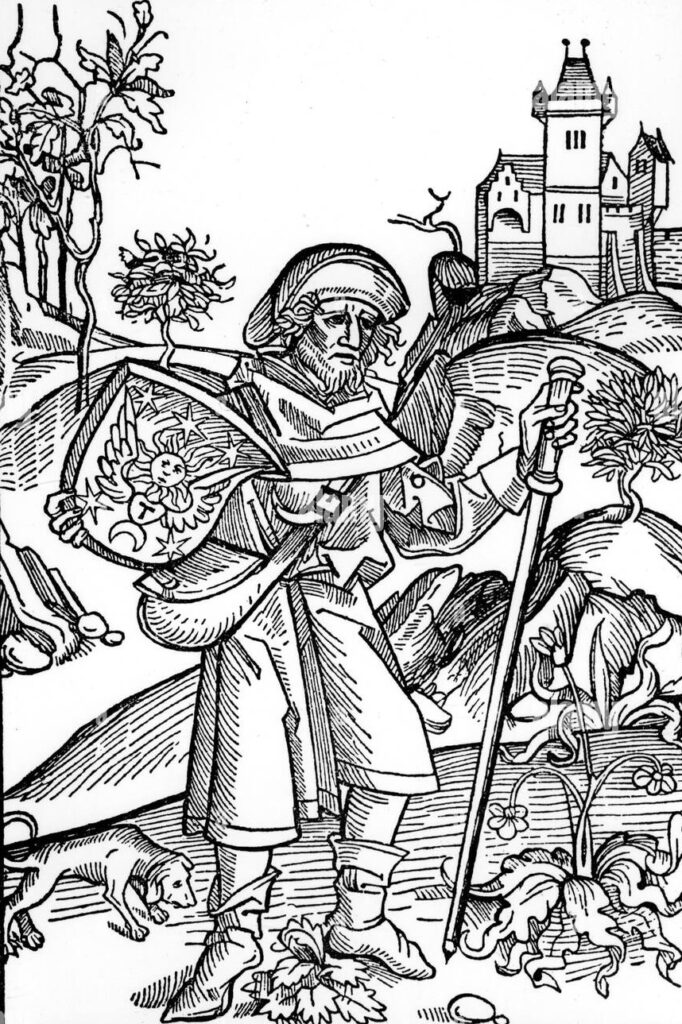
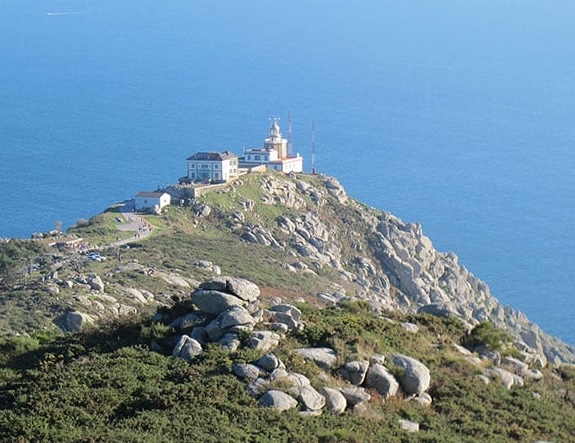
It was that of pilgrims throughout the ages, making the 1,600 kilometre journey from Mont St Michel in Normandy, France, to Santiago de Compostela in Spain. The most recent pilgrims were my son and I on bicycles.
Here are the first five minutes. I suggest you count the elements: scripted speech, actuality, pre-recorded music, etc, and think about how you would plan the shape, and record and assemble these elements.
SETTING OUT
| ANNOUNCER: | A reflective pilgrim on the road to Santiago makes a double journey: the backward journey through time and the forward journey through space. |
|
(INTRODUCE MEDIAEVAL HARP MUSIC BY MARY REMNANT) |
|
| Every step the pilgrim makes evokes memories of those who passed that way ever since the discovery of the tomb of the Apostle James in the Ninth Century. | |
| READER: | (FROM JACQUES DE VORAGINES) When St. James was beheaded, his disciples placed his body in a boat without a rudder and an angel of the Lord guided them to Galicia, the Kingdom of Queen Lupa. When the disciples asked her for a burial place she set them a series of trials. In the last of these they were attacked by two wild bulls. They made the sign of the cross over them and the bulls became as gentle as lambs. The disciples followed a star, until it stopped. There they buried St. James. This was in a field called The Field of the Star, or Compostela. |
| ANNOUNCER: | The Field of the Star. Last year Shaun MacLoughlin was among the five or six hundred pilgrims who walked, cycled or rode horseback to Santiago de Compostela in Spain. His companion was his son, Seamus. |
|
(FADE MUSIC) |
|
| SEAMUS: | My dad told me we were going to cycle to Santiago. He just told me, but now I’m glad I went. It was about 1,100 miles and took us around five and a half weeks. I was 12 then, but now I’m 13 and we both kept diaries. |
|
(ACTUALITY RECORDING OF DEPARTURE) |
|
| SEAMUS: | (TO SMALL SISTER) Binnie, get off my – Don’t put your foot in the pedal, Binnie. The whole thing will tip over. |
| MOTHER: | Right? Right? And just be careful. |
| SEAMUS: | Yeah. |
| MOTHER: | Won’t you? |
|
(LOSE ACTUALITY) |
|
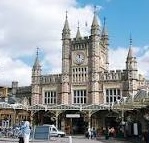
| SEAMUS: | At 3.29 pm we set off for Temple Meads, and I recorded everyone saying good bye. |
| SHAUN: | (A prayer) Please St. James, guide our wheels and bring us safely to your shrine and to heaven. |
| SEAMUS: | And at 4.10 the train set off. At 6.46 the train arrived at Portsmouth Harbour Station. We cycled one and a half miles to the ferry terminal at about seven o’clock. I’m very excited about having to cycle onto the boat. |
|
(INTERWEAVE SOUND EFFECTS OF SEAGULLS AND SEA WASH) |
|
| ACTORS AS MEDIAEVAL FRIENDS OF PILGRIMS: | (Calling) Pray for us at Santiago. May St. James look after you, etc, etc. |
| SEAMUS: | The boat rocked all night, up, down, up, down, and it was awful, but I still liked it. |
|
(SAILING BOAT MAKING GOOD WAY. MEDIAEVAL MUSIC.) |
|
| ACTOR: |
Haul up the bowline, now, veer the sheet! Cooke make ready our meat, Our pilgrims have no lust to eat. Steward a pot of beer! Anon of the best. |
|
(MIX FROM MEDIAEVAL MUSIC TO BACKGROUND OF CONTEMPORARY TOURIST CROWD) |
|
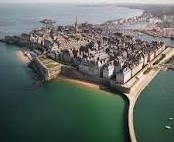
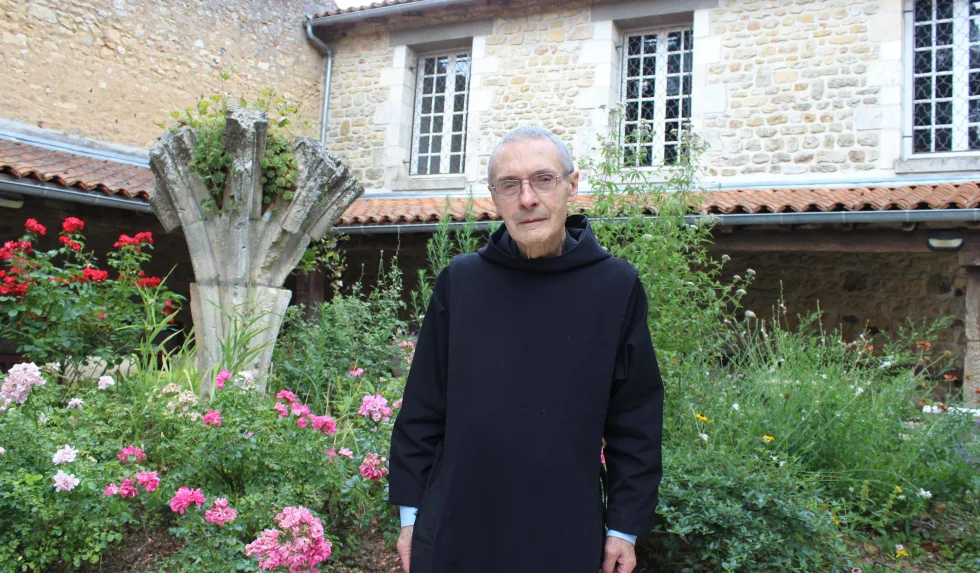
| SHAUN: | After docking at St. Malo, we started our pilgrimage proper from Mont St Michel, Normandy, where many pilgrims set out in the Middle Ages. |
|
(ACTUALITY OF GUIDE IN FRENCH) |
|
| GUIDE: | Ça commence ici la visite à Mont St. Michel, etc. |
|
(FADE AS WE MOVE AWAY) |
|
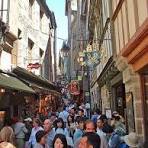
| SEAMUS: | Mont St. Michel was crowded with tourists and very noisy. We left our bicycles by the Gendarmerie. |
| SHAUN: | And walked up the crowded, tripper streets with our heavy packs to the Abbey. |
|
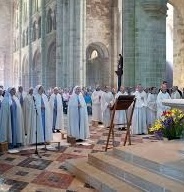
(LOSE CROWDS. BRING UP A MIXED COMMUNITY OF MONKS AND NUNS SINGING PLAIN CHANT IN FRENCH) |
|
| SHAUN: | There we were met by Sister Brigitte and attended vespers. We had a simple Friday supper and walked round the island with the tide coming up and we had a good night’s sleep. |
|
(LOSE PLAINCHANT) |
|
| SHAUN: | Matins at seven o’clock in the small oratory, followed by breakfast and Lauds; and then one of the brothers blessed our undertaking. |
| BROTHER: | Benissez especialment nos deux amis qui maintainent vont partir vers St. Jacques de Compostelle |
|
(INTRODUCE GENTLE MEDIAEVAL CHIMES) |
|
| BROTHER: | que l’Apotre et notre coeur les accompagne sur la route et les ramene sains et sauf dans leur foyer, par Jesus Christ, Notre Seigneur, Amen |
| SHAUN: | Amen |
| SEAMUS: | Amen |
FRANCE
| WOMAN READER: | In the year of Our Lord 814 Pelayo, a pious hermit, had revealed to him by a large star and by the music of angels the resting place of Saint James. King Alphonsus II built a small wooden church over the tomb of the Apostle; and from that time on, have flocked to the shrine, pilgrims in their thousands. |
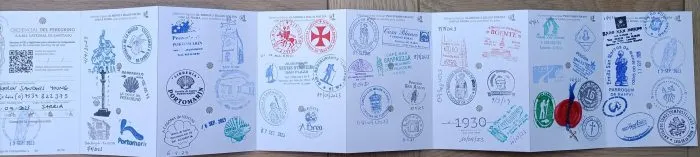
| SHAUN: | We paid our contributions, had our itineraries stamped and left. The certificates or compostelas as they are called act as a proof that ours is a genuine pilgrimage. |
| (MEDIAEVAL MUSIC) | |
| They were introduced during the Middle Ages, when it was not uncommon for people to embark on pilgrimage for obscure or selfish reasons. | |
| MALE READER: | Clerical tramps have no choice but to tramp. Their pilgrimage is not for the sake of their souls, but for their bellies. Since they have no taste for the discipline of a monastery, they may not work and live in a fixed place like other men; but must keep moving on from day to day, walking, begging, sweating, whining – always wondering. They know not in what place their last moments will be, nor in what grave their bones will rest. |
| SEAMUS: | We left Mont St Michel at 8.40 English time, and kept up an average speed of twenty miles an hour for about forty minutes. We had lunch at a lake and I watched lots of people fishing. |
| (SOUND OF FISHING ROD REELING) | |
| Nobody caught anything longer than ten centimetres, until the people next to me caught and landed in an extremely large carp, weighing at least five pounds and more than a foot long. After that I decided to take up fishing. We arrived at the youth hostel at 5 pm. The next day there was a downpour and it must have been the longest downpour ever known. We had to cycle very slowly and had to go over 84 kilometres. | |
| ENGLISH CYCLISTS: | There again you think, we packed a medical kit and all sorts of creams and modern conveniences that a medieval pilgrim wouldn’t have had. They just had their wide brimmed hats and whatever and it must have been extremely uncomfortable for them. There were moments when one would have wished to have been in any form of motorised transport, rather than a bicycle. I think of going up the pass of Roncesvalles, when we were attacked by a plague of flies. That was extremely unpleasant; and we certainly did get on our knees and pray about that; and fortunately we were delivered from the flies, but it was a most unwelcome introduction to the Camino. I’ve been given to think how grateful the pilgrim must have felt on his road, having trudged for far less than we covered in a day; but each night having somewhere safe and relatively secure to stay on the pilgrim route. There are so many hostels and so forth that one passes by that were used by the pilgrims. I think one can share, historically, in that sense of deliverance or gratitude. Some places seem to breathe gratitude, don’t they? |
| SHAUN: | The hotel that night was comfortable and refreshing. The next day was warm and I reprimanded Seamus for always wanting things. (In retrospect I cringe at what a pompous ass I was). |
| SEAMUS: | I’m fed up because I couldn’t afford a fishing rod. Dad decided to cycle to a place to swim for lunch. |
| (SPLASH AND SHAUN CALLS “BEAUTIFUL – COME ON IN”) | |
| SEAMUS: | But I refused to go in. A while later I climbed across a boat that sank when I stood on it – to a large raft; and from it I saw a trout by the mill there. And then we went to the monastery for the night. |
| (MONKS CHANTING) | |
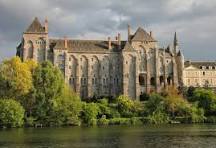
| SHAUN: | Solesmes makes one feel very humble. It’s a magnificent surprise. I had no idea that such orthodoxy and strength of vocation remained in France today. Several of the guests are young men. They follow the office with great attention. Several priests are also staying here. I bought myself a rosary and a priest offered to bless it. |
| MALE READERS: | Keep all these things, afore writ, and ye shall with the grace of God well speed you on your journey to go and come to the pleasure of God and the increase of your bliss, the which Jesus grant you. Amen. William Wey, a priest of Eton College, made the journey to Santiago in 1456. Collecting material for his guide book, he was struck by the ritual of repentance and pardoning, repeated by the pilgrims on their journey. The spiritual urgency of many of the pilgrims cannot be underestimated. A Somersetshire pilgrim, struck by infirmity learnt that he could go no further than Portsmouth. I advised him that he should go to Saint James, and that it would be better to die on the way home, because of the spiritual blessings received on such pilgrimage. |
| SEAMUS: | In the morning before breakfast I went to Mass, and it only went on for ten minutes. Later I came face to face with two red squirrels and they were beautiful. We set off at 9.30. |
| SHAUN: | The Pere Hotelier refused to take any money, which almost put our finances back into the black. Mind you, this was in the medieval tradition of pilgrims. |
| SEAMUS: | Thursday 4th July. Woke up at 8 o’clock and had brekky. We set off at 10.12 and we cycled along a railway. |
| (SOUND OF CROP SPRAYER AND SEAMUS SHOUTING) | |
| SEAMUS: | During the day I was sprayed by a crop sprayer twice. After lunch I sped ahead of Dad and while I was cycling past a field full of grapevines, I saw a large alsatian chasing me. Suddenly he jumped over the ditch and onto the lane and nearly caught up with me and I thought, “No way am I stopping now!” So I cycled on as fast as I could; and then it went for Dad, who was quite a long way behind me. Dad took out some pepper and squirted it straight at the alsatian’s nose, and it just stopped in its tracks. |
| SHAUN: | In the Middle Ages pilgrims had to face far worse, such as wolves while crossing the open plains. |
| READER: | It is not uncommon for pilgrims to be held up by bandits, who armed with two or three clubs, demand an extortionable toll, and if any traveller refuses they will not hesitate to strike and injure the pilgrim. They will even search his breeches to find the money. |
| SEAMUS: | The next day we cycled so far and fast before lunch that I began to feel sick. When we got to Ligugé Abbey I was sick. It must have been about 6.20 and every hour for about three hours I was sick, mainly because I ate too many cherries. During the next day I just lied in bed getting well. |
| READER: | The fever returned everyday at the same time. I couldn’t walk at all. However I eventually reached a miserable hospital on the route. The nurse asked me whether I wanted to undergo a remedy to cure the fever. I consented due to my desire to reach Santiago. She went and collected a great handful of nettles. Then she pulled off my shirt, lay me stomach down on the bed and rubbed my kidneys something marvellous with the nettles. I suffered like a wretch. Then she put my shirt back on and covered me with blankets; so many that I sweated eight or ten shirtfuls of water, from 6 or 7 in the morning until 3 in the afternoon. Then she stopped my sweating by removing some of the blankets. The next day the fever had gone. My companion having seen my sufferings, had no intention of being cured with nettles. He said he’d rather have the fever. |
| SHAUN: | Ligugé Abbey is the oldest monastery in Western Europe and the first that we stayed in on the traditional pilgrim route. |
| PERE FRANCOIS: | Nous somme a peu pres au moyens parents entre vingt et vingt cinq pelerins plus …. |
| (START TRANSLATION) | |
| BROTHER: | Pere Francois, the guestmaster, told me about the other pilgrims They received, about .twenty or twenty five on their way to Lourdes or Santiago each year. He told me of a Dutchman who received twenty one fractures in a car accident; and who vowed to walk to Santiago if he were cured. He was cured and he thought it a miracle. So he walked all the way from Holland and back: several thousand kilometres. A French professor of medieval history at Poitiers made the pilgrimage on foot and without any money at all. He begged for his bread and stayed with priests along the way. |
| SEAMUS: | Next morning I was fine and we set off just after 8.50. We cycled quite fast and after lunch Dad took us on a detour to a perfect river – no water. |
| SHAUN: | (LAUGHS) Lack of water or polluted water was another problem faced by medieval pilgrims. |

| READER: | In one area flows a river, which is known for being unclean. Take good care when you go to drink or water your horses, because this river can kill. |
| SEAMUS: | We arrived at the hotel at 4.45 and I went to look for fishing rods. |
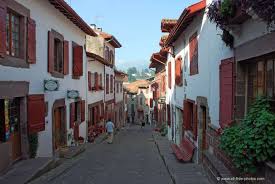
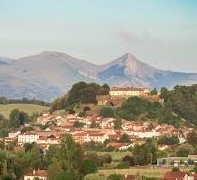
| SHAUN: | Wednesday 11th July. Lunch by a tiny stream outside Blanzac. Thence to Couvent de Sainte Marie de Maumont on, I had forgotten, the feast of Saint Benedict. |
| (NUNS CHANTING) | |
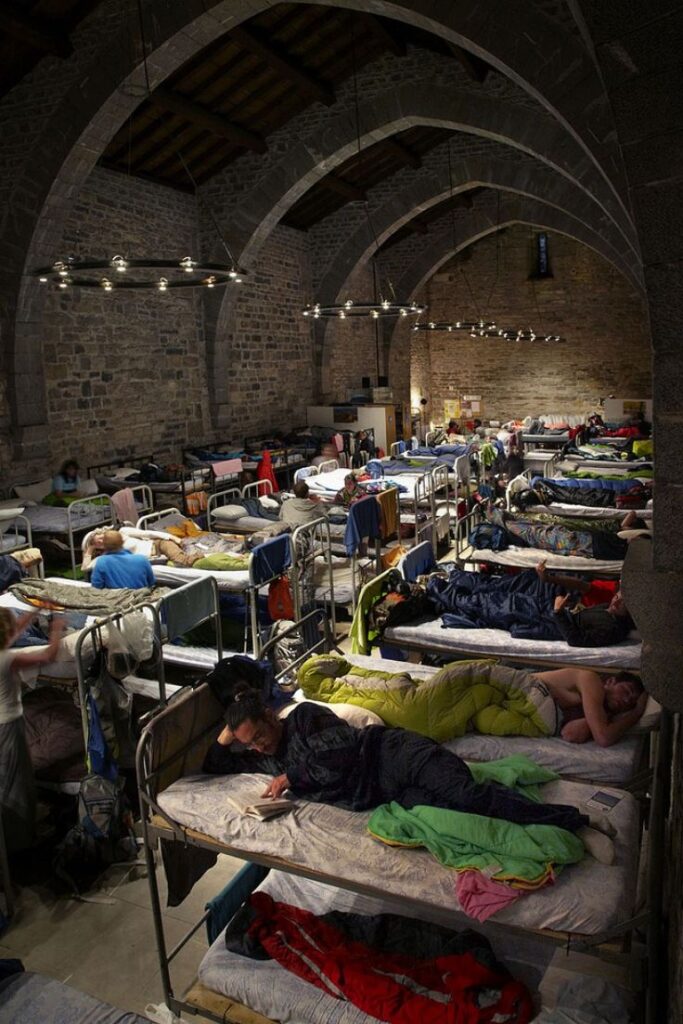
| Many families were there to celebrate their daughters entering the novitiate. It was a beautiful chanting that reminded me of Stanbrook Abbey. A really lovely, happy spot.. | |
| (FADE CHANTING) | |
| ENGLISH CYCLISTS: | It’s not so much the visiting of holy spots that’s inspired me. It’s the thought that of all these pilgrims together, having to live together, having to suffer each others’ idiosyncrasies; and it’s that really that teaches one the virtues that one needs to acquire in order to make one’s own pilgrimage through life. For example in the old days people used to smell much more than they smell now. Imagine after a sweaty walk over the mountains, it must have been quite hard to have to live at such close quarters to one another. But having come all the way with everyone else, there must have been a great feeling of community, of togetherness. And I think that is something that is very important; to me almost more important than meeting the physical object of one’s pilgrimage. |
| SEAMUS: | We got up at 6.30, had breakfast and set off at 7. The weather was rather dull and we had to cycle up some big hills to Duras and then on to La Reole. |
| (SOUND OF CYCLING AND RAIN) | |
| During some of the day it rained so we had to have lunch in a wood outside Langon. After lunch we entered Les Landes. I find it very boring and the trees are too far from the road to give shade and you couldn’t see the landscape. | |
| READER: | This is a desolate region, barren of everything. There is no bread, no wine, no meat, no fish, no water sources. There are few villages in this desert-like area, which nevertheless abounds in honey, millet and swine. If you should chance to cross Les Landes in summer, take good care to protect your face against the gigantic flies, which swarm everywhere, and if you do not pay attention to your feet, you will quickly plunge right up to your knees in sand. |
| SEAMUS: | When we arrived at the hotel, it poured with rain. At supper I taught Dad a bit about BMW’s and we had some wonderful trout. |
| WOMAN READER: | The pilgrim is no ascetic. Eating is a good thing, necessary if one is to complete one’s task. All meals are good to partake of without after-thought or guilty conscience. At the edge of the river Minon we have enjoyed superb and excellent trout. At Badia Castilla my friend and I devoured a quarter of a lamb and drank a good moscatelo, costing four sous a bottle. |
| SHAUN: | After such a good meal we were on fine form next morning. It was a beautiful fresh day with some clouds to keep the temperature down. I thought of Seamus and I – his natural joy of youth – and how my sense of wonder at the beauty of landscape was – as my favourite author, Belloc, remarked – slowly waning with age. I realised the only way to enter the joy and vividness of life in later years is to pray, to lead the spiritual life. |
| SEAMUS: | At Hagetmau, the first town in the Basque country, the hotel had a swimming pool; but we couldn’t swim in it, because the owner had had a heart attack. |
| SHAUN: | In the morning we set off down beautiful country lanes, through the flowered villages of Cazalis and Amou. We were now in what used to be called Gascony. The Gascons were the same race as the English during the Middle Ages. |
| READER: | The Gascons are a flippant race. They’re talkative, derisive, debauched, drunkards, gluttonous, dressed in rags and practically destitute. However they are experienced fighters and remarkably generous towards the poor. |
| SHAUN: | Wednesday 18th July. We left in good time; and visited Ostabat where three of the medieval roads to St Jacques meet. There I lit a candle to Our Lady of Fatima and prayed that the whole family should go to heaven. I seemed to get the message that if I said the rosary every day my prayer should be answered. |
| SEAMUS: | We got to St Jean Pied du Port by lunch. After lunch we went to the tourist office. Then we booked into a posh hotel and I wrote some post cards, while Dad recorded Madame Debril. |
| MADAME DEBRIL: | Or depuis neuf cent cinquante …. |
| SHAUN: | Madame Debril of the Confraternity of St James has been befriending pilgrims now for over thirty years.. |
| MADAME DEBRIL: | Nous somme a peu pres au moyens parents entre vingt et vingt cinq pelerins plus …. |
| SHAUN: | At Pentecost four Swiss had already walked from Lausanne across France, past St Jean Pied de Port and must have arrived at Santiago. They are also walking back from Santiago. They are musicians. One plays the accordion, another the cornemuse and the third the flute. The fourth is a doctor. There is also a group of motorcyclists from Bordeaux and a group of cyclists from La Rochelle. Usually these groups are accompanied by a priest who looks after their spiritual welfare. |
| SEAMUS: | We set off about 10 o’clock and crossed the border into Spain at about 10.50. |
| SEAMUS: | On the way at the top of the pass, we saw some fantastic scenery. We had lunch on the way up by a stream and we met an English family. On the way down the road was dangerously steep and windy. When we got to the monastery we met two Dutch people who spoke English and who were walking some of the way. At supper we met an Austrian man and a Spanish woman that were also walking. |
| SHAUN: | Spain was very different to France. The contrast of atmosphere and attitude were at once noticeable. As Richard Ford who travelled through Spain in 1845 remarked: |
| RICHARD FORD: | Those who aspire to the romantic, the poetical, the sentimental, the artistical, the antiquarious, the classical, in short to any of the sublime and beautiful lives will find in the past and present state of Spain subjects enough in wandering with led pencil and notebook through the singular country which hovers between Europe and Africa; between civilization and barbarism. |
| SEAMUS: | The room we were sleeping in was very dirty and we were kept up half the night. |
| SHAUN: | We were staying at the ancient pilgrim’s monastery at Roncesvalles. We settled down and got to sleep at midnight, only to be woken at 2 o’clock in the morning by five hundred Spanish school children, who were hiking though the Pyrenees. They incessantly shined lights in our eyes, made an enormous din, and, believe it or not, they left again at five o’clock in the morning. When they got to sleep I don’t know. We won’t forget that night at Roncesvalles. The famous abbey was also engrained on Picaud’s memory. |
| (CHANTING RECITATION) | |
| AYMERIC PICAUD: | The door is open to all, to sick and healthy; not only to Catholics, but also to pagans, Jews, heretics and vagabonds. In this house they wash the men’s feet. They cut their hair. In fact it would take too long to relate all that is done for them. If you saw them repairing the footwear of the poor pilgrims, you would give praise to God. And even the mere telling of the benefits given by this house would make you love it all the more. |
| SEAMUS: | We cycled most of the day along a rather boring route and stopped to swim in a river outside Pamplona. The outskirts were awful and there were so many traffic lights, it took hours to get to the centre. |
| SHAUN: | A charter in 1031 demanded a bridge be built to carry the pilgrims across the otherwise treacherous rivers. Picaud reveals his own enthusiasm for such safety. |
| PICAUD: | The lives of many pilgrims have been endangered due to the necessity to cross swirling currents. I thank the Lord for all those involved with the building of the bridges, and pray that they will be eternally blessed. |
| SEAMUS: | At Puente la Reina we met some cheeky kids and two Belgians. |
| BELGIANS: | We are from Belgium and anyway it’s a hard trip, about 700 kilometres for us to go, by foot. I study agriculture at the university and I’m always looking what crops they sow here, in a country that is so hot. and also I like the beautiful landscape, the nature and the flowers that is around. It is absolutely amazing. In the beginning we walked from half last eight till four, but it’s too hot you know. The people here just live from morning till one o’clock. Then they have a rest till four or five, sometimes six and then they work on, and we have to do the same. Otherwise it’s impossible for us to go on. I think the heat is a very big problem, but the food – well it’s hard to get hot food, because most of the things are the same over here tortillas – er. You don’t need a lot of food here, because we drink I think six or seven litres a day for the heat, but it’s difficult to sleep here; because there’s a lot noise late in the night, and we must get on at seven for the heat. It is very difficult to sleep a lot. |
| SEAMUS: | Two Belgians told us about a few free places to stay. |
| SHAUN: | Especially the pilgrim house at Torres del Rio. So we arranged to meet them there. All went well. We had a pleasant siesta by the stream, and dozed. We felt quite well rested then onto Torre del Rio, an attractive village, where we met our host, Ramon, in the one bar in the village. We met a very warm, slightly venous welcome. |
| RICHARD FORD:: | The accommodation for travellers is secondary to that for beasts. The inns in general are bad, often very bad; and even the best in the country are only indifferent when compared to those which Englishmen are accustomed at home, and have created on those highroads of the continent, which they most frequent. |
| SEAMUS: | Then we were taken into a disgusting house, and the loo was in the back garden. |
| (SPANISH BRASS BAND) | |
| SHAUN: | After lunch we cycled against an exhausting head wind to San Domingo de la Calzada, where we received a marvellous welcome from the boys in the streets, from the shopkeepers, and finally from the Guardia Civil, who showed us to a splendid pilgrim house, known as Casa de Santos, where we slept and ate in real style. |
| BELGIANS: | I think the people here are very nice. It’s easy to make contact with them. They are always ready to talk about the trip, because most of the people know the Camino de Santiago, especially the old people and they always like to tell about it. They are very friendly over here. Yes, especially when they hear you have studied a little bit Spanish. Oh they are very proud that somebody of another country learns their language, because Spanish is not that great a language, and they appreciate it. |
| SHAUN: | That morning we climbed steadily. It was a nice gentle climb, and the countryside was beautiful. There were skylarks and many, many wild flowers. We stopped for a picnic just beyond the pass by a fountain. Then we left the main road and travelled for the first time down untarmacked roads through woods. We arrived after a picnic lunch and a siesta at San Juan de Ortega, an old Roman hospice on the route. There we were welcomed by a Spanish priest in mufti. He offered us lunch, which we declined and wine, which we accepted. |
| ̣(YOUNG SPANISH GIRLS CHANTING) | |
| SHAUN: | Outside there were a group of girls enjoying a summer school holiday with a nun. They were singing and Seamus joined in. |
| ̣(MORE CHANTING) |
| SEAMUS: | In the evening I went swimming in a dirty river with some Spanish girls. Then they left. |
| (INTRODUCE FRENCH CHOIR) | |
| After that some French singers arrived in coaches and cars. | |
| SHAUN: | There were seventy four of them, men, women and children. They were on a singing pilgrimage to Santiago. They made their supper and we were offered a marvellous meal by the French priest and thoroughly enjoyed the company of his Spanish friends. The French sang a farewell to the Spanish school children. Then they sang for us in the church. We didn’t get to bed, till one o’clock in the morning. Seamus loved that. |
| (BELLS) | |
| SHAUN: | Wednesday 25th July. The Feast of Santiago and of Saint James and of Seamus. Seamus seemed to have made lots of pen friends both French and Spanish. I gave a contribution to the priest and tired but refreshed we sped on our way to Burgos. |
| SHAUN: | ̣Buenas Dias Senora |
| OFFICIAL: | Ola. Buenos dias Senor. Que quere usted? |
| SHAUN: | ̣Somos peregrinos sobre el Camino de Santiago. |
| OFFICIAL: | Si, si. |
| SHAUN: | ̣Es que es posible poner el sello sobre nos pasaportes de peregrino? |
| OFFICIAL: | (MAKES AGREEING NOISE) |
| SHAUN: | ̣Gracias |
| OFFICIAL: | De nada. Es su primera visita? |
| SHAUN: | ̣Si la primera vez.. |
| OFFICIAL: | Ah. (SHE STAMPS HIS PASSPORT) Donces espero que usted pasa un de muy feliz. |
| SHAUN: | ̣Muchas gracias, muchas gracias. |
| ̣(HE LEAVES) | |
| ̣After collecting our stamp, we sped quickly out of Burgos, shopped at Targados and up into the hills and footpaths. We had to walk almost fourteen kilometres. It made a tiring, but interesting change, through fields of oats and barley fields, up and down hills, over occasional trickles, and enjoying the skylarks. | |
| ENGLISH CYCLISTS: | ̣I think travelling by bicycle we have missed certain things that pilgrims on foot would have taken in their stride. Perhaps we’ve lost something by that. Certainly I think the pilgrimage on foot must be a very different experience from the pilgrimage on bike. Frankly I don’t think we’ve lost a great deal. The people who shoot past us in cars, I think they must miss a great deal. Although when we’re slogging up a hill, the idea of going by car is a very pleasant one. But I think we’re going slowly enough to take in the surroundings. |
| SHAUN: | ̣We met a shepherd who was very proud of his Japanese binoculars. We gave him a doughnut and he gave us some wine out of his gourd. Later on there was tarmac again, and free wheeling down through an attractive valley, we found a lovely picnic place by a spring. Seamus of course damned it. |
| SHAUN: | Thence to Castrogeriz, where we met a poet in the hotel and were taken to an exhibition of pictures, scalded onto wood. We walked up to the fort, constructed to defend the Castilians against the Moors, although, I think, traces were Roman; and then we enjoyed a decent meal and quite a good night. The only drawback was that the village water supply was turned off at 6 o’clock in the evening and we hadn’t been warned. |
| SEAMUS: | At ten o’clock we set off rather slowly along a plain. For lunch we stopped by a river, and I dropped all my lunch down a bank, which rather annoyed a fisherman |
| SHAUN: | Seamus decided he’d like to bash on through the heat of the day, and gain an extra day on our schedule – to Sahagun, where we arrived at 6.45, tired but triumphant. The Benedictine nuns at the hotel there took one look at Seamus and declared that we should have an early supper at 8.45 instead of the usual 9.30. The Mother Superior was a Galician. She asked Seamus to pray for her at Santiago. |
| SEAMUS: | We set off at about 10 and cycled along a very busy, noisy main road all day, and we met a cyclist. We stopped for lunch at a camping site next to a river. Then set off along the main road for Leon. My Dad promised me we could stay in a five star hotel in Leon, because it was the old pilgrim’s hostel; but I didn’t like the style, so I turned it down. |
| SHAUN: | ̣Monday 30th was a cold and slightly rainy morning. We weren’t used to that. |
| SEAMUS: | We set off at 9.26 and cycled along a small, ordinary lane and I pulled a muscle in my right elbow. The climb over the pass was steep and long. |
| SHAUN: | I forced the pace a bit, up through some semi-deserted villages, from the plains of Castile to the open moors and the almost completely deserted village of Foncebadon, which normally has only one family living there, a mother and her son. There we met a very jolly Madridian, who laughed at our exploit and told us that if we added a stone to the pile at the summit we would be granted a wish. The landscape had changed to moorland with heather, bracken and rosemary. |
| READERS: | Here beginneth the way that is marked and made with mountjoies, from the land of Engeland unto St. James in Galice. Always add a stone to the piles or mountjoies that mark the route. For you too will be blessed by such landmarks, as you make your way to St. James. Indeed our own journey to Compostela was ridden with snow. Many times we felt beneath the snow with our staffs to feel whether there lay a pile that would mark our route. When we found nothing we committed ourselves to God, and our blessed St. James. |
| (SENOR BALLLISTEROS SPEAKS SPANISH) | |
| SHAUN: | Senor Ballisteros, who welcomes pilgrims to Santiago, told us of the Belgian probation officer who discovered an unrepealed Medieval law. This man wanted to come to Santiago, but not alone. He wanted to take with him four young criminals from the prison, so he asked for permission from the magistrate for young offenders in Ghent; and after almost four thousand kilometres on foot, because they followed the path through France as well as through Spain, they reached Santiago four months later. They arrived at the Cathedral; but the strange thing about the pilgrimage of these Belgian boys is that from the very moment that they arrived at Santiago, they also gained their freedom. By completing the pilgrimage, they had gained their remission. After a picnic lunch, we cycled down and down through El Asebo. |
| SEAMUS: | We cycled into Ponferrada and went to the town hall, where they told us about a free place, where we could sleep. When we got there, we found it was a barn at a fire station, so we had dinner and went to sleep. In the morning we got up very early and cycled twenty four kilometres to Villafranca for breakfast. There we met two English cyclists. On the way up a new main road had been built, so it was very easy until the last bit to Cebreiro, because there was just a small lane up a very steep mountain. |
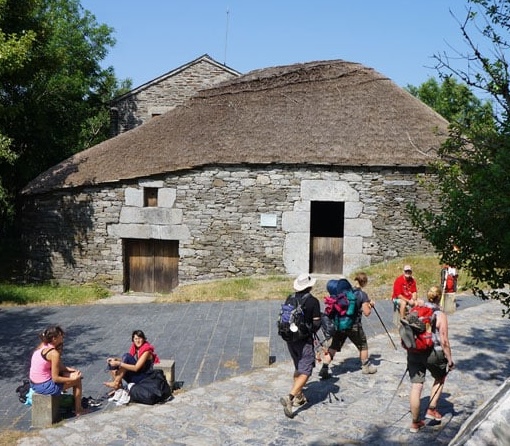
| SHAUN: | Cebreiro was the high point of the trip in every way, at least until that point. Apart from the fact that it was almost 5,000 feet up, we were lucky enough to arrive there on a brilliantly clear day, with a magnificent view looking back into Castile one way and over mountain range after mountain range towards Galicia, Santiago and the Atlantic in the other. There was a ninth century pre-Romanesgue church with a Medieval hostelry attached to it and several small houses built like beehives to protect them from both the sun and the snow. There too we met far more pilgrims than we had anywhere before. They all seemed to arrive there. |
| DUTCHMAN: | Now I am in Cebreiro. It’s the pearl on the route of Hut Corbella(?) Santiago is the star of St, James, but Cebreiro is the pearl on the route. |
| ENGLISH CYCLIST: | In a funny way, it reminds me a bit of Bunyan’s Pilgrim’s Progress, because shortly before he reaches the Celestial City he comes to a beautiful country that is quite high up. This is a foretaste of what is to come. Well, okay, we’re only going as far as Santiago, but one already feels a sense of accomplishment. |
| SEAMUS: | One of my favourite places was Cebreiro on the top of the mountain. The scenery there was fantastic and there was a lovely ride up from Leon and Villafranca. |
| SHAUN: | That night a group of us, Henry a German artist, Arnold a Dutch Pilgrim, Seamus and I, had a delicious supper. We locked our bicycles away and then went out to enjoy the sunset, and retired at 10.30 to one of the most comfortable nights, we had enjoyed on the pilgrimage. |
| : | (SPANISH MONKS CHANTING) |
| SHAUN: | Deo Gratias. The next morning we woke to beauty at 8 o’clock, enjoyed our breakfast, and lingering after breakfast, were invited by the local priest, Father Elias to a cognac, apparently a parting gift he gives to all the pilgrims. He was a most hospitable and generous and gracious man. We had a really lovely stay in Cebreiro. |
| SEAMUS: | In the morning we set off quite late and cycled up the path, even though my Dad couldn’t steer very well because of the cognac he’d had. At the top we met Henry and the two Dutch. We had supper with Henry, and when Dad went to interview one of the monks, we met a cow. After supper I went to watch some bats. |
| SHAUN: | I returned to the monastery. A very ebullient little monk rushed up and asked whether I’d interpret for him. He was being asked something by one of the German priests. The German priest explained that he wanted sheets. Well, the Spanish monk explained, they didn’t have any sheets for poor pilgrims. There were only eight monks there and hundreds of pilgrims were coming through and how could they do any laundry? But the german priest insisted. He insisted on a German sense of hygiene. I found myself in a very. very awkward situation, being blamed on the one hand by the Spaniard for not being a poor pilgrim, for not travelling in the spirit of a poor pilgrim, and being blamed by the German priest for being as unhygeinic as these Spaniards. |
| SEAMUS: | Our next day was the last, and it was one of the best, the most exciting. We reached Santiago. |
| SHAUN: | The final stretch, but first we had to climb Montjoie. So named because of the real joy felt by the pilgrims on sighting the Holy City. |
| : | (TRIUMPHANT TE DEUM) |
| WOMAN READER: | When we saw the long-desired Santiago half a league away, we threw ourselves on our knees, and such was our joy that tears fell from our eyes and we began to sing the Te Deum. But after two or three verses we could sing no more, such were the floods of tears that we shed and the sobs that choked our song. Only when we exhausted our weeping did we take up the Te Deum afresh, and we went on singing as we descended Mountjoy, until we reached the outskirts of the city. |
| SEAMUS: | We went on. And I rushed ahead over all the hills towards santiago, and then I came to the top of the hill and saw the town a few hundred feet below us. |
| READER: | When I saw Compostela, I threw my hat into the air to signal to my companions behind that the Holy City was in sight. When they caught up with me, they claimed me as king, the first to have sighted Santiago. |
| SEAMUS: | I was a long way ahead of Dad, so I sped down , racing down the mountain, down towards Santiago. And I didn’t actually go into Santiago. I waited about four feet before the sign, which said, ‘you are now in Santiago’, in Spanish. I was waiting for Dad, and he didn’t turn up for about twenty minutes. So I cycled back up the hill, back towards the airport. Then suddenly an English car, I saw, stopped near me, and said, ‘Are you Seamus?’ and I said, ‘Yes’. And the English family said, ‘Your father’s up on Mont Joy, straight up there. And then I saw him coming down, and he told me that I’d missed Mountjoy. Then we cycled into Santiago and we got lost, and I crashed. We eventually met near a bar, which is a bar where all the pilgrims are meant to meet. The owner of the bar, he got very worried about me, because Dad went there and told him about us and asked if he’d seen me at all, cos it was near the tourist office, and the man got quite worried because i’d crashed quite badly, because of this person walking into the street. I broke the bike a bit and did bruise my arm very badly, and everytime I went in there he gave me a free cup of coffee and olives and things like that. |
| SHAUN: | He was a really nice man. As Seamus was the youngest pilgrim, he took him under his wing, and used to say, ‘Jaime, un cafe, hombre!’ |
| : | (WE HEAR SENOR BALLISTEROS IN SPANISH) |
| SHAUN: | Senor Ballisteros, Head of the Tourist Office in Santiago, thinks it important that pilgrims be welcomed as enthusiastically to Santiago, as they have been all along the route. |
| WOMAN READER: | It is the gift of Santiago to seem for each man the place where he would be. The low streets arcaded with low browed houses and a low hanging sky are like places to which you come in a dream, and remember that you have known them long ago. |
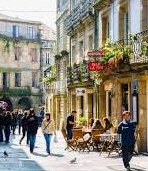
| SEAMUS: | The town itself is very large, and the modern bit of it wasn’t very nice; but the old bit of it was beautiful; and there were lots of markets all over the place, and there were some very nice gardens. |
| (SANTIAGO CATHEDRAL ORGAN) | |
| The Cathedral was enormous. The inside was so high, and the altar was fantastic. Behind the altar there was an enormous statue like thing, and you could go behind it, either down into this sort of dungeon, or up over it. It was absolutely fantastic. | |
| DUTCHMAN: | Then I arrived at the 22nd of July in Santiago and I went immediately to the Cathedral. I greeted the tomb of St James. And after that I went to the secretary of the Archbishop. |
| SEAMUS: | There is always a lot going on: people are always rushing about, shouting for taxis, things like that. There are lots of stalls outside selling jewellery, hand made. Lots of people playing music, people showing off their skills, millions of things going on. |
| (ALAIN, A FRENCHMAN SPEAKS IN FRENCH) | |
| SHAUN: | Alain, he didn’t want to make a song and dance. He was happy that he had the bare necessities of life. |
| SEAMUS: | I don’t think I cycled just to go to Santiago. It was nice at Santiago; but I think the main thing was actually the travel. |
| SHAUN: | The atmosphere at Santiago is special. It is right at the end of Europe, and is probably changed, and will be changed less by the modern world than any other parts of Europe. The Cathedral is, I imagine, rather as St Peter’s in Rome was, a couple of generations ago, an amazing mixture of the present and the past, of the profane and of the sacred. But I agree with Seamus, that the travelling is more important than the arriving. The pilgrimage is after all a symbol of our journey through life. We do not arrive at the end this side of the grave. |
| ENGLISH PILGRIM: | I did the pilgrimage to sort out if I had a vocation or not. It’s a way of obtaining grace. |
| MADAME DEBRIL: | Pour moi parceque le chemin traditionel, le chemin du pelerinage … |
| SHAUN: | For Madame Debril tradition is important. Since the discovery of the apostle’s tomb in the Ninth Century, pilgrims have followed in one another’s footsteps. She believes more and more in the pilgrimage today. |
| (MEDIEVAL MUSIC) | |
| SEAMUS: | I’m very proud that I’ve done it and that I can tell people and it’s quite astounding. They won’t believe you many times, cos not many twelve year olds get to do things like that. So I am proud that I have done it. It was a great adventure. |
| ANNOUNCER: | In the Field of the Star, Shaun MacLoughlin and his son, Seamus, talked to fellow pilgrims, and to those who offered them hospitality. The readers were John Church, Garard Green, George Parsons, Gordon Reid and June Tobin. Medieval music was arranged and performed by Mary Remnant. The programme was researched by Rebecca Curtis. The Field of the Star was produced by John Theocharis. |
This feature was over a year in the making. As you can imagine, cycling up to fifty miles a day with a twelve year old and finding the route and accommodation was a full time activity. We managed to keep diaries however; most of which we recorded on family holiday in France (with background noise of cicadas) the next summer, just before Seamus’ voice broke. Can you imagine recording and editing – mostly in English – an adventure in your own life – or that of a friend or family member?
|
(BIRDS, CRICKETS, ETC: THE MUTED SOUNDS OF THE AUSTRALIAN BUSH AT MIDDAY.) |
|
|
ACTOR: |
Axe-fall, echo and silence. Noonday silence. Two miles from here, it is the twentieth century: cars on the bitumen, power lines vaulting the farms. Here, with my axe, I am chopping into the stillness. Axe-fall, echo and silence. I pause, roll tobacco, twist a cigarette, lick it. All is still. |
|
(INTRODUCE PEACEFUL MUSIC) |
|
|
|
I lean on my axe. A crowd of fragrant leaves hangs over me, moveless, pierced everywhere by sky. |
|
(EPIC THEME MUSIC IS FADED DOWN) |
|
|
ANNOUNCER: |
Episode Thirteen: ‘Lucky Country?’ After the boom, multiculturalism and the search for new values. |
|
(SWELL MUSIC AND THEN FADE TO SILENCE) |
|
|
MANNING-CLARKE (Historian): |
I was very enthusiastic about Gough Whitlam, because he was one of those gifted men, who believed the labour movement could create a society, in which there was equality of opportunity, without spiritual popery, without conformism and without pandering to mediocrity. |
|
(START SONG: ‘TIME FOR FREEDOM’ IN BACKGROUND. WEAVE IN AND OUT OF FOLLOWING SPEAKERS) |
|
|
WOMAN: |
I don’t think deep down we actually believed it could happen. |
|
MAN 1: |
A lot of people clearly felt it was time. |
|
MAN 2: |
We had years and years of conservative government under Menzies and he tried to do things for Australia in a hurry. He knew that the forces of reaction would get him out of power. |
|
MAN 3: |
We were in a period of decline, brought about by the skillful manipulative moves of the new president of the trade union movement of Australia, Mr. Robert James Lee Hawke. Inflation was on the rise. Unemployment was rising. Liberals were hoisted and Gough’s banner ‘it’s time’ was all the go. |
|
(SWELL SONG ‘TIME FOR FREEDOM’ TO CONCLUSION AND MIX WITH ACTUALITY OF GOUGH WHITLAM’S SPEECH. USE THE CROWD’S SPONTANEOUS CHEERS TO WEAVE IN AND OUT OF HIS SPEECH AND OF VOX POP) |
|
|
WHITLAM: |
Men and women of Australia, there are moments in history when the whole fate and future of nations can be decided by a single decision. For Australia this is such a time. |
|
(CHEERS) |
|
|
MAN 4: |
I was a fan of Whitlam. Whitlam embodied many of things that Menzies had, funnily enough, this tall, leonine, silver-haired figure with fluent tongue and persuasive arguments. I suppose, people wanted to revere him in a similar fashion . |
|
(CHEERS) |
|
|
WHITLAM: |
We will abolish conscription forthwith. |
|
(CHEERS) |
|
|
NARRATOR: |
During their first few days in office labour made sweeping changes. |
|
WHITLAM: |
Not just because a volunteer army is a better army, but because it’s intolerable that a free nation at peace and not under threat should cull by lottery the best of its youth to provide defence on the cheap. |
|
(CHEERS) |
|
|
HUMPHREY MACQUEEN (Marxist Historian) : |
These were people who believed that there was enough wealth in the country to do something for the poor and for Aborigines and that it was no longer necessary to despoil the environment in order to have enough dirt to sell to the Japanese. |
|
WHITLAM: |
We will legislate to give the Aborigines land rights. |
|
(CHEERS) |
|
|
HUMPHREY MACQUEEN: |
Questions like Urban planning and the environment and the Arts entered into the political agenda. |
|
WHITLAM: |
Australians are diminished while the Aborigines are denied their rightful place in this nation. |
|
(CHEERS) |
|
|
WOMAN 2: |
The two most important things that happened early in the Whitlam period were freedom of education and withdrawal of troops from Vietnam. |
|
WHITLAM: |
It’s time for a new team, a new programme, a new drive for equality of opportunities. Time for a new vision of what we achieve in this generation for our nation. |
|
(CHEERS) |
|
|
MAN 5: |
The Labour Government spent like drunken sailors. Government spending increased by seventy five percent. Wages exploded by over fifty percent. |
|
MAN 6: |
Prices went through the roof. When you think ten dollars and somebody comes along and says ‘think a hundred’, the whole spectrum of the community changes. |
|
MAN 5: |
Businesses went to the wall. |
|
MACQUEEN: |
The people who attacked him were saying, ‘there’s too much governmental activity of every kind in every way.’ |
|
WHITLAM: |
We ought to be angry with a deep determined anger that a country as rich and skilled as ours should be producing so much inequality, so much poverty so much that is shoddy and sub- standard. We ought to be angry with an unrelenting anger that our Aborigines have the world’s highest infant mortality rate. |
|
(CLAPPING) |
|
|
WHITLAM: |
We ought to be angry on our children’s behalf, at the mindless destruction of our national and historical heritage. |
|
(CHEERS) |
|
|
MACQUEEN: |
Australian intellectual life really came of age since the seventies with Patrick White’s winning of the Nobel Prize, with Australians winning the Booker Prize, with the Australian film industry. |
|
NARRATOR: |
McDonald’s opened their first take-away, wine boxes appeared, the Sydney Opera House was opened. |
|
(BLASTS AND WHOOPS OF SHIPS’ SIRENS IN SIDNEY HARBOUR, VAST CROWD CHEERING, ACTUALITY FROM THE DAY OF THE OPENING.) |
|
|
GIRL: |
The Queen came to open it. It was really exciting. Everyone loved it. It was exciting for us and she came and did a tour. And all the schools were out in force and I waved and she waved back – at me! |
|
NARRATOR: |
It was a boom time, enhanced by the richness of the nations mineral reserves. Nothing seemed impossible. |
|
MACQUEEN: |
We could buy champagne and caviar till the cows came home and this kept to push up the value of the dollar until by 1974 the Australian dollar was worth 1.44 American dollars. We were on the crest of the wave. We could travel around the world, everything was cheap. It was the bonanza years of selling off Australia. |
|
(SONG ‘LADY SUNSHINE’) |
|
|
MAN 9: |
Well if it’s good enough for Whitlam it’s good enough for me, because it’s the first decent, bloody government we’ve ever had for twenty three years. |
|
(SWELL SONG AGAIN: ‘LADY SUNSHINE, LET YOUR SUN SHINE ON ME’) |
|
|
(INTRODUCE QUIET SLIGHTLY OMINOUS MUSIC) |
|
|
MAN: |
We were all brainwashed. The Messiah had offered us the world, but three years down the track we realised he was just a politician. |
|
MANNING-CLARKE: |
He was a charismatic personality, but he was in the great river of life… |
|
(THE MUSIC COMPLEMENTS THE THEME.) |
|
|
MANNING-CLARKE: |
… Things went wrong – Partly because Gough was not a very good judge of other men and he made some tragic mistakes in the choice of people to work with. |
|
WOMAN: |
His fatal flaw was to try to do too much too soon. |
|
MAN: |
The fear of change began to seep darkly into the bottoms of the bellies of all of us. |
|
NARRATOR: |
Nature so often a force in Australian life chose to exhibit its power in 1974 when the city of Darwin was struck by Cyclone Tracey. |
|
(LOSE MUSIC. THREE SECONDS SILENCE. THE CALM BEFORE THE STORM.) |
|
|
WOMAN 2: |
We had two small earth tremors and the mangoes ripened very early and all the ants were in frenetic activity. Well, the Aborigines know their signs and in the two weeks before Cyclone Tracey some of the old Aborigines just rolled up their swags and left. |
|
(ACTUALITY NEWS BROADCAST (HISSY QUALITY):) |
|
|
NEWSCASTER: |
And here’s the latest cyclone warning. At three Cyclone Tracey was centred 80 kilometres north west of Darwin and moving south easterly at seven kilometres per hour. |
|
(MIX OF THOUSANDS OF FROGS CROAKING WITH RADIOPHONIC MUSIC) |
|
|
WOMAN 2: |
And then the frogs started. And Illiwara the old Aborigine said, ‘If the frogs sing out very loud, well then look out’. They started off in a slow chorus and then by the time dusk fell it was a screaming frenzy. |
|
(HEIGHTEN MUSIC AND FROG EFFECTS) |
|
|
WOMAN 3: |
(SHOUTING ABOVE THE DIN) We came home about six o’clock. We had to fill everything we had with water, lock the windows, seal the doors. |
|
(LOSE FROGS AND MUSIC. INTRODUCE SLIGHT WIND) |
|
|
WOMAN 2: |
You heard a distant moaning and then it got louder and louder. I was going to put my daughter in the land rover and make a run for it, but my husband said just look out there and clumps of trees were rushing past the house and some people did try to make a run for it and were killed. |
|
(STEEPLY INCREASE NOISE OF BUFFETING WIND) |
|
|
WOMAN 4: |
Ours was a tropical house with louvres. The wind could get out. In houses where it couldn’t get out, they just exploded with the pressure. |
|
WOMAN 5: |
There was a great tree at the back of our house and in that tree there was a refrigerator. |
|
INTERVIEWER: |
You were under the bed with your Mummy? |
|
SMALL GIRL: |
Yeah, it was terrible. |
|
(MIX WIND INTO ‘AFTERMATH’ MUSIC) |
|
|
WOMAN 2: |
When the daylight came we looked out on a scene of utter desolation. Where trees and houses had been there were just stumps and rubble. |
|
MAN: |
I saw a boat half way up a hill. |
|
(LOSE MUSIC. EMERGENCY BROADCAST- FROM THE TIME): |
|
|
GENERAL STRETTON: |
…people of Darwin, this is General Alan Stretton, the civilian chief of the natural disasters organisation |
|
WOMAN 4: |
The looting was indescribable. To me it was like something out of a movie. My daughter was bending over looking at this wedding photograph and well a man made an obvious movement… I won’t go into that, it’s too awful and I saw that they were rapists, so I raced and got the gun and I said, ‘I’ll kill you’ and they knew I meant it and they took off. |
|
(EMERGENCY BROADCAST:) |
|
|
GENERAL STRETTON: |
… We must stop rumours. There are rumours about the police shooting people, when in fact it was Tiger Brennan probably shooting the dogs. |
|
WOMAN 3: |
And nature reasserted itself. (GIGGLES) There were people making love all over the place. I passed a house of which there was nothing left except the floorboards and one double bed. It was like Salvador Dali. And there were two people in bed making love, quite oblivious to who might be going past and it didn’t matter. (LAUGHS) |
|
(BIRDSONG AND CRICKETS AS AT THE BEGINNING OF THE PROGRAMME. HOLD FOR SEVERAL SECONDS.) |
|
|
ACTOR: |
After the tree falls, there will reign the same silence as stuns and spurs us, enraptures and defeats us, as seems to some a challenge and seems to others to be waiting here for something beyond imagining. |
|
(ACOUSTIC OF LARGE HALL. QUIET BACKGROUND CHAT AND SINGING, PARTICULARLY OF SMALL CHILDREN, IN MANY LANGUAGES ): |
|
|
SWEARING IN OFFICER: |
In a few minutes you will be all equal Australian citizens. At the ceremony we have people here from Yugoslavia, Libya, South Africa, Afghanistan, New Zealand, Turkey, United Kingdom, Vietnam, Chile, Hong Kong, France, Argentina, Portugal, Ireland, Canada, Finland, Pakistan, Indonesia, Philippines, Korea, Malaysia, Spain, Sri Lanka, Greece, Lebanon and Taiwan. (FOLDS PAPER) And that spells multi-culturalism to me. I’m sure it does to you too |
Finally for those who love poetry, I should like to share the beginning of a documentary that was a labour of love.
|
ANNOUNCER: |
Siegfried Sassoon: Poet’s Pilgrimage Compiled by Shaun MacLoughlin with Hugh Burden as Siegfried Sassoon and Hugh Dickson as the Reader. |
|
SASSOON: |
My real biography is my poetry. |
|
READER: |
Last thing at night, in solitude serene, |
|
(PLAINCHANT FROM STANBROOK ABBEY) |
|
|
ANNOUNCER: |
This programme is presented by Dame Felicitas Corrigan of the Order of Saint Benedict, Stanbrook Abbey, Worcestershire. Dame Felicitas was a close friend of Sassoon’s during his later years. |
|
DAME FELICITAS: |
Siegfried Sassoon has always seemed to me a parable of Twentieth Century man. To most of those acquainted with his name he is essentially the fox hunting man, the infantry officer, the poet of the First World War. Few know him for what he was beneath outward appearances: prophet, sage, pilgrim, a Mister Valiant for Truth going to the Celestial City. |